
A wagon from 1910: The Harvester
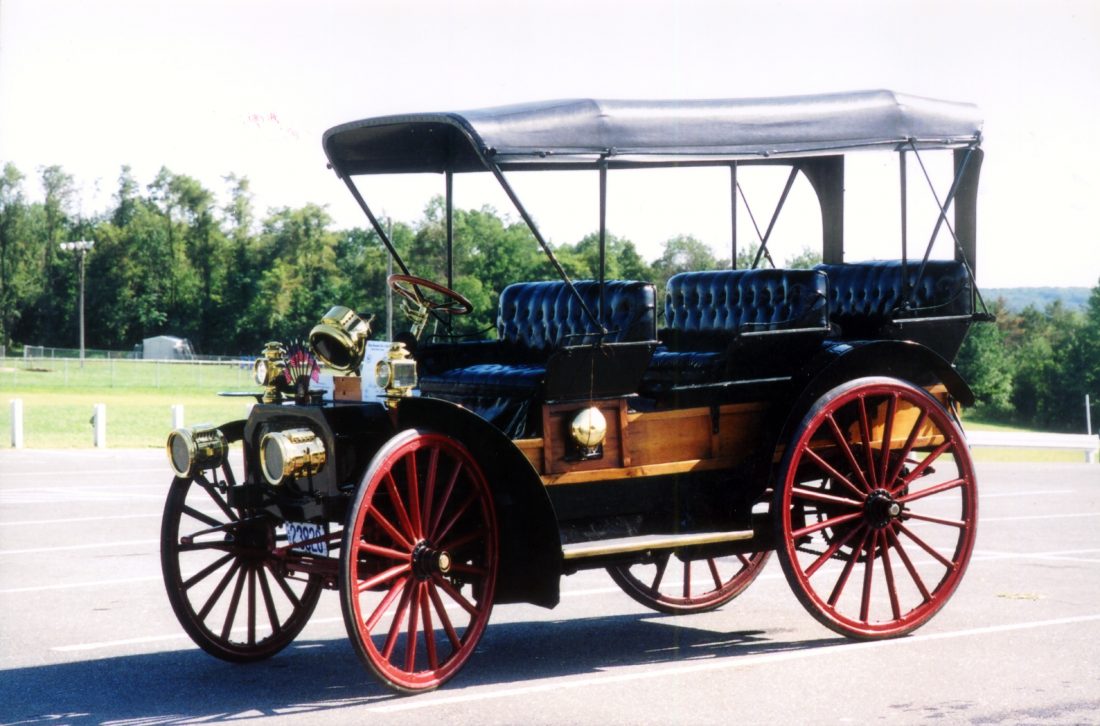
International Harvester began building vehicles at a Chicago plant in 1907. Production was soon transferred to Akron, where in 1910, one of the Auto-Wagon models rolled out the factory door on solid rubber tires mounted on 36-inch front wheels and 38-inch rear wheels.
This vehicle could be identified by the shiny brass “IHC” monogram attached to the front of the car. The two-cylinder, four-cycle, horizontally opposed, air-cooled engine had a 5-inch bore and a 5-inch stroke. After being hand-cranked to life, the engine produced 20 horsepower.
That Auto-Wagon was promptly shipped off to its first owner in Rhode Island, used for three years, and then put into storage for 39 years. The world fought two wars before its second owner bought the vehicle in 1952 and took it home to Maryland, where it underwent restoration, and was presented as a gift to a physician who drove it occasionally until the temperamental machine ceased to function and was left to languish in his garage.
That’s when Bob Griner entered the picture. He was taking the doctor’s daughter home from an afternoon date when he spied the 16-spoke wood wheels under the partially open garage door.
“If that’s a buggy, I don’t want it,” he told his date. “If it’s a car, it’s mine.” Griner peeked under the door and ascertained that it was indeed a motorized vehicle. He went inside the house and stunned the doctor by asking, “Why is my car in your garage?”
The doctor acknowledged that the engine didn’t run and also that the car was up for sale.
“How much?”
“I’m not sure.”
For a month or so the two men played a cat-and-mouse game until Griner broke the impasse by offering to trade a valuable piece of jewelry for the car. After a jewelry appraiser gave a “thumbs up,” the doctor agreed to swap, and in 1965 Griner became the fourth owner of the 1910 International Harvester Auto-Wagon.
Griner gave his treasure a thorough examination and found the oak chassis and body to be in excellent condition, as were the red leaf springs and red wheels.
Griner soon had the engine running again with trebler coils firing both cylinders. While seated behind the wooden steering wheel — which is supported by four brass spokes with spark and throttle controls on the steering column — he learned the intricacies of operating the dual chain-drive using the combination clutch and shift lever: Push the lever forward for low gear, and pull it back for high gear. Pulling out the ring on the lever places the transmission in reverse.
“A 2-quart-capacity oiler drip-feeds 10 tubes, which in turn lubricate eight critical parts,” Griner explains as if it were common knowledge. The right running board features a brass carbide tank that, when chemically activated, produces gas to feed the brass headlights and spotlight. Spotlights were common in the early days of motoring because roads were often nonexistent or mere trails that, after dark, had to be sought by spotlight. The taillight and front running lights are fed by kerosene. There is no brake light.
International Harvester designed the Auto-Wagon so the second and third seats can be removed to transform the vehicle into a truck. Because Griner has no intention of ever “trucking” any cargo, he went to Amish country in Pennsylvania to have a top made from a pattern taken from a photograph.
“Top speed is 28,” he says, “And that’s with a tailwind going down hill.”
Griner has observed other vehicles from the 1910 era and came to the conclusion that, despite the shortcomings of his Auto-Wagon, he wouldn’t be happy with any other vehicle. “It was antiquated when it was built,” he says, “but I like it.”