Winter Carnival history
Part II of Bill McLaughlin’s Story
-
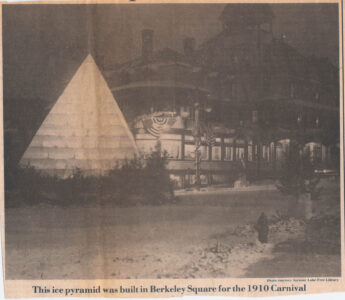
- After consulting with a number of friends, with absolutely no experience in counting ice blocks, we have determined that the ice pyramid in Berkeley Square is approximately 30 or more feet high. There are 10 rows of blocks visible, more behind the greenery and guessing again at the height of the hotel, the thickness of the blocks and taking into consideration the angle of the photo, we are probably not even close to the correct answer. But it is one of the best I have seen of the many pyramid photos showing the Hotel Berkley beautifully lit and decorated. Reading McLaughlin’s history he described the evergreen trees standing in blocks of ice, as shown in the photo, which decorated the downtown streets … and how about that fire hydrant … not bad for a little village 116 years ago. It has been recognized that village officials from around the state visited Saranac Lake in those early years to study the sanitary and water works facilities which apparently were way ahead of their time.
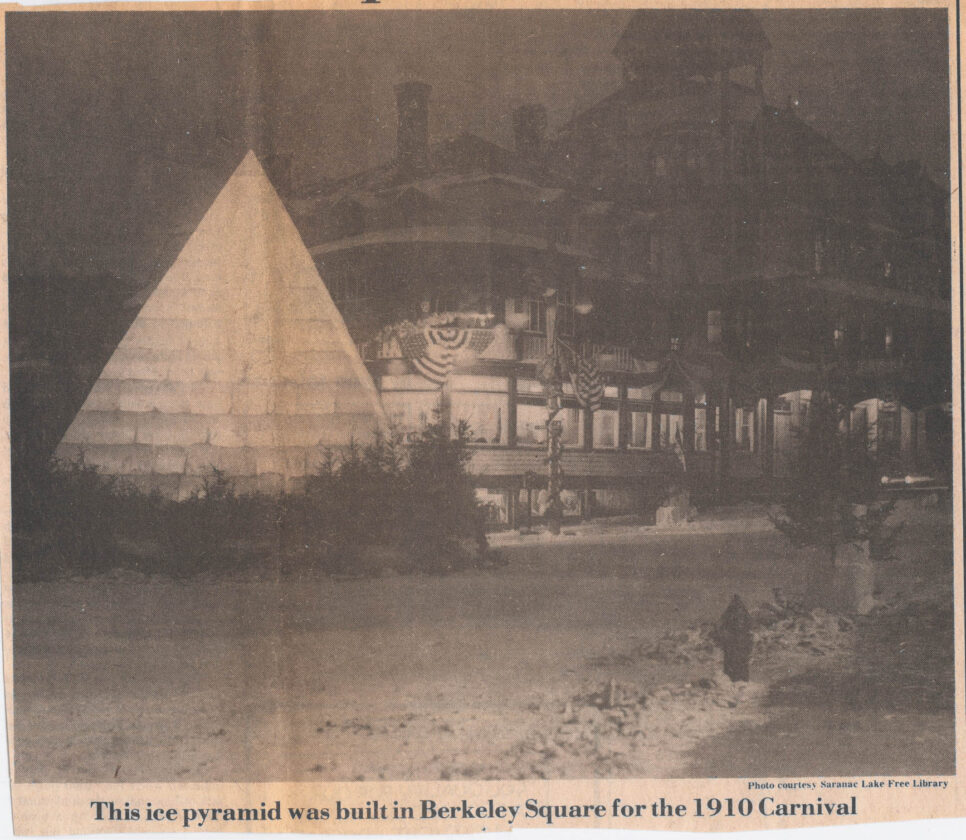
After consulting with a number of friends, with absolutely no experience in counting ice blocks, we have determined that the ice pyramid in Berkeley Square is approximately 30 or more feet high. There are 10 rows of blocks visible, more behind the greenery and guessing again at the height of the hotel, the thickness of the blocks and taking into consideration the angle of the photo, we are probably not even close to the correct answer. But it is one of the best I have seen of the many pyramid photos showing the Hotel Berkley beautifully lit and decorated. Reading McLaughlin’s history he described the evergreen trees standing in blocks of ice, as shown in the photo, which decorated the downtown streets ... and how about that fire hydrant ... not bad for a little village 116 years ago. It has been recognized that village officials from around the state visited Saranac Lake in those early years to study the sanitary and water works facilities which apparently were way ahead of their time.
Last week’s story ended with — “Minneapolis, Minn., has sporadically launched a similar claim to its own carnival’s longevity, with its sister city, St. Paul, not far behind … now…
“The great changes were perhaps accelerated by the introduction of the automobile and the gradual decline of the horse and buggy.
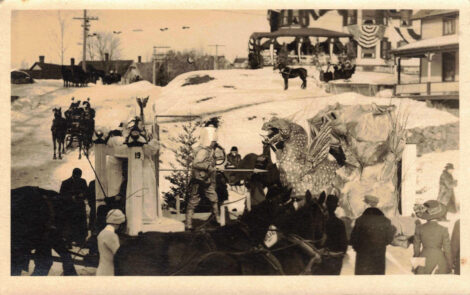
“The spirit of the early carnivals was heightened by the presence of horse drawn sleighs, mounted cavalry units in foreign military plumage and huge floats pulled by strong teams of beautifully-groomed horses wearing floral blankets and silver-trimmed harnesses linked together with chains of bells.
“It was then possible to decorate the village streets with much attention to visual appeal. Berkeley Square traditionally featured an ice block pyramid internally lighted or some equally dazzling masterpiece formed from pillars of ice chipped and rounded to form Roman columns.
“Such sculptures posed no threat to horse-drawn traffic. Snowmen appeared on lawns and terraces, some 10 feet high waving flags of welcome to visitors here for the long weekend.
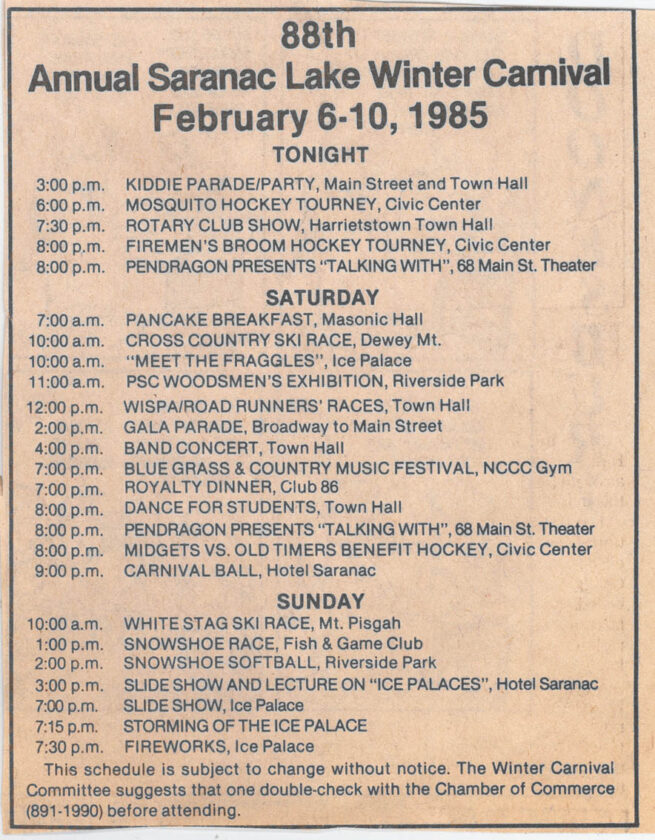
“Everyone dressed colorfully in Hudson Bay coats [Bill always wore one] or brightly knitted hats and mittens, socks and mukluks [soft-soled, knee-high boots]. Berkeley Square, ever the pacesetter in decorative aesthetics, initiated the use of evergreens on a more dramatic scale than simple wreaths and boughs.
“A triangular evergreen arch extending from the three corners of the mid-town square looped over the streets 25 feet in the air, its boughs illuminated at night by a hundred incandescent lights.
“Every building in Main Street, Broadway, Church and River Streets, Bloomingdale Avenue, Academy and St. Bernard Street and even Park Avenue vied for prizes in the arts of decorative magic. Originality knew no bounds and great expense was written off as a worthwhile investment in community publicity and national fame.
“Public buildings including the banks, post office, hotels and even the high school were literally clothed in splendid national colors draped in every conceivable form.
“Butterflies, fans, half fans, streamers, shields and Old Glory herself waved from every window and even from the rooftops facing the business arteries.
“1910 was the first the first year that evergreens played a dominant role at street level. Spruce and balsam trees 12 feet high were set in blocks of ice at close intervals and hundred of yards of evergreen rope linked the trees, bridges and storefronts together to add even more glamour to the business district.
“It was the feeling of color and greenery which added an excitement, an ‘on stage’ dimension to Saranac Lake which cannot be matched today for obvious reasons.
“Decorative themes even invaded side streets and medals, prizes or ribbons were liberally distributed to proud homeowners with outstanding displays.
“The high school students combined efforts to give the old Main Street High School [now the location of the Hotel Saranac] a carnival appeal to match its commercial neighbors.
“Community pride dictated long hours and expensive carpentry and the fashioning of thousands of floral pieces gave the floats an almost unbelievable fairyland appeal now seen only in the Rose and Orange Bowl parades in warmer climates.
“The Saranac Lake parade was generally advertised as extending for a mile and the children’s parade was, in itself, a major addition to the carnival activities and is still included in today’s version.
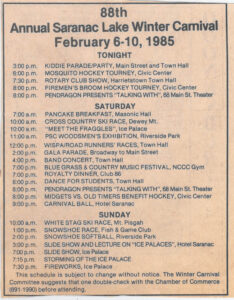
“The fairyland magic is still around for today’s carnivals, (1985) of course though clothed in less dramatic regalia. Youngsters who rode on the floats of the early century are now in their 70’s and 80’s and they still remember fondly those special days before the village lost its identity as a health resort and an oasis of privacy and pleasure.”
[Last week’s column left out an important piece of history. The poem ‘The Ice Palace’ was written by Alfred L. Donaldson, a former New York City banker who came to Saranac Lake to “take the cure” for tuberculosis. He wrote two treasured volumes of local history — and then, you know what? He composed that poem to celebrate the inaugural event of construction of the first ice palace — 50 feet high — built by the Pontiac Club in 1897, not 1898, which seems to be the most often used inaugural date.]
Columns
Winter Carnival history
Valentine’s Day
With Valentine’s Day upon us, I thought this week I’d share with you some specials gifts you can give your ...

Love, lie to me
When ‘too cold’ is a four letter word
I was in Nori’s cafe with Doc McHugh doing what we do best — drinking coffee, shmoozing and swapping sea ...
Image of the Week