
Wider edge lines provide greater driver safety
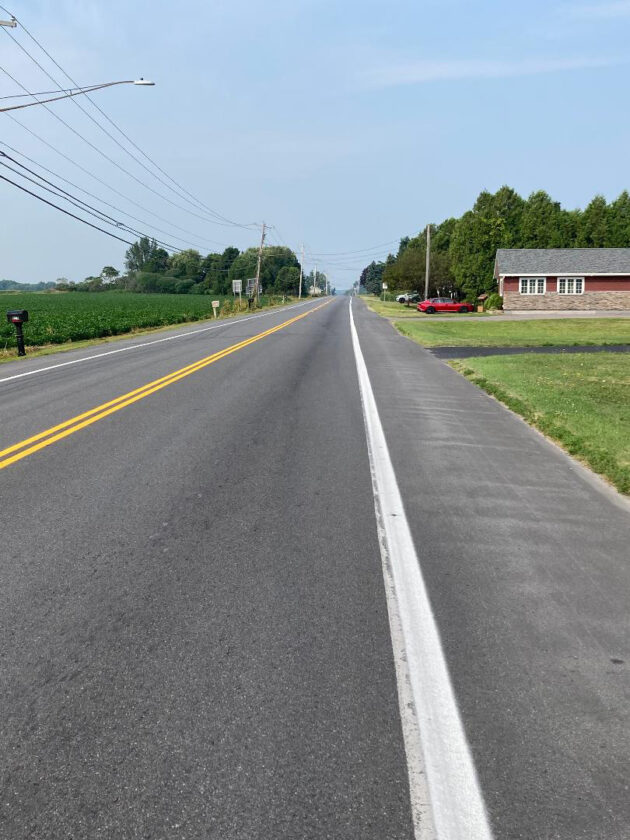
This photos shows a new, wider edge line on state Route 11B. (Provided photo — Dave Werner)
Pavement markings make driving on highways safer, and drivers find it easier to drive on roads with yellow passing/no passing lines and white edge lines. The first lane and center-line markings were introduced more than 110 years ago.
Painted centerlines were first used in the United States around 1911 in Wayne County, Michigan after a road engineer observed a white trail left by a leaking milk wagon. Other states also adopted painted lines by 1917. Over time, pavement markings became regulated, with the first Manual on Uniform Traffic Control Devices being published in 1935.
The national manual requires these lines on paved urban arterials and collector roads 20 feet or more in width and with an average daily traffic count of at least 6,000 vehicles. Lane markings are also required on any paved road with more than two lanes. However, center-line pavement markings are not recommended on paved roads less than 16 feet in width without an engineering study.
As for the normal white edge lines, the MUTCD requires them to be a minimum of 4 inches wide to a maximum of 6 inches. Increasing edge line width from 4 to 6 inches has been shown to be a beneficial countermeasure to enhance safety.
Six-inch edge lines are the new standard for rural high-speed highways — 45 MPH and higher — in New York state. They were already the standard for freeways and expressways.
Wider edge lines are one of the Federal Highway Administration’s proven safety countermeasures with multiple benefits attributed to them. They are credited with reducing roadway departure crashes up to 37% and have the additional benefit of easier recognition by vehicles with lane departure sensors and other autonomous functions.
Drivers will be pleased to know that the New York State Department of Transportation is implementing 6-inch edge lines on all state highways where the speed limit is 45 mph or greater. I live on state Route 11B, and when DOT crews refreshed the markings on this road this year, they painted 6-inch edge lines. It makes a significant difference, especially at night or in bad weather.
Roadway departures account for more than half of all traffic fatalities in the United States. If drivers cannot clearly identify the edge of the travel lanes and see the road alignment ahead, the risk of roadway departure can be greater. Wider edge lines enhance the visibility of travel lane boundaries compared to traditional edge lines. Edge lines are considered “wider” when the marking width is increased from the minimum normal line width of 4 inches to the maximum normal line width of 6 inches.
Wider edge lines also increase drivers’ perception of the edge of the travel lane and can provide a safety benefit to all facility types (e.g., freeways, multilane divided and undivided highways, two-lane highways) in both urban and rural areas. They are most effective in reducing crashes on rural two-lane highways, especially for single-vehicle crashes.
Kudos to NYS DOT for taking the edge line requirement beyond the minimum width to enhance safety on rural two-lane roads, which are the majority of our main roads in the North Country.
Columns

The astronomer who accidentally cataloged the universe

5W Wednesdays
Do children grow up so fast?
When I was struggling with various growth stages my child was experiencing, I thought they were never going to get ...

Green food is good food
1,000 columns and still counting
This column isn’t about vehicle and traffic law or even traffic safety. It’s about the 1,000 weekly column I ...
The wearin’ of the green … and the grin
“So are you going to the parade?” Kean Riley asked me. I frowned but said nothing, in silent dismissal of the ...