Traffic counts — how busy is your highway?
All that traffic! Have you ever wondered just how much traffic there is on our highways? Are counts really increasing? How do they measure traffic volumes?
The New York State Department of Transportation counts traffic not only on state highways but also on county and town roads and on some village streets – not every year, but periodically.
For consistency, traffic counts are measured in “Average Annual Daily Traffic.” The numbers for any given location are the average number of vehicles that use that particular location every day of the year. Because the number of vehicles varies from day to day, season to season, and other variables, DOT uses multipliers that take into account when the traffic counts were obtained and converts the data into AADT numbers.
Although there are some locations equipped with permanent traffic counting equipment, most of the counts are taken over a short period ranging from a couple of days to a couple of weeks. You can tell when the counts are being taken by the rubber hoses that cross the road.
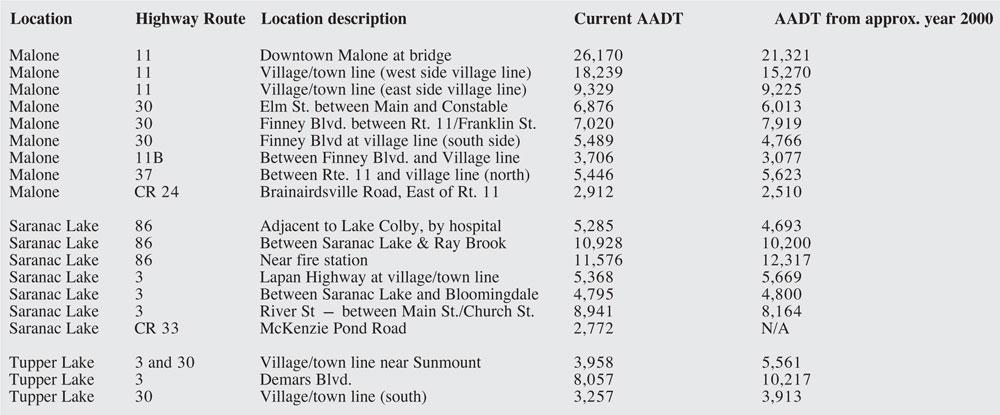
To obtain the AADT numbers for some of our area roads, I contacted Brian Staie from the DOT for his assistance. In the table accompanying this article are some traffic counts in Franklin County. You can see that the busiest location is on Main Street in downtown Malone, with an AADT of 26,170 vehicles daily. Of interest is that this is the third busiest location in DOT Region 7, which includes Lewis, Jefferson, St. Lawrence, Franklin and Clinton counties. In Region 7, the busiest highway is Cornelia Street (state Route 3) in Plattsburgh, just east of the Northway (I-87) with an AADT of 35,547, and the second busiest is Arsenal Street (also Route 3) in Watertown, with an AADT of 29,486.
The busiest highway in the state is on I-95 at the George Washington Bridge in New York City. The AADT there is 276,476. Now, take a guess at the busiest highway in the world. You are probably thinking New York City, or perhaps Los Angeles; or, maybe in China or Japan.
Wrong!
According to Wikipedia, it’s highway 401, also known as the Macdonald-Cartier Freeway, through Toronto. It is 16 lanes wide and carries between 450,000 and 500,000 vehicles a day.
With the assistance of DOT’s Brian Staie, the following spread sheet compares a number of roads in the Malone, Saranac Lake and Tupper Lake villages and surrounding roads with the most recent AADT counts and those from around the year 2000. You can see by the figures most counts have increased somewhat, but not all.
Traffic counts are important to highway departments for a number of reasons, including maintenance and determining levels of service. It is also important in programing traffic signals and even determining if a signal is warranted.
Just remember, when you think traffic is slow and hard to drive in, don’t get too irritated – you could be on the 401 in Toronto!
Columns
Big meeting of the VIS
The Village Improvement Society has kept Saranac Lake beautiful over the years with the many parks throughout the ...
My first brush with history
Even though I was always a logophile and I taught English for a year or two, my first love in academe was ...

Image of the Week, from Historic Saranac Lake

5W Wednesdays, from Historic Saranac Lake
Making sure all bellies are full
I am obsessed with food. I’m not talking about just eating it, though that is a very important element. I make a ...