
On aging — part II of III
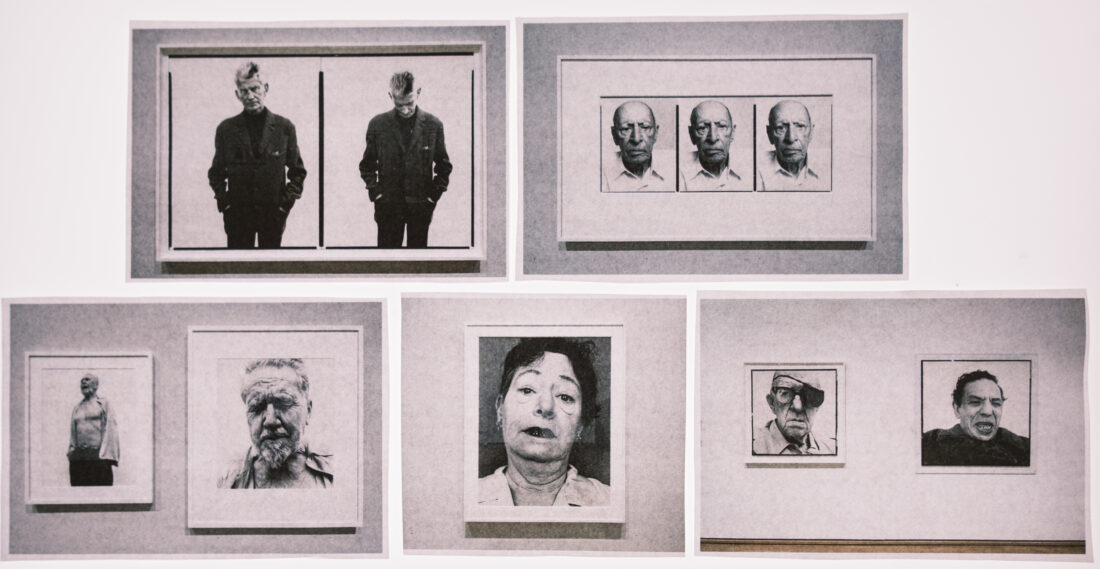
(Provided photo — Peter Berra)
“Why are they all sad?” C asked me.
I was back at the Richard Avedon exhibit, this time with my daughter. An exhibit is different every time you go, but never quite as different as when you go with a child. You follow their path and irregular pace. You crouch to their eye level to see things that you’d missed before. You answer their unpredictable questions.
–
‘Immortality’ with C
–
When we arrived at “Immortality,” C rushed in just the way she rushes into any room. I trailed behind with my slower gait. I watched her fly past the first few walls and head straight to the large print of Dorothy Parker. C stood looking up, leaning in to inspect the catchlight in Parker’s eyes, a miniature Richard Avedon in his recognizable hunch appearing in the patch of white, his gaze forward and focused on his subject — on Parker, and on us. Then C turned left and stopped at Ezra Pound, my petal arrested by the apparition of his contorted face. She turned left again and took a few slow steps forward to face the eyepatch of John Ford. A slight shift to the right and she was staring at Oscar Levant’s teeth.
I caught up with her and asked what she thought. “A lot of them look sad,” she said. “Why are they all sad?”
“I don’t know that they are,” I replied. “Maybe it’s just the moment, or it’s just the way Avedon took their picture. Or maybe it’s the lighting and the white backdrop?”
I avoided saying what I think is the truth. Life will make you melancholy. Of course it will also delight you, and it can be full of great surprises, but grief and sorrow are part of it too. I couldn’t bring myself to tell C that the sadness she sees in the portraits is in all of us, even in her. Why, I wondered, is it so hard to talk openly about unhappiness and its concurrence with happiness?
–
Sisyphus is happy
–
The idea of the co-extensive relationship between sadness and happiness is treated with aching clarity in Albert Camus’s book “The Myth of Sisyphus.” In the short, philosophical work, Camus reimagines the original story of Sisyphus in new, absurdist light.
The original Ancient Greek myth told the story of a crafty king who outsmarted the gods on a few occasions. He was finally sentenced to roll a boulder up a steep hill for eternity. When he reached the top, the boulder would roll back to the bottom of the hill forcing Sisyphus to begin again. For most of us, the punishment sounds agonizing, but Camus revises the typical interpretation of the myth and in the last line of his book he writes, “One must imagine Sisyphus happy.”
How can he be happy? Because Camus believes that fulfillment comes from persevering through the absurdity of life, not from achieving final goals. His absurdism is the philosophical idea that humans desperately seek meaning and purpose in a world that is ultimately futile. Our response, he argues, should be resolute. Neither deny nor avoid the conflict, he says; rather, we should face our despair with passion and creativity. As Camus writes in the penultimate sentence, “The struggle itself towards the heights is enough to fill a man’s heart.” In other words, strive for meaning, therein joy and dignity are found.
–
Absurdism in photos
–
There’s philosophical absurdity in Avedon’s photographs on aging. His portraits reveal the intertwining, contradicting components of despair and joy and the struggle between the two. Sadness co-exists with the sharp and bright minds of Parker, of Pound, of Ford, of Levant. It is traceable in the crevices of Samuel Beckett’s face, a grid that is offset by the play and brilliance of his eyes, the arctic blue of them shining through the black and white print. It pulls Igor Stravinsky’s eyes down in the first exposure, a weight he lifts himself out of in the second and third prints. The triptych of Stravinsky is a symphony; there is movement, rhythm and tension.
Part of the reason we like to celebrate our happiness is because it is ephemeral. There will always be an event that adds another line to our face, that contorts our body, that drains the fire in our gaze, so why not mark the good times? This makes sense. But it also makes sense to concede that there is sadness in all of us, and that if we live long enough, we will have losses. From that concession, maybe we’ll be a little more like Avedon and Sisyphus — comfortable with the contradictions and happy to strive.
Columns
Butterflies and Hawke
SARANAC LAKE — Hotel Saranac will host the second evening of the Saranac Lake Art & Science Series, featuring ...
Gutting public land protections
To the editor: What is happening to our National Park Service and public lands is not just neglect, it is a ...
On aging — part II of III

No such thing as away
Image of the Week
Walt McLaughlin: Man of many titles
Walt McLaughlin may be the least known prolific and versatile Adirondacks-oriented writer ever. He’s the author ...