On aging — part I of III
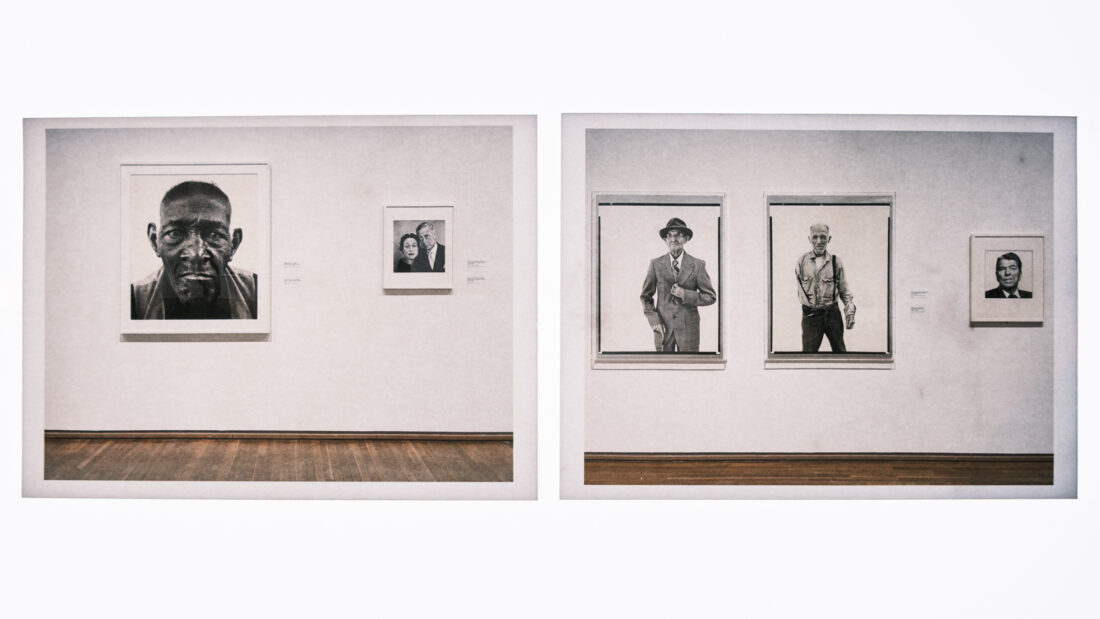
(Provided photo — Peter Berra)
The first thing I notice when I enter the Richard Avedon photo exhibit at the Montreal Museum of Fine Arts is the number of photographs. There are roughly 100 pictures, a surprisingly large amount given the topic and given the artist.
–
An exhibit about aging
–
I know Avedon for his fashion photography; prints of Nastassja Kinski, Audrey Hepburn, Brooke Shields and Dovima and the elephants are recognizable to many of us without knowing the person behind the camera. This exhibit, however, features a dimension of Avedon that was new to me and is fittingly called “Immortal: Portraits of Aging, 1951-2004.” I discovered that during his long career working for magazines such as Harper’s Bazaar and Vogue, Avedon simultaneously produced an extensive portrait series on aging.
I rarely see older people photographed like this, framed to reveal the natural process of aging and our defenselessness against it. Avedon shows us unvarnished beauty in each study. Standing in front of these faces, I think to myself, a museum exhibit dedicated to aging is an act of defiance.
–
The act of defiance
–
Defiance against what? Against ageism, and the passivity we show towards it. Our prejudice is even proven by science. The Harvard-run Implicit Association Test (IAT), originally designed by psychologists to reveal hidden biases, confirms that most of us have persistent negative attitudes towards the elderly. On the test for ageism, 90% of respondents from a sample size of 50,000 tests show a moderate to strong preference for young over old.
The normalization of ageism is one reason why it is often described as the most socially tolerated form of prejudice in the U.S. We don’t have to look further than our screens to understand why. In popular culture and the media, seniors are egregiously underrepresented, either absent or depicted negatively, rarely shown as nuanced, diverse individuals with real human experiences.
How, then, do we neutralize our prejudice? The developers of the IAT test name exposure as a crucial step. We can disrupt our biases by exposing ourselves to images that simultaneously reinforce positive associations and counteract negative ones. I can’t think of a more pleasant way to defy our bias against the elderly than to spend time with Avedon’s photographs on ageing.
–
Curation doubles defiance
–
I’ve been to the exhibit four times and will keep going as long as it’s showing. Of course I’ve been a few times with P, my favourite photographer. I took my students. I will go with C. I will visit and revisit those portraits and uncover something new each time.
The last time I went I realized that the exhibit is a double act of defiance, skillfully curated by Mary-Dailey Desmarais to showcase the subtext of Avedon’s technical choices. In her arrangement, the photographs not only elevate the process of aging from invisibility to visibility but also amplify the aging of the powerless over the aging of the powerful. Desmarais places photos in pairs, in clusters, in opposition, and surfaces new meaning in Avedon’s work.
Her curation guides our eye to trace the repetition of the white backdrop of the portraits, a uniformity that suggests a basic truth — that we all struggle to make something of our time here. With a longer look, we see that the relative size of the prints suggests something more — that the struggle is not portioned equally. Desmarais’s groupings have hinted meaning. A medium print of Ronald Reagan is near a life-size picture of an amputated farmer named Alfred Lester. The former King Edward VIII and his wife are next to a magnified picture of William Casby, a former slave.
The combinations reveal power dynamics — there are those born into Buckingham Palace and there are those born into bondage. Moreover, the scale of the photographs is a reversal of invisibility — the people given the biggest canvas are those who are typically unseen. “In Immortal,” hiddenness is defied twice.
–
The luck of aging
–
Here’s another basic truth — aging comes for us all, if we’re lucky. Our collective will to ignore this fact is staggeringly short-sighted. A generation that does not care for its elders will produce children who will not care either. More importantly, taking care of each other is the right thing to do. So why do we accept ageism? And how do we do better?
I like Richard Avedon’s specific and practical response to the question. He picks up his Rolleiflex camera, peers into the waist viewfinder, and releases the shutter. On the other side of the exposure is a subject that is usually hidden, an opening to a conversation we should all have, and that’s never too late to join.
Prompt: To my senior readers, tell me about your favourite haunts.
Columns
Park association opposes bill
Page one of the The Adirondack Daily Enterprise was jam-packed with local news on Monday, July 10, 1961. What ...
Dealing with swollen glands
Parents have recently been asking me some swell questions about their children having swollen glands. Let me ...
On aging — part I of III
A 12 caret nightmare
Question of the day is: What’s orange and sounds like a parrot? Answer: A parrot. I mean, really, what ...
Strength in voices and community
Imagine this: a young person has finally found a space where they feel they belong. That they can unmask and be who ...