Daylight saving time
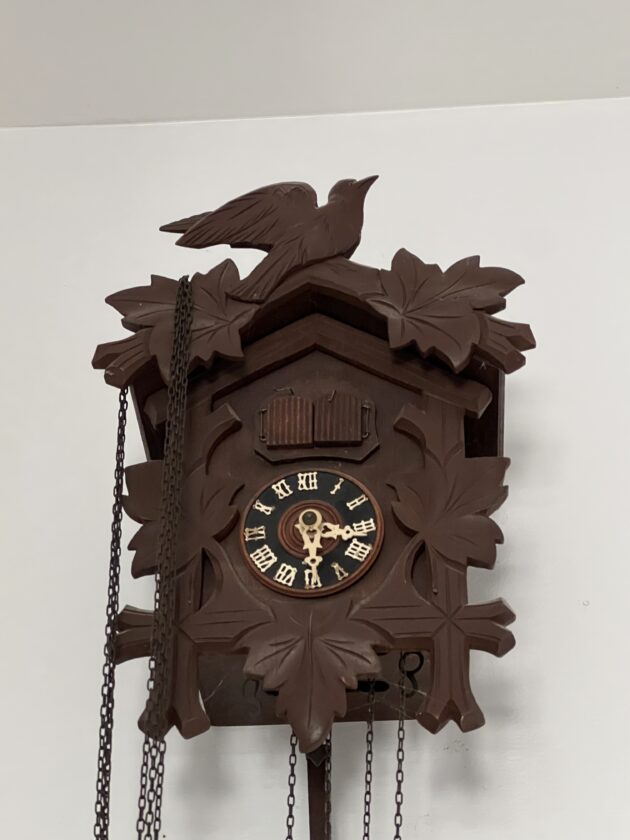
A German farmhouse cuckoo clock chimes the time each hour. (Provided photo — Diane Chase)
“Spring forward and fall back” is the easiest reminder when it’s “that time of year,” Daylight Saving Time. Daylight Saving Time actually refers to only the springtime change, this year on March 8, when most of the Continental United States turns clocks forward one hour. We “fall back” to normal Standard Time each autumn. Whatever we want to call it, waking up in the dark is a struggle, and it can take patience to get schedules on track.
The U.S Naval Observatory website mentions that railroads first created a time standardization in 1883 when municipalities were still using local solar time. The public did not universally embrace a standard time. The USNO has maintained a Time Service Department since 1883, serving as the official time source for the U.S. Department of Defense and the source of standard time for the rest of the country.
Germany was the first country to implement a daylight-saving policy in 1916 to conserve coal usage during World War I. The idea was to spend more time outside and less time inside using fuel or power. The U.S. Congress adopted the Standard Time Act three years later. After the war, individual states had the option to continue the practice.
Another factor to consider during that era is the lack of a national electrical power system. Though some electric grids were available in the 1880s, it wasn’t until the 1920s that most cities and towns began connecting to a municipal or private utility company. By 1930, only 10% of rural America had electricity, so the cost-saving benefits had little effect on that demographic.
Farm lobbies protested the time-changing decision because it disrupted routines, while financial and sporting institutions supported the effort. President Roosevelt resurrected the national daylight saving time law during World War II, but Congress repealed it in 1945, leaving each state to decide its fate. The issue became so problematic no one knew the time, even within a single state. Metropolitan areas implemented the time change into operation while outlying regions did not, causing chaos. The confusion led to the 1966 Uniform Time Act, six months of Daylight Saving Time and six months of Standard Time. States could adopt the resolution or opt out. Since that official Act, changes continue to be made.
Today, Hawaii and most of Arizona are the only states not changing clocks twice a year, along with the U.S. territories of Puerto Rico, American Samoa, the U.S. Virgin Islands, Guam and Northern Mariana Islands.
Daylight Saving Time isn’t some government conspiracy to disrupt my household. I look at it as I do any seasonal change. It’s a chance for new beginnings. So, go off and frolic into the wee hours. Just think about what you can accomplish with an extra hour of evening light. I’ll probably be asleep.
Columns
Daylight saving time

Lasagna: Great way to feed a crowd
Chasing the dragon
When you’re a kid, you believe you can be anything. Astronaut, Olympic Athlete, long lost princess — no matter ...

Lasagna: Great way to feed a crowd
Whining and screaming
Parents are often screaming for solutions that will help them handle their toddler going through the stage we call ...