The cold hard facts
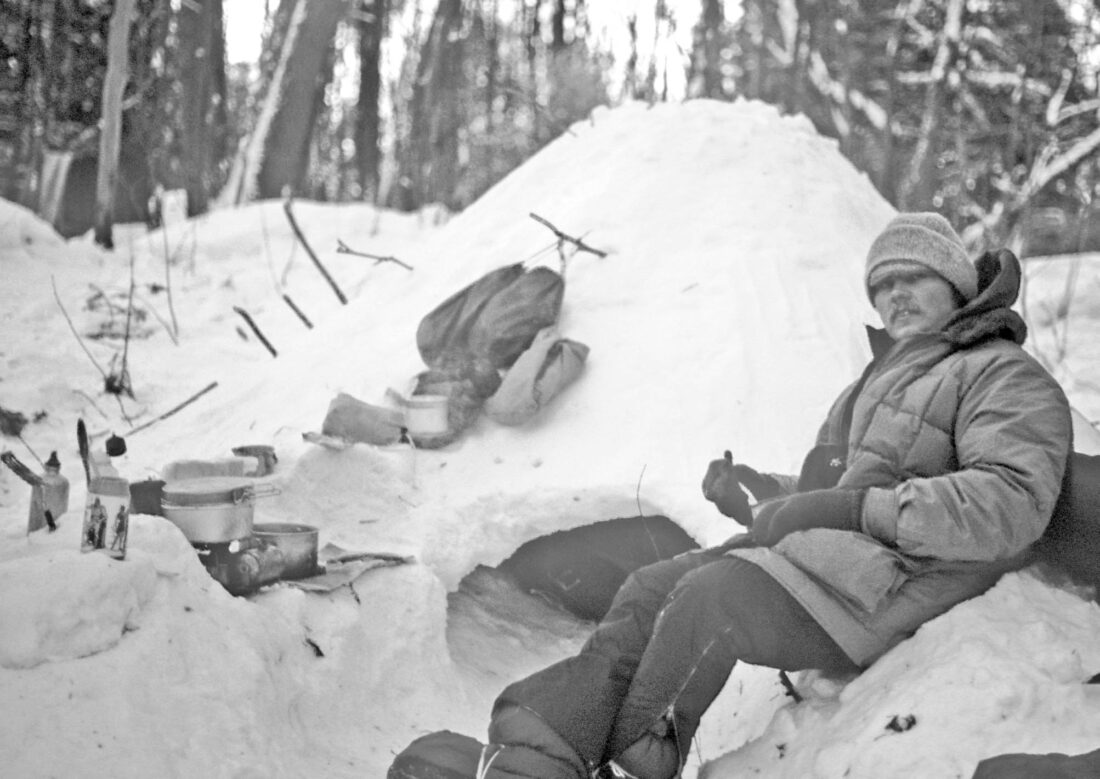
Instructor Doug Fitzgerald next to a snow shelter at 18 below zero in 1982. (Provided photo — Jack Drury)
Last week sadly, another wilderness traveler died of hypothermia in the High Peaks Wilderness.
News of such calamities reminds me that winter isn’t an abstraction or a romantic postcard–it’s a force to be reckoned with. People often ask how I endure winter camping. I wouldn’t call it easy, but I think of it in three parts.
First, there’s knowledge: how to dress in layers, how to fuel your body, how to conserve heat, how to recognize the early signs of trouble. Winter punishes ignorance ruthlessly.
Second, there are skills. Physical conditioning matters, as does knowing how to pack efficiently, travel on skis or snowshoes, and cook nourishing meals in the cold. You also must stay hydrated when water so readily turns to ice and manage all the other essential tasks that keep you functioning when the temperature drops below zero.
Finally, there’s attitude. I tell students: One of the biggest requirements for a winter expedition is a positive mental attitude. We repeat it often–PMA. Because when it’s dark at 4 p.m., when your fingers ache from the cold and the wind won’t let up, mindset isn’t an abstraction — it’s a reality
I’ve logged a fair number of nights outside in winter–enough that the smell of damp wool socks feels like an old friend. For 16 winters, I led two-week expeditions for NCCC throughout the Adirondacks, a place where few realize the average January temperature is lower than it is in Anchorage, Alaska.
In 1974, there was also a four-week ski tour across Yellowstone National Park–observing elk and bison in all stages of life and death, and with temperatures as low as minus 36. Add a three-week 1976 February traverse of the High Peaks Wilderness from west to east; and my 1971 climb of Denali, where the summer low hit minus 27 degrees; a July spent building snow caves and avoiding avalanches — all totaled, 322 winter nights outdoors. If you include the countless one- and two-night winter camping forays, I’ve spent over a year of sleeping in below freezing temperatures. You’ll understand why it’s hard for me to muster sympathy when a bareheaded, barehanded citizen dressed as if warm clothing is a government conspiracy, whines, “I hate the damned cold.”
Each of the NCCC winter expeditions stands out for different reasons, but the college’s first winter practicum in January of 1982 was one of the coldest. By that time, I had nearly 100 days of winter camping under my belt. But I’d never been responsible for 10 others in such a severe environment.
The learning curve was steep. We learned big things like we had to get warmer sleeping bags. We learned little things like cutting our cheese into bitesize cubes so if it freezes solid, which it did much of the time, we could still eat it.
The second year we learned an even bigger lesson. Cold feet in camp were never a problem because we all wore two pairs of polyester booties covered by nylon over-boots. On the trail it was different. We had high quality leather ski boots, but our feet were particularly susceptible to the cold when we first started on the trail in the frigid mornings.
On the second day, one student was ready first, had put on his ski boots but, of course, couldn’t leave until everyone was ready, nearly a half hour later. Although we frequently reminded students to let us know if they were painfully cold, we didn’t learn how cold this student was until two days later and he showed us his big toe had turned black. Fortunately, we were heading back to civilization the next day and he fully recovered. There’s a saying among winter campers: Never trust anyone with black toes! It may sound like a joke but it’s serious … deadly serious.
What was the lesson learned? No student could put on their ski boots until everybody was ready. We called it Boot Time and followed the practice religiously. Once everyone was ready, we’d ski hard for half an hour, and our feet stayed warm until we made camp in the late afternoon. Luckily, that student had the only case of frostbite I saw my entire career.
I remember one year crawling out of my sleeping bag after a day of above-freezing drizzle to find the thermometer at minus 22 degrees. Students who failed to scrape down their skis the night before found them encased in something with the structural integrity of concrete. As I hacked and chipped away on a pair of student’s skis, one shivering student looked at me and asked, “Do you actually enjoy this?”
I told him, “Oh, dealing with the cold is easy. It’s dealing with cold students that’s the real challenge.”
How cold was that first year? With my colleague Doug Fitzgerald and I as leaders, the group experienced low temperatures for the first four nights of minus 24, minus 21, minus 35, followed by a balmy minus 18.
For the 14 days, the average daytime temperature was 9 degrees and the average nighttime low was minus 17. As a result, on the fourth day, we thought it the better part of valor to retreat, rearm — or in our case, rewarm — for a couple of days before heading back out which we did.
And you wanna know a supreme irony? The two days we retreated to civilization were the two warmest days of the month.
Columns
Roof raking is my Arm Day
The cold hard facts
Safety versus luxury
When buying a new vehicle, choices abound. Not just what make and model to buy, but also what features you want. ...

Beyond chili

Heart murmurs