
Lessons and burdens carried forth
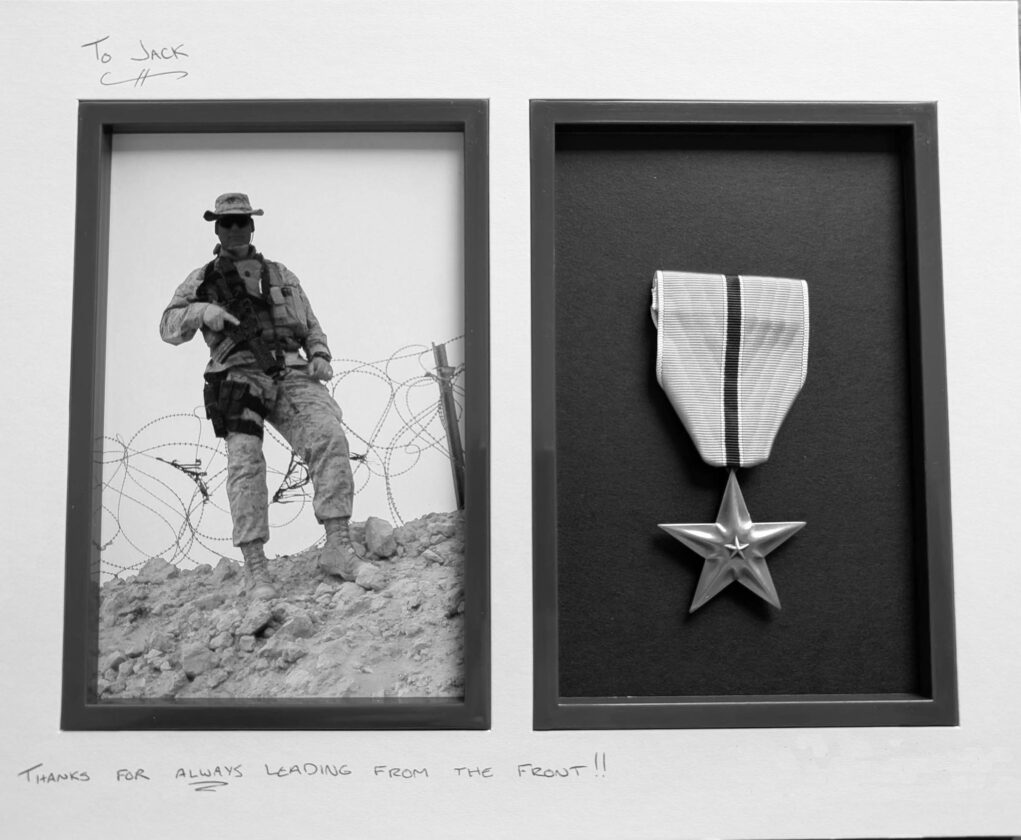
Photo and bronze star gifted to me. (Provided photo — Jack Drury)
About a decade ago, I received a package from a student who I hadn’t heard from in over 30 years.
Our paths first crossed early in 1981 when Terry, as a Saranac Lake High School senior, reached out to me about attending our field-based Summer Practicum. (Terry’s not his real name. When I contacted him about writing this story, he was amenable to the idea but asked that I not use his name. He’s not the type to draw attention to himself.)
The course was demanding both physically and mentally — canoeing and backpacking for 33 days while students developed their leadership and decision-making skills. I’d never considered allowing a recent high school graduate to attend, but the young man was persistent. So, I reached out to his guidance counselor who gave a glowing reference.
I asked Terry to stop by for an informal interview. He all but burst through the door, a restless, scrawny, blond-haired 17-year-old with bright eyes, and an eagerness that seemed to hum in the air around him. He perched on the edge of his chair, hands never quite still, grinning as if I’d already said yes. I liked him right away. I told him I’d send his request up the chain of command, and when my supervisor kicked the decision back to me, it felt inevitable. By July, Terry had joined our motley crew.
What was Terry like as a student on our nearly five-week wilderness leadership trip? Exemplary. He rose before the sun had burned off the morning fog, asked questions as we hiked, listened hard and seemed to soak up instruction the way dry ground soaks rain. His youth showed only in his boundless energy; he complemented it with focus, curiosity, and a readiness to speak up — calm but firm — when he believed a teammate had missed something or made the wrong call.
I remember clearly the end of a hard day of hiking and the student Leader of the Day was looking for a campsite. We usually looked for primitive sites where no one had ever camped, or at least very rarely camped. Students had to make sure they met the legal requirement of being at least 150 feet from a water source or the trail. State-designated campsites didn’t have to meet that requirement and rarely did.
The student leader found a nice site with plenty of room alongside a good size stream. It had obviously been used by previous campers but was just as obviously not an officially designated site. After a long day of hiking with heavy packs, everyone in the group was eager to camp there. Terry pointed out, “If it isn’t an official site, should we camp alongside the stream? Isn’t it illegal?” It generated a lively discussion and eventually the students all agreed they should find an alternate site a legal distance from the stream.
By the end of the course, it was clear that although Terry was young, he had a bright future if he decided to pursue a career outdoors. He eventually enrolled at the college full-time. But after a year in the classroom, he decided college wasn’t for him. After he dropped out, I lost contact with him.
Fast forward 30 years and the box has arrived. I opened it and I gazed at a couple of photos of Terry, a letter and a box.
In his letter he described his time at NCCC.
“After two years, and the exhilarating — and humbling — experiences in both Practicums, I came to the realization that I simply lacked the mental and physical attributes required to become an effective Outdoor Leader. So, I left the program, and following a couple of ‘wasted’ years of chasing my tail … I decided that it was time to finally address those very same issues, lest they continue to shape my future as they had my past. Enter the United States Marine Corps … I wanted to learn from the very best our armed forces had to offer, and boy … did I ever learn! Ding-ding … the School of Hard Knocks was now in session … some 22 years later, I found myself a Master Sergeant standing at my retirement ceremony at the Pentagon in June 2008.
“…. I travelled to four distant continents, sailed across the vast expanses of three oceans, and dipped my hands in the waters of four different seas. I trekked on high ridges and stood atop snowy mountains … I rappelled down sheer cliffs of unforgiving rock, and humped through deep lush valleys of rivers and streams. I plodded over the sands of massive deserts, and waded through the shoulder height grasses of vast plains. I walked the black volcanic sands of Pacific islands, and slashed my way through the dense canopies of impenetrable tropical rain forests.
“And throughout it all, regardless of the mission or circumstances at hand, I always tried to find a moment or two to take in the many wonders of the world around me, a habit which to this day I attribute to your influence. And on more than a few occasions, when finding myself staring out over some jaw-dropping natural wonder, I remember saying to myself … “Now this is something that Jack would appreciate!”
He went on to share how, as a leader in the Marines, he came to realize his first exposure to the same concepts and principles of leadership came from his experience at NCCC.
“Thank you, Jack … for planting the seeds of leadership in me …”
He spoke of my son’s death in 2012 and, in doing so, offered comfort in a way I hadn’t expected or felt up to that point. He reminded me — gently, almost reverently — that throughout my career, I had helped shape and mentor countless students, and that there might be some small measure of solace in knowing those lives carried forward a piece of the care and guidance I could no longer give my son.
He said, “The enclosed photo was taken in July 2005 at an ‘undisclosed location’ somewhere in the Middle East. At the time, we were engaged in combat operations to locate and destroy groups of heavily armed foreign terrorists.”
He went on to tell me he was awarded the Bronze Star for exceptionally meritorious service in connection with combat operations. He placed the original in the casket of a good friend who was killed in action in Afghanistan.
And now for the box. In it was a framed photo of him, with another bronze star, obviously not his original one. This was a gift for me. He explained it by saying that, “I nonetheless hope you will accept it as a small token of my appreciation.”
It’s still hard for me to read the letter without shedding tears. Terry obviously had all the attributes to be a good Marine. I doubt I played any role other than perhaps facilitating some existing attributes.
I believe Terry has paid a price for his work around the world on behalf of our country. When he visited me a few years ago, I could see it in his eyes — tired, steady, perhaps carrying memories he couldn’t share. I could hear it in his voice, roughened by distance and time, each word measured. Yet HE was thanking ME.
Instead, I thank him. We should all be grateful that people like Terry serve our country — often carrying their burden long after the work is done.
Columns

5W Wednesdays
Daylight saving time

Lasagna: Great way to feed a crowd
Chasing the dragon
When you’re a kid, you believe you can be anything. Astronaut, Olympic Athlete, long lost princess — no matter ...

Lasagna: Great way to feed a crowd
Whining and screaming
Parents are often screaming for solutions that will help them handle their toddler going through the stage we call ...