Night reading
(Provided photo — Peter Berra)
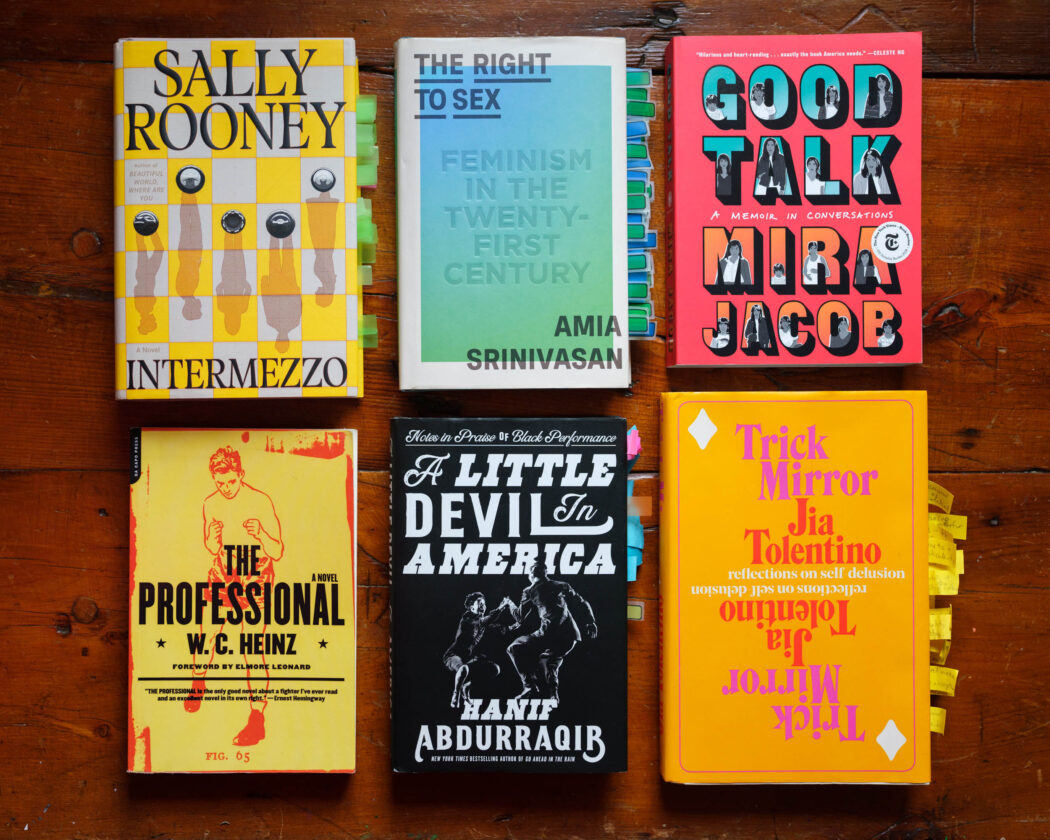
One of my favorite ways to spend the winter holidays is staying up late to read. Just as my little corner of the world darkens and quiets, I let my mind come alive in a book. In case you also want to indulge in night reading this winter, here is a list of a few of my favorite books from Decembers past, and a bit about what the books mean to me.
–
“Intermezzo” by Sally Rooney (fiction)
–
I read Intermezzo last December, just after I broke my right ankle and had 7 screws and a 4-inch titanium plate put in. At the time, I didn’t believe I could think about or feel anything other than the post-surgery pain, but by some miracle, I grabbed “Intermezzo” from my shelf, and it took me out of my body and into the world of two brothers trying to find their way in new relationships after the death of their father.
The relationships are atypical on the surface, but the vulnerability, regret, anger, desire and suffering are universal and so vividly described that I don’t remember feeling pain the days I spent reading. I do remember the conversations of new lovers, arguments between brothers, tears, panic, loss and renewal. And I remember that by the time I finished reading, the book had healed me.
–
“The Professional” by W.C. Heinz (fiction)
–
Despite its niche subject, “The Professional” is a story for everyone.
I read the entire book in one sitting over Christmas Eve in 1997, choosing to stay up all night to find out what happens to Eddie Brown, the young professional boxer vying for the middleweight title.
I was also young when I read the book and felt a kinship with Brown, a man who could not have had a life more different from my own. But I recognized that his goal was everyone’s goal — to get from here to there, to make something of yourself, to do good. Much like a big break that appears in life, the actual fight is short and only a small part of the book with the major part of the story spent describing the boxing world, the characters that populate that world, the grit behind the dazzle of professional boxing, and the unfaltering community needed to prop up the boxer long before they step into the ring on fight night. The everydayness of the ending is as gutting as a liver punch.
–
“Good Talk” by Mira Jacob (graphic memoir)
–
I don’t read a lot of graphic novels, but I loved “Good Talk” so much that I bought it for three people the Christmas that I read it, just before COVID-19 shut down the world.
Written and illustrated by Mira Jacob, the book is a hilarious, sad and beautiful depiction of her life as she grew up with South Asian immigrant parents in Albuquerque, navigated young adulthood in post-9/11 America and became an artist and mother in an increasingly polarized world.
Jacob’s narrative timing is as sharp as her ear for dialogue and eye for deadpan humor, but the greatest gift of this unique graphic memoir is its optimism. It was exactly what I needed during the pandemic and remains one of the most heartening books I’ve ever read.
–
“A Little Devil in America: Notes in Praise of Black Performance (ALDIA)” by Hanif Abdurraqib (personal essays)
–
I read “ALDIA” just as Omicron hit in December of 2021 and it buoyed me through another winter holiday far from loved ones.
The work is genre-bending — part memoir, part cultural criticism and written with a clear love of rhythm and play more characteristic of poetry than prose. Unsurprisingly, Hanif Abdurraqib, the author of “ALDIA” and a MacArthur Genius Award winner, is also an acclaimed poet.
“ALDIA” is a book about what it means to love a place that doesn’t always love you, to keep loving it even when it betrays you and the community that catches you when you don’t have it in you to keep on loving. I read this book as slowly as I could, which is to say I read it breathlessly, and then read everything else Abdurraqib wrote. He is a voice I return to again and again.
–
“Trick Mirror: reflections on self-delusion” by Jia Tolentino (cultural criticism)
–
I first read Jia Tolentino when she was an editor at the online feminist magazine Jezebel, and was transformed by her 2016 interview with a woman who had an abortion at 32 weeks (tinyurl.com/mppvypp2.)
Despite the strength of her previous journalism, I was amazed by the exhaustive research, the insight and the generosity of Tolentino’s sharp cultural criticism in “Trick Mirror.”
I took my time over the 2019 December holidays to mull over each essay. While the topics range from internet culture to contemporary feminism to the relationship between religion and drugs, the focus is squarely on the question of what it means to be a young adult today.
I teach parts of the book in my philosophy classes, and the chapter “Always Be Optimizing” shakes, stretches, and inspires my students and me every semester.
–
“The Right to Sex” by Amia Srinivasan (philosophy)
–
“The Right to Sex” is not exactly what it sounds like.
The book is a collection of feminist essays on rape, pornography, sex work, power and sex, sex and pedagogy, the ethics of desire, and sex and freedom.
The author and Oxford University philosophy professor, Amia Srinivasan, offers no easy answers to the problems she raises. Instead, she writes a clear explanation of the terms of the debates and the implications of those terms.
I read this book over the winter break of 2022 with a feminist book club that I’m part of. My book club comprises two philosophers, an art historian, a historian and a former human rights lawyer. We are not what I would describe as a group of conventional thinkers, but this book had us wrestling with uncomfortable feelings. Every meeting went overtime, our discussions flowed seamlessly from the book to our personal lives, to the news, back to the book. There never seemed to be a beginning or an end to our conversations because the questions that Srinivasan raises have no obvious beginning or end. The problems are systemic, complex and fundamental to being and sexuality.
It was a challenge to read over Christmas, but it was important that I did.
Columns

Heart murmurs
As Yogi Berra famously said, ‘It’s deja vu all over again’
Carnival 2026 wrap-up rap
For those given to walking about
The Irish Jig
In 1982, I stood outside the dressage arena at the Franklin County Fair in Malone, New York. Groomed and braided, ...