
My Mother’s Christmas
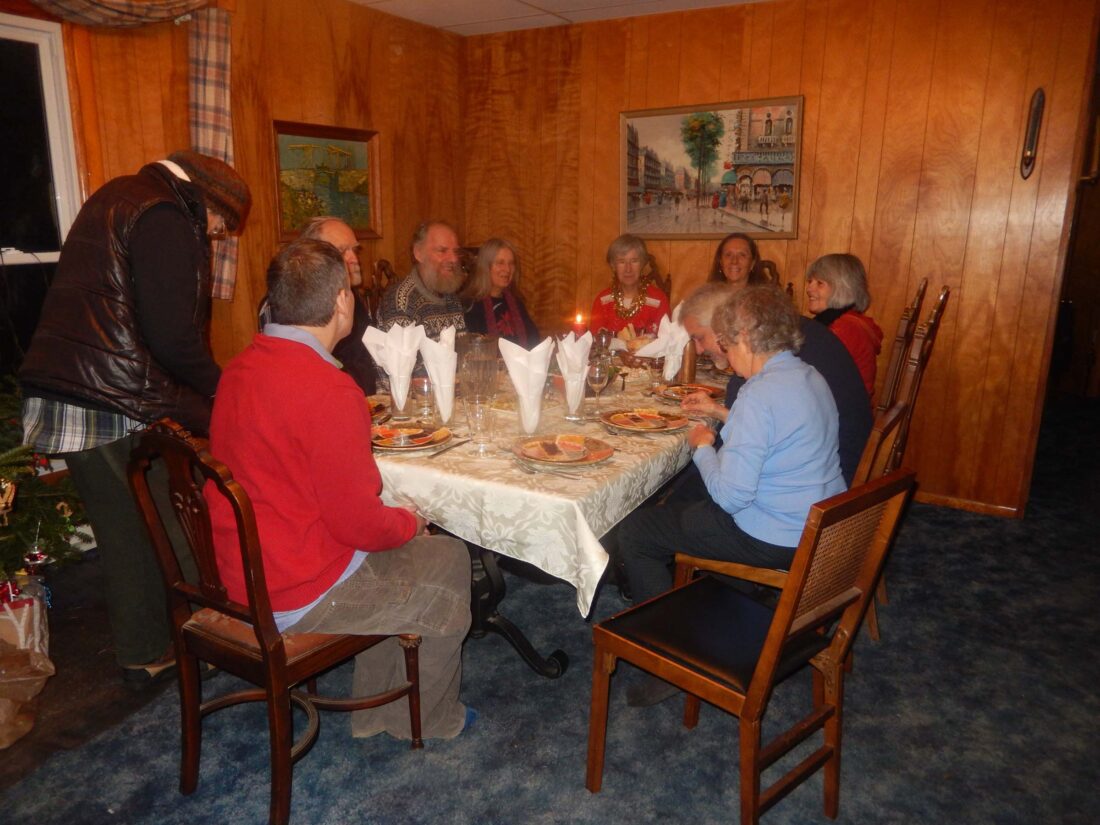
Christmas dinner (Provided photo — Yvona Fast)
My Mom grew up during the 1930s in a secular home. She had little concept of special holidays or religious celebrations of any type.
When she was four, walking to the market with her nanny on a cold December day, they stopped at her fiance’s home, where she was mesmerized by the sight and scent of her first Christmas tree. She writes in her memoir: “In the corner of the living room was a large Christmas tree with its full decor … I was awestruck at the sight. To have such a thing in one’s home, that must be so wonderful. I told myself then that, when I grew up, I would try to have such a wonder too!” (Good in the Midst of Evil, Rise, 2022).
A few years later, this secular Jewish girl masqueraded as a Roman Catholic girl in a small Polish country village. Mom recalls making straw ornaments, paper chains and Christmas angels with Eva and her friends.
Her dream came to be. In the 1960s, after immigrating to the United States, she began decorating a Christmas tree in her home each year. After moving to the Adirondacks a half-century ago (1974), each year we cut down a balsam fir tree in the forest that surrounds our home, bring it in and decorate it. Electric lights have replaced the candles that probably lit that spruce in 1935. Silver and gold garlands replace homemade paper ones. We have many different ornaments, including Polish ones made from straw and ornaments given by friends in past years that we cherish.
When she retired in her sixties, Mom began celebrating the Polish Wigilia (Christmas Vigil) festive, meatless dinner. Sharing this tradition with American friends and preparing all the special dishes gave her great joy.
Each year, we gathered with good friends, exchanging small mementos, mostly homemade. One year, Mom gave jars of homemade jam. Another year, she made candied orange peels, dipped in chocolate. Our friend Betty once brought a bag of oranges and gave an orange to each person.
In Poland and other Roman Catholic countries, Dec. 24 is a time of fasting and abstinence, preparing our hearts to celebrate the birth of Jesus with a midnight mass. In Catholic countries from northern Europe to Latin America, this meatless dinner, rich in symbolism, is part of many ethnic traditions. Christmas Eve — Wigiilia (the vigil) in Poland, is known as La Vigilia de Natale in Italy and Noche Buena in Mexico.
On Christmas Eve, the table is set with Mom’s special, homemade tableware. Hay is placed under the white tablecloth, representing the manger. Holiday music plays.
We sat down to dinner as the sun set in the west. According to Polish tradition, the youngest children go outdoors to look for the first star to appear, recalling the journey of the wise men towards Bethlehem. When they return, the celebration begins.
We start with Oplatek — a communion wafer. In Poland, these are handed out at church. You break bread with each guest or family member in turn, wishing them a merry Christmas as you take a piece of their wafer and they take a piece of yours.
Then we light the candles and sit down to eat the food that we have spent days preparing. The whole meal omits meat, because you are supposed to fast as you await the coming of the Christ child into the world, so fish has a major role in the festive meal. There is a basket of hearty bread on the table, sometimes homemade. There was often a bowl of paszteciki, small filled crescent-shaped savory mushroom pastries for hors d’oeuvres.
The first course is herring with bread. Mom always made it two ways: with oil, onion and pickle or with sour cream and apple. A root vegetable salad accompanies the herring and is also served later with the fish.
The next course is soup — usually a vegetarian borscht consomme or a mushroom soup. Also eaten with good, hearty rye bread.
Then we bring out the fish dishes. In Poland, carp in a gelatin sauce is often served chilled. Since it’s difficult to find carp here in the Adirondacks, we usually have salmon and tilapia. This is served with boiled potatoes and sauerkraut cooked with dried wild mushrooms.
After the main course and before dessert, we duck under the tree to retrieve the homemade gifts and small token presents.
Dessert is compote made with dried fruits and poppyseed cake — a yeast jellyroll dough with a ground poppyseed filling. Some of our guests also brought desserts like cranberry nut bread or a Hungarian Beigli, a tender, yeasted dough with a beautiful crackled crust filled with sweet, spiced walnuts. The desserts are served with a large pot of freshly brewed tea.
In Poland, this lavish supper is followed by singing carols and walking to midnight mass.
–
Steamed Fish and Vegetables
–
Ingredients:
–
2 tablespoons olive oil
2 large onions
4 stalks of celery
2 large carrots
2 green peppers
2 cloves of garlic
1 14 oz. can diced tomatoes (about 2 cups), with liquid
1 teaspoon salt, divided
1/2 teaspoon basil
1/2 teaspoon tarragon
1/2 teaspoon thyme
2 pounds fish fillets (flounder, sole, tilapia, etc.)
1/4 cup fresh chopped parsley
–
Directions:
–
Prepare vegetables. Peel and dice the onions; wash and slice carrots, celery and peppers. Heat the oil in a large skillet. Add vegetables, and cook slowly on low heat, stirring occasionally, about 10 or 15 minutes. Peel and mince the garlic and add with the tomatoes and half a teaspoon of salt; continue cooking 10 to 15 minutes more. Stir in the basil, tarragon and thyme; place the fish on top of the vegetables, sprinkle with remaining salt, cover and steam about 10 minutes, until fish is opaque and flakes easily with a fork. The time may depend on the size of the fillets and the type of fish.
To serve, place the fish on a serving plate and pile the vegetables around it. Sprinkle with parsley, and serve. Serves eight to 10.
–
Polish Cabbage with Wild Mushrooms — Kapusta z Grzybami
–
This traditional side dish is served with fish for the Christmas Eve meal.
–
Ingredients:
–
2 ounces dried porcini mushrooms
1 to 2 tablespoons oil or butter
1 large onion
2 pounds Kosher sauerkraut (the kind cured with salt, without vinegar)
–
Directions:
–
In a saucepan, cover mushrooms with water and soak overnight or for several hours. Bring to a boil, lower the heat and simmer until soft for about 30 minutes.
While mushrooms are cooking, heat oil in a large saucepan. Peel and finely mince the onion. Add and cook on medium-low heat for about 5 minutes, until translucent. Stir in the kraut and a little water, cover, bring to a boil, lower the heat and simmer 20 to 30 minutes. Stir in cooked mushrooms and their liquid, and continue to simmer over low heat, the longer the better — at least an hour or two, making sure they don’t stick or burn (add liquid if needed). Taste and season with salt and pepper if needed.
–
Filled Poppy or Nut Roll
–
Ingredients:
–
Dough:
–
3 tablespoons yeast
1 1/2 cup sugar
1 1/3 cup warm milk
4 cups flour, divided
2 eggs
2 egg yolks
1 teaspoon vanilla
1 cup (2 sticks) butter, melted
–
Directions:
–
Heat milk till warm (not hot). Combine 1/3 cup of the milk, 1/2 cup sugar and the yeast, wait until bubbly. Stir in the remaining one cup of warm milk and the remaining one cup sugar and two cups of flour. Stir to combine, cover with a cloth and allow to rise until doubled in size.
Beat eggs and two egg yolks (reserve whites for filling) with one teaspoon vanilla. Stir into the batter, along with one cup of flour. Melt the butter, and stir it in. Stir in additional flour; then turn out on board and knead, adding flour as needed. Cover and let rise in a warm place until just doubled in bulk, about one hour.
Divide the dough into two or three parts. Roll each part, top with filling and roll up like a jellyroll.
–
Poppy Filling:
–
2 cups poppy seeds
1 cup honey
2 egg whites
1 teaspoon vanilla
1 tablespoon grated orange zest
1/2 cup raisins
1/2 cup slivered almonds
–
Directions:
–
Simmer the poppy seeds in water until soft and you can rub them in your fingers, 3 to 5 hours. Drain in a colander covered with a clean cloth.
Put the mixture through a meat grinder; you have to repeat this process three times until the seeds are totally crushed. Add honey. Beat egg whites until stiff peaks form, and stir in along with vanilla and orange zest. Stir in raisins and almonds. Spread on rolled out dough, and roll up jellyroll fashion. Let it rise. Bake at 375 degrees F until golden brown.
–
Nut Filling:
–
1 pound shelled walnuts
1 cup sugar
1/2 cup raisins
2 tablespoons milk
–
Directions:
–
In a food processor, grate nuts with a steel blade. Combine with sugar and raisins. Heat milk until boiling, and stir in. Cool. Spread on rolled out dough, and roll up jellyroll fashion. Let it rise. Bake at 375 until golden brown.
— — —
Author of the award-winning cookbook Garden Gourmet: Fresh & Fabulous Meals from your Garden, CSA or Farmers’ Market, Yvona Fast lives in Lake Clear and has two passions: writing and cooking. She can be found at www.yvonafast.com and reached at writeyvona@gmail.com.
Columns
Whining and screaming
Parents are often screaming for solutions that will help them handle their toddler going through the stage we call ...

Breaking news in brief
An occasion of note
Last week at Nori’s, after a hard day of hanging out, swilling coffee and swapping lies, I went out to my car and ...
The cat’s meow
Cats are the best. If you don’t have a cat, you should get one. If you can’t get one, you could visit the cat ...
Image of the Week
Correcting history
A new book by Curt Stager and David Fadden, “The First Adirondackers: 12,000 Years of Indigenous Peoples in the ...