
Maggie’s Room, Part II
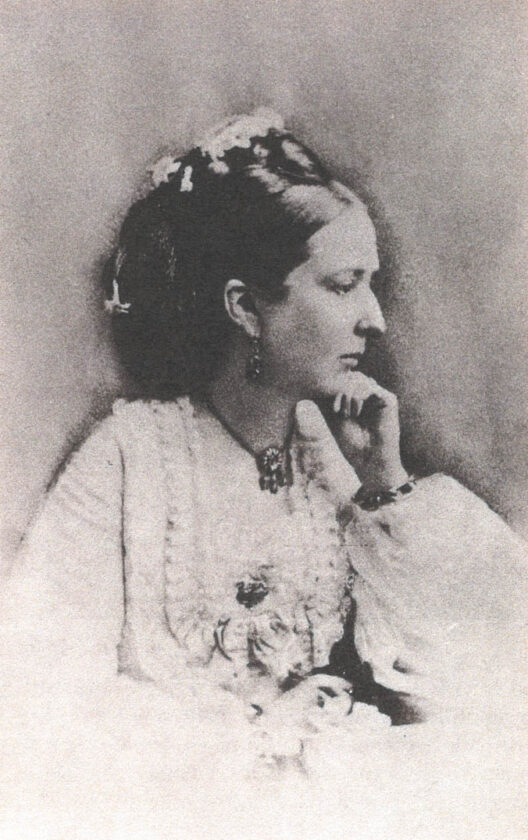
Margaret Isabella Balfour Stevenson, or “Maggie,” age 20. (Photo provided)
“I must give you some account of how we pass our days here. My stove is lit about 6:30 in the morning, and warms the room very quickly, so that I can soon sit up to read or write. Louis and Lloyd breakfast early and work until lunch-time; when Lou writes in the sitting room, I keep up the fire in my stove and stay in my own room, which is very bright and cheery.”
— “From Saranac to the Marquesas and Beyond: Being Letters Written to Miss J.W. Balfour, by Mrs. Margaret Isabella Balfour Stevenson,” the mother of Robert Louis Stevenson, called “Maggie” from childhood.
—
It had already been a long, strange trip for the widow of Thomas Stevenson, ever since leaving her splendid New Town residence at 17 Heriot Row opposite Queen St. Gardens, in Edinburgh, Scotland. Her doctor was one of her brothers, Dr. George Balfour, and Louis was his patient, too. With Thomas gone, he reasoned, there was nothing keeping Robert Louis Stevenson in the U.K., except his mother. Uncle George advised his nephew to take a long trip for at least a year, to a healthy place, say for example, the American Rocky Mountains …and take your mother with you. She needs a change too, doctor’s orders.
So began the North American leg of the next migration of the so-called Stevenson expedition, always in search of a healthy locale for their leader, the author of “Treasure Island.” There were five members of this group, namely, Robert Louis Stevenson, his wife, Fanny, his stepson, Lloyd Osbourne, Mother and a young Swiss travelling servant, Valentine.
Colorado Springs was their target when all boarded the steamship Ludgate Hill on the Thames River, bound for the New World via Le Havre, France, to pick up cargo. By then Margaret was already writing her letters to sister Jane: “It is a week today since we left Havres and will likely be another week before we reach New York. The weather is still cold and stormy and the wind dead ahead of us, so we got on very slowly …
“The sensation of today, the 5th of September, was the arrival of the pilot.”
By summer, 1887, the public intoxication with Stevenson’s recent gothic horror novelette, “The Strange Case of Dr. Jekyll and Mr. Hyde,” was at its zenith. Stevenson and company, still at sea, were not aware of this uniquely American phenomenon bearing down on them, the cult of celebrity. Margaret continues:
“I must not forget to tell you that the pilot was greatly delighted when he found out who Louis was; it seems that he himself actually went by the name of ‘Mr. Hyde’ on board the pilot boat, and his partner was called Dr. Jekyll, because the one was easy and good natured and the other rather hard and inclined to screw the men down to their work. Was it not strange that he out of so many, should have been the one to bring us into New York?”
New York was supposed to have been a stopover for RLS and the rest, on their way to Colorado. They didn’t know what to make of the crowd gathered at the pier they happened to be heading toward, but Louis was surprised and happy to see in there, the face of his old friend, Will Hickock Low. Low, from Albany, New York, befriended RLS in France, in 1875, when he was 23. An artist, Low was from the inner circle of Stevenson’s set. Three of his paintings have hung around at Baker’s for a century.
What a surprise it must have been for the Stevensons when they surmised that the crowd assembled before them on the pier had come to see him, the suddenly famous invalid author from Scotland. It was, as they say, “the first day of the rest of his life.” They also like to say that “his ship had come in.”
Until September 1887, Robert Louis Stevenson had been the victim of thievery by American publishers who printed and sold his books for callous profit in unauthorized versions known as “pirated” editions. They did it without shame at a time when American copyright law applied only to Americans. Charles Dickens had the same problem here, too, years before Stevenson came. It was up to Congress to do something.
RLS didn’t have time for that though — his marriage to an American would have its benefits. In the case of his rise to fame and getting the money he deserved, timing was crucial, but in the kind of way that supports the belief in some circles that Louis really had supernatural assistance at critical milestones in his short life. They use the timing of his voyage to the New World with his mother in the late summer of 1887 as evidence.
Stevenson had risen to fame, even legend, on the shoulders of his 19th century fictional schizoid man, “Dr. Jekyll and Mr. Hyde.” His arrival in the Big Apple, in late summer, 1887, just happened to coincide with the cresting of the countrywide mania over his two-faced villain. That made him “hot” to the American publishers, who then entered into competition to make the first contract with the guy they had been ripping off for years. From this day forth, the Americans would finally be doing right by RLS, and for the first time in his life he could ponder what life he had left with lots of money, more than he ever dreamed, and he said as much in his letters from Baker’s. It all just boiled down to common sense, the way he expressed it in his first letter to cousin Bob, Oct. 8, 1887: “Wealth is only useful for two things–a yacht and a string quartette. For these, I will sell my soul.”
The American cult of celebrity was fickle then, too. Had Thomas died a year or two later, his son’s reception in America a year or two later might have been less dramatic and profitless. By then, there would have been a new star for the masses to adore and put in the lights. Somehow, the Stevenson expedition had hit the nail on the head, timewise. On Sept. 7, 1887, the first ever stage production of “Jekyll and Hyde,” unauthorized of course, was only five days out at Madison Square Theatre. Meanwhile, preachers in every county of every state were exploiting his material for fantastic new sermons; and then RLS just happens to show up in the Big Apple, just at the right time to milk it to the max. Some say that is too serendipitous not to be suspicious.
Such is the fleeting nature of fame, American style, but for Robert Louis Stevenson, the timing of his so-called “second-coming” made possible the extremes he would go to to find a place to live where he could actually feel alive. He succeeded, and his mother was there through it all, and all of that started in Saranac Lake in the winter of 1887-88.
Mrs. Margaret Isabella Balfour Stevenson, proud mother of this author, had already begun using scrapbooks to document the progress in her son’s career from newspaper and magazine clippings, etc. There are at least six. Three have a home in the “Robert Louis Stevenson House” in Monterey, California. Three have a home at the “Robert Louis Stevenson Memorial Cottage” in Saranac Lake. These scrapbooks have value to academic types and biographers. For that purpose, the Stevenson Society of America in 1974 permitted the Yale University Library to microfilm them, since digitized, maybe.
One of the scrapbooks in Saranac Lake today is the very one Maggie was using in New York City as her boy was skyrocketed to fame in less than a day; the same one she brought to Baker’s a few days later. It is just another artifact in Maggie’s Room that really got around.
Columns

Kugels and Gratins Celebrate Spring Festivals
Vehicle and traffic laws vary from state to state
If you are a regular reader of these weekly articles, you might have picked up on my call for vehicle and traffic ...
Park association opposes bill
Page one of the The Adirondack Daily Enterprise was jam-packed with local news on Monday, July 10, 1961. What ...
Dealing with swollen glands
Parents have recently been asking me some swell questions about their children having swollen glands. Let me ...
On aging — part I of III
A 12 caret nightmare
Question of the day is: What’s orange and sounds like a parrot? Answer: A parrot. I mean, really, what ...