Under the wide and starry sky, Part I
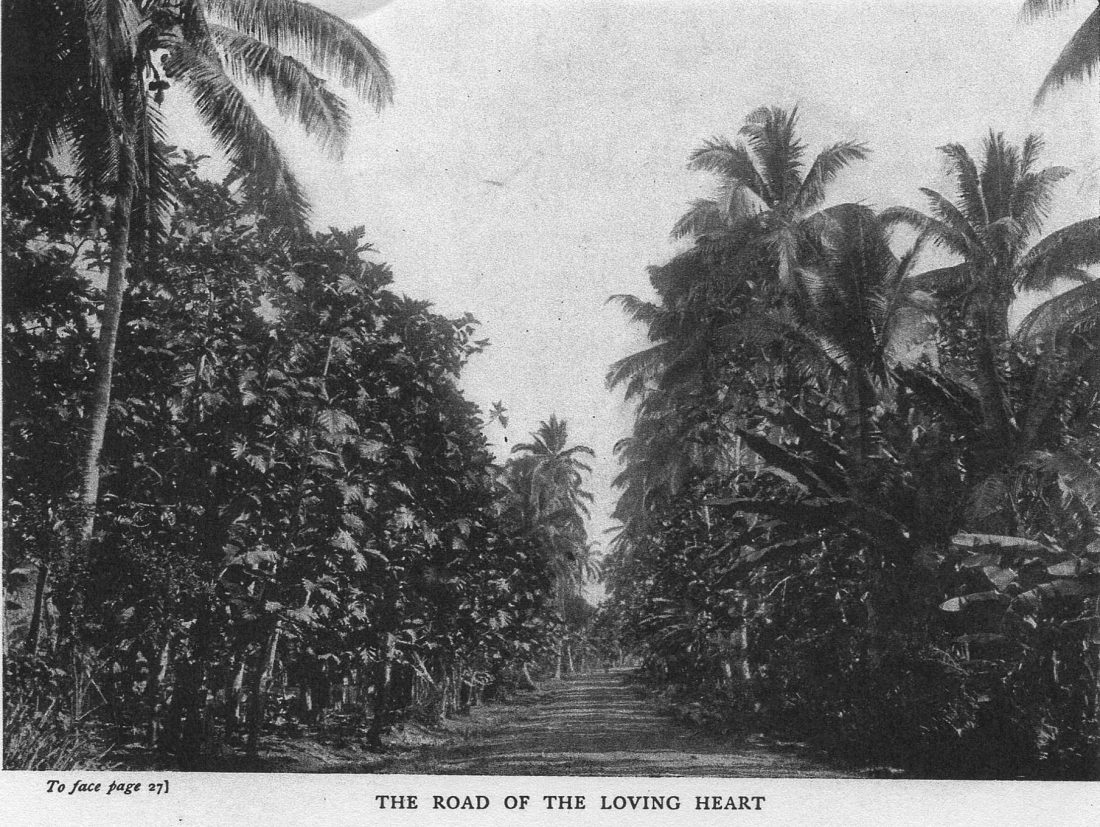
Only a few weeks before Robert Louis Stevenson had his last experience in the form of a fatal stroke that struck “like a wilful convulsion of brute nature,” he had thrown a party at his home called “Vailima.” Its purpose was to dedicate The Road of the Loving Heart, a construction project carried out by 22 Samoan chieftains to demonstrate their gratitude for “the kindness of Mr. R.L. Stevenson and his loving care during our tribulations while in prison.” That quote is from the sign the builders set up at the entrance to the brand new driveway through the jungle to Vailima, where lived “Tusitala”–“Teller of Tales,” and hero extraordinaire to the chiefs.
Stevenson wrote a speech for the occasion, which he gave to a missionary to translate into Samoan and then was said to have done an impressive job reading it aloud to his guests in their own tongue. The authorities were afraid that he would say seditious things, and may have been behind the rumor spread by some party poopers that this party was going to be a target for terrorists. Consequently, it was a smaller gathering than anticipated to whom Tusitala spoke his words. He talked about reality in common sense terms, that the Samoans had to quit fighting among themselves if they ever wanted to get rid of the colonizers and in the meantime, they should start searching now for ways to protect their land.
About six weeks later, Tusitala was suddenly dead. This time, all the people turned out to say goodbye to their friend and benefactor, one of the few white men they could trust. His casket was carried by successive gangs of strong Samoan warriors in a relay, until they reached the hastily prepared clearing at the summit of Mt. Vaea, with its hole for one ready for occupation.
A rare set of three original photographs of the burial scene at the summit are in the Saranac Lake collection. Their provenance is interesting. They had been acquired by King Tembinok, the tyrant of Apemama in the Gilbert Islands. In 1889, he had allowed the Stevenson expedition to remain on his island for a number of weeks, contrary to his known animosity to the white man. He even had individual huts built for each one of its five members on a piece of land he then put under tabu to his people to guarantee their privacy. The occupants called their temporary home Equatortown, after the trading schooner, Equator, which had left them there and, hopefully, would return to take them even further into Oceania. When King Tembinok got the news of his death, he wept openly but was no longer king. The colonizers took care of him, too.
In 1921, Austin Strong, Stevenson’s step-grandson, obtained these photographs still in the folding leather case the king had, from Tembinok’s descendants. A fourth photo shows RLS lying in state in his great hall at Vailima. Strong brought them to Saranac Lake in 1925.
Everybody around him knew that the author of Treasure Island had wanted to be buried on top of Mt. Vaea, a dead volcanic peak on his property, about 500-foot elevation. His stepson, Lloyd Osbourne, believed he thought about it too much. From his article, “The Death of Stevenson,” in the Tusitala Edition of his works:
“There was about him a strange serenity … I think he must have had some premonition of his end; at least, he spoke often of his past as though he were reviewing it, and with a curious detachment as though it no longer greatly concerned him … I began to notice how often he stopped to gaze at the peak as he walked up and down the veranda. It was specially beautiful at dusk with the evening star shining above it and it was then he would pause the longest in an abstraction that disturbed me … It is a curious thing that his previous illnesses, which might so easily have concluded in his death, caused me less anguish than the look on his face as he now stared up at Vaea. I think it was the realization that he meant to fight no longer; that his unconquerable spirit was breaking; that he was not unwilling to lie on the spot he had chosen and close his eyes forever.”
Robert Louis Stevenson had started preparing for his death long before it came, by about 15 years. In February 1880, Louis was staying in a cheap room at 608 Bush St., San Francisco, California, a complete unknown. The invalid had staked everything on a dangerous solo journey to the New World from Scotland, hopefully to hook up with his American girlfriend who he ran into in France, Mrs. Fanny Vandegrift Osbourne (separated from Sam Osbourne).
Stevenson routinely played the game of denial with his chronic ill health and he paid for it more than once. But this trip to America to be with Fanny, which his father called a “mad, sinful business,” his friends in agreement with his father, was a make-or-break situation. We all know how he survived and made it, but during the darkest days of his quest, when he was alone at Bush St., living on about a dollar a day, his nemesis made his debut, “Bloody Jack,” the aspiring author’s hemorrhaging lungs. This must have seemed like curtains to Louis.
Before Stevenson married Fanny (May 18, 1880), the person he confided in most was his friend and mentor, Sidney Colvin. From the depths of his soul, Louis wrote a letter to Colvin from Bush St., expecting to die presently and getting ready for it by composing his epitaph, his poem Requiem, published in Underwoods in 1887. Louis wrote the letter after completing the poem. In 1920, when RLS was long gone, Sir Sidney Colvin was one of four British Representatives of the Stevenson Society of America. For a reason we can only guess at, Sidney cut off the end of the letter and sent it to Saranac Lake, where it is known as artifact #764 in the museum collection on Stevenson Lane. Here is RLS pondering in ink about his apparently imminent destruction, alone in the U.S.:
“Robert Louis Stevenson
born 1850, of a family of engineers
died ________________
‘Nitor Aquis’
Home is the sailor, home from sea,
And the hunter home from the hill,
You, who pass this grave, put aside hatred;
love kindness; be all services remembered in your
heart and offenses pardoned; and as you go
down again among the living, let this be
your question; Can I make someone
happier this day before I lie
down to sleep? Thus the dead man
speaks to you from the dust; you will
hear no more from him.
“Who knows Colvin, but I may be of more use when I am buried than ever while I was alive? The more I think of it, the more earnestly do I desire this. I may perhaps try to write it better some day; but that is what I want in sense. The verses are from a beayootiful poem by me.” RLS (end of letter)
Requiem
Under the wide and starry sky,
Dig the grave and let me lie.
Glad did I live and gladly die.
And I laid me down with a will.
This be the verse you grave for me;
Here he lies where he longed to be,
Home is the sailor home from sea,
And the hunter home from the hill.
A popular guess as to why Sidney Colvin sent that personal communication to Saranac Lake was to complement the acquisition by the Stevenson Society of the wooden prototype of the bronze plaque cast for Stevenson’s tomb atop Mt. Vaea, the one with the “beautiful” poem from Bush St. Too bad that the finished bronze plaque on Stevenson’s tomb came with a flaw, a flaw that began with the prototype in Saranac Lake.
To be continued.
Columns
Big meeting of the VIS
The Village Improvement Society has kept Saranac Lake beautiful over the years with the many parks throughout the ...
My first brush with history
Even though I was always a logophile and I taught English for a year or two, my first love in academe was ...
Image of the Week, from Historic Saranac Lake
5W Wednesdays, from Historic Saranac Lake
Making sure all bellies are full
I am obsessed with food. I’m not talking about just eating it, though that is a very important element. I make a ...