The road of the loving heart, Part I
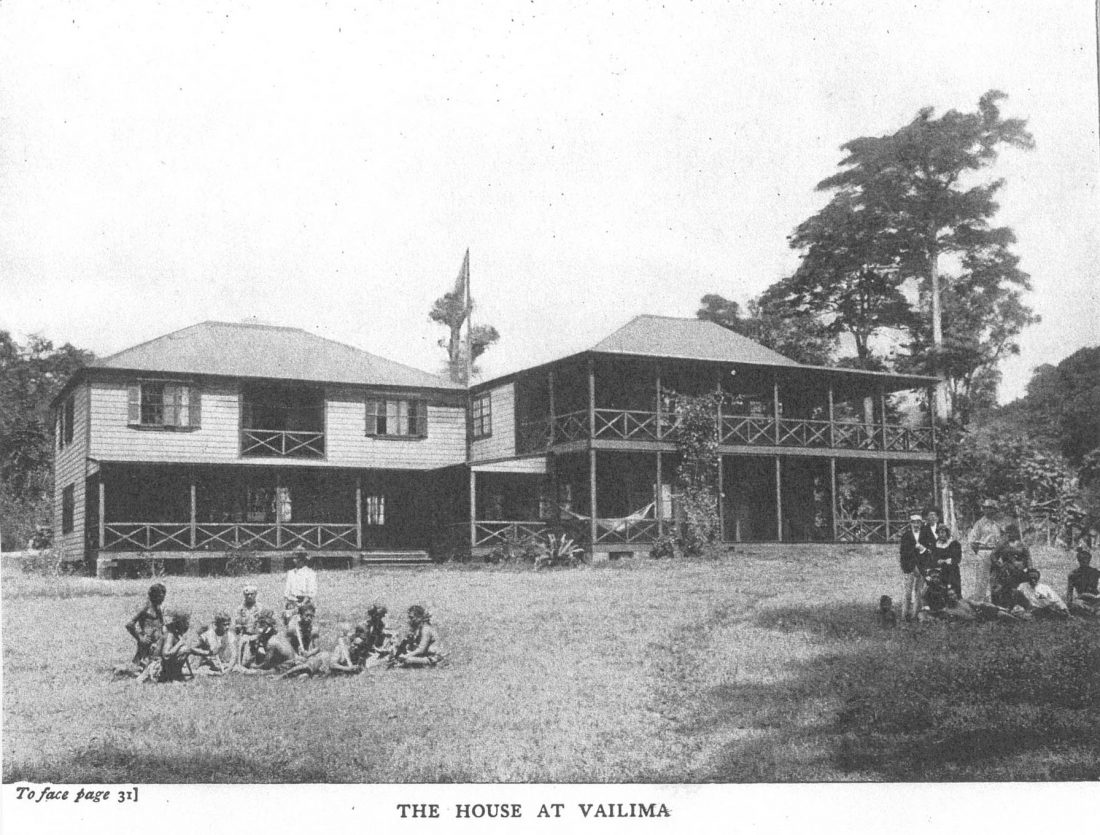
Still unsurpassed as the “world’s finest collection of Stevenson lore,” the memorabilia in Saranac Lake pertaining to the invalid author from Scotland, Robert Louis Stevenson, is comprehensive in the way it represents all phases of his life and career, short though it was, from his white linen baby cap to the pen with pewter inkpot that he used the day he died on Dec. 3, 1894. These artifacts have a diverse background, geographically speaking, originating in Scotland, England, Switzerland, France, United States, Tahiti, Australia, and his final home on the island of Upolu, 800 feet above the harbor town of Apia, capitol of the Samoan Islands.
Artifact #769 in this collection is a legal document from Samoa. It is listed in the Stevenson Society’s first Annual Report, 1916-1917, as the “Malietoa Bond,” a permit signed by Malietoa, “King” of Samoa.
It was probably inevitable that Stevenson would get sucked into the turmoil of island politics, considering his status as a modestly rich white man who was buying land and employing a domestic work force. There was also his objective interest in island affairs. As a writer and self-appointed historian, RLS was out to make a record of events in Oceania while the native cultures there were being squeezed by the Western Colonial powers for the usual reasons. In the case of Samoa, these powers were Germany, Great Britain and the United States. The book that Stevenson wrote on this subject is called “A Footnote to History–Eight Years of Trouble in Samoa.”
Lloyd Osbourne, the author’s stepson to whom “Treasure Island” is dedicated, was eyewitness to these events, too. In his address at the unveiling ceremony of the Stevenson plaque by Gutzon Borgum, in Saranac Lake, in 1915, he mentioned three traits that correspond with his step-father’s self-professed Don Quixote alter ego (see “The Penny Piper of Saranac–An Episode in the Life of Robert Louis Stevenson,” p. 60, by Stephen Chalmers): “his high-flown ideals, his super-sensitive honor, his vehement resentment of wrong and injustice.”
Osbourne had recently seen Louis put those qualities into action when the writer had used words to publicly slice, dice and roast a certain Dr. Hyde, a self-righteous minister who had publicly slandered and said mean things about a dead Catholic priest, Father Damien. Lloyd Osbourne knew from long observation that defending the weak and supporting the underdog was simply behavior baked into the Stevenson persona; too bad that government officialdom in Oceania took that behavior to be naked partisanship with a non-compliant subject population which earned RLS a place in the police record of people to suspect of sedition, a prelude to deportation.
“Tusitala,” meaning the “Teller-of-Tales” or “Storyteller,” was Robert Louis Stevenson’s special name among the islands of the South Seas. The Rev. J.E. Newell, an English missionary came up with it when he had to introduce RLS to an audience of Samoan students at the mission school in the village of Malua. The name stuck because Rev. Newell had resorted to native tradition whereby one is given a name which reflects what one does.
By whatever name he went, Robert Louis Stevenson always had an effect on people wherever he went and he was effective in a positive way and people noticed. That simple truth covers the collective sentiments that turned Andrew Baker’s farmhouse into the Robert Louis Stevenson Memorial Cottage in 1916. In its archives was found an anonymous handwritten statement, origin Samoa:
“Let me name one very singular thing. You cannot remain long in Robert Louis Stevenson’s company without feeling like a good man. You may not be good, mark you, more than I am, but everything that is bad in you lies low, and every power that makes for kindness, tenderness, uprightness, and charity seems as if it must begin to flourish–Tribute from a British Admiral at Samoa.”
To explain the local history behind the above-mentioned artifact, #769, the “Malietoa Bond,” is only possible if you don’t mind getting lost in a tangled bunch of Samoan native institutions and traditions and keeping in mind that your idea of kingship is not that of a 19th century Polynesian.
Germany was the first of the Western colonial powers to stake a claim in Samoa, followed by Great Britain which claimed to distrust German ambitions there, meaning that they had to be watched closely, they said. The Americans said they were investigating real estate fraud involving Upolu’s sister island, Tutuila, which suddenly became a U.S. territory. Warships from all three nations were always to be seen anchored in Apia’s harbor.
Like anywhere else on earth, Polynesian peoples had their political factions, too. Just like we see happening today, each group can be exploited by foreign meddling, using disinformation, etc., to cause friction between the factions to destabilize, divide and conquer, an old trick the Germans excelled at in 19th century Oceania.
Shortly before Robert Louis Stevenson arrived in Samoa, the Germans had brought out of exile a political prisoner, a chief named Laupepa and they unilaterally set him up as their puppet king by conferring on him the highest honorary name “Malietoa.” He’s the one who signed the permit, article #769, Malietoa Laupepa by using his royal seal.
There were rivals of course, two in this case, Tamasese and Mataafa. An exercise in futility called the Treaty of Berlin, 1889, was signed by the big three powers to force them, in theory, to all agree that only one chief could be the chief called Malietoa and that they all would agree on who it was. When the Germans tried their stunt with Malietoa Laupepa, they got their civil war, their opponents being armed by British and American traders. The fighting spilled over onto Stevenson’s private property up on his plateau. The house he called Vailima took some hits. After the battle, someone unknown preserved a splintered piece of wood molding from the violence which didn’t end its wandering until it came to Saranac Lake, c. 1920, to join the collection at the Stevenson Cottage.
Since the Germans had the first and biggest investment in Samoa, they also had the clout, and won the first round. They ran the jails too, and that’s where Mataafa and his supporters ended up as seditionists in custody. When the jailors heard rumors of a rescue attempt to free the prisoners, the Germans dug a tunnel under their own jail and placed a case of dynamite there with a remote control, then put that fact in circulation for the attention of any wannabe rescue party.
Robert Louis Stevenson brought more heat on himself when he wrote letters exposing this incident and other German shenanigans to the London Times. Stevenson personally believed that Mataafa was the ablest and most impressive of the three contenders and most worthy of kingship. History would prove him right but he wouldn’t live to see it. When the Germans finally got what they wanted, official control of Western Samoa, their first official act was to make Mataafa the unrivaled ‘king’ of Samoa. That was in 1899.
But long before any of that could happen, in 1893 to be precise, Mataafa and his friends were locked inside a German jail, sitting over a case of dynamite, wondering if they had any future at all.
To be continued.
Columns
Big meeting of the VIS
The Village Improvement Society has kept Saranac Lake beautiful over the years with the many parks throughout the ...
My first brush with history
Even though I was always a logophile and I taught English for a year or two, my first love in academe was ...
Image of the Week, from Historic Saranac Lake
5W Wednesdays, from Historic Saranac Lake
Making sure all bellies are full
I am obsessed with food. I’m not talking about just eating it, though that is a very important element. I make a ...