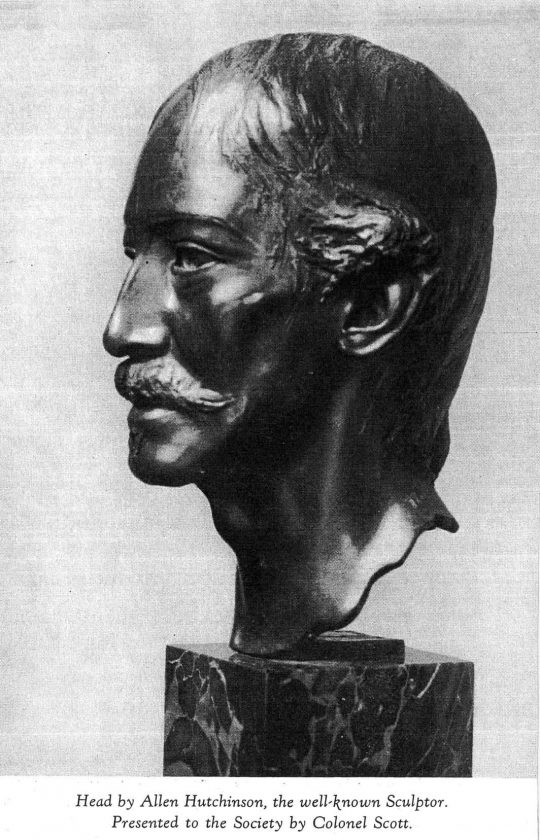
Stevenson’s only bust from life
In October, 1893, Robert Louis Stevenson took a cruise to Hawaii because he felt like it and he could. This diversion would turn out to be Tusitala’s last contact with the world beyond his Samoan domain.
For a companion and nurse, if necessary, he brought with him Taalolo, his Samoan chief cook at Vailima and a minor chief in his own right. For young islanders throughout the Pacific in 1893, a voyage to Hawaii was in the nature of a trip to Disneyland or a World’s Fair, because of all the new conveniences imported from Europe and the U.S. Taalolo wanted most to ride on the narrow gauge railroad from Honolulu to Pearl Harbor.
Much had changed in Hawaii since June 26, 1889, when RLS put it behind him aboard the trading schooner Equator, bound for the Gilbert Islands and points beyond. His old friend, King David Kalakua, had died while his consort and successor, Queen Liliuokalani was forcibly removed in a bloodless coup led by Americans. That cleared the path for Hawaii’s annexation as a U.S. territory by undermining the previous government, though we don’t believe in regime change as a policy.
Robert Louis Stevenson liked his quarters in the San Souci boarding house. It was owned by an Englishman and had a truly Bohemian feel to it, with no pretense of modern luxury. It was inconspicuous in a large grove of palm trees on Waikiki Beach. There was a large main building with the essential facilities while the guests stayed in individual small, thatch-roofed bungalows placed around it, each about 10 feet by 12 feet. The furniture consisted of bed, table and chair.
Louis and Taalolo each took a bungalow. The author’s long-standing custom was to devote the morning hours of the day, health permitting, to doing the most important writing of the day, in bed, the way Dr. Trudeau remembered him in Saranac Lake: “His long legs drawn up for a table, his head propped forward by pillows, in one hand a pen, in the other a cigarette; scribbled sheets of paper everywhere, the windows shut, the room stuffy with stove heat and cigarette smoke. So did genius take the cure.” (“A History of the Adirondacks,” A. Donaldson.)
RLS was in this morning routine position when the sculptor, Augustus St. Gaudens, made his drawings for the famous Stevenson Medallion bas-relief in 1887, less than a week before the author came to Saranac Lake. Next time you go into St. Giles Cathedral in Edinburgh, Scotland, make sure you see the largest version of this work of art in its modified form which is rectangular, the original being circular; also, the cigarette was changed to a pen. “No smoking in Church.”
Six years would pass before another sculptor came along to make drawings of Stevenson, again propped up by pillows in bed, but this time all the artist wanted was his head.
Meet Allen Hutchinson (1855-1929), an English sculptor who worked in Honolulu from 1888-97, then Australia, New Zealand and California. His account of his modelling of his life-size bust of RLS, the only one taken from life, is in Scribner’s Magazine, August, 1926. Like so many others, Hutchinson thought Stevenson was simply amazing:
“I never met a man who could extract so much out of the commonplace. He had a faculty of endowing the most prosaic individual with interest, drawing out unsuspected qualities humourously, till we all began to think ourselves rather clever people … It was in one of these bungalows that Stevenson had established himself, propped up with pillows in bed in his shirt-sleeves … It was here that I established my turntable and bucket of clay while my subject entertained his visitors. I cannot say that he was a good sitter, as he was never still …”
“The visitors were various, and I was amused at the way he entered into their idiosyncrasies … A judge of the supreme court arrived with a rather formal manner … I remember a naval officer who came with great curiosity to interview the author … I had not imagined Stevenson in the role of a theologian, but it appears he was one, as he discussed John Knox and the covenauters with a Scotch divine …”
“His appearance was always striking … He impressed me as a man of vivacious personality and a brilliant talker. He was certainly a man of wide sympathies and generous instincts. He returned to Samoa almost immediately and I had my last sitting the day before he left.”
Six months after Stevenson’s death, which would be in the spring of 1895, Hutchinson shipped “the head” as he called it to the New Gallery, London, England, for an exhibition. When that was over, it got stored away at his brother’s house for about thirty years. “I can offer no reason why it has remained all these years stored away, further than that, though I have always intended to bring it into the light, I have procrastinated.” Soon thereafter, Col. Walter Scott, President of the Stevenson Society of America, received the following letter from the sculptor in January, 1927:
“Dear Colonel Scott: I have at my studio the original bronze of Stevenson from which the working models of the replicas were cast. As a portrait it has no more value than its replica which is identical with the same.”
“There is however, to me, an enormous sentimental value in this original. It is the first cast taken in bronze from the clay which I modeled from life in 1893. It is therefore only one bronze shrinkage less than life measurement; the replicas being of necessity, two shrinkages less.”
“I have intended to keep this original but considering my age and the uncertainty of life, I would now gladly find a permanent home for it where its identity would be preserved for all time. With this purpose in view, I cannot think of a more appropriate resting place than the archives of your Society. I am therefore offering it to you, exclusively, as President of the Society, for a nominal sum with every hope that my offer will commend itself to you? With kind regards, Allen Hutchinson.”
The Stevenson Society liked the offer but could not buy it. Enter Col. Walter Scott. It wouldn’t be his first time helping the relatively new society which put up a bronze plaque to honor his contributions at the entrance to the Cottage Museum. In this case, Scott purchased the “head” direct from the artist for $300, then directly donated it to the Stevenson Society.
Col. Walter Scott was a successful NYC businessman who was born in Montreal, Canada, while his parents were emigrating from Scotland to the United States. He has no relation to Sir Walter Scott. He was a profound and very knowledgeable admirer of Robert Louis Stevenson. Just read his speeches and reports as president of the society. He was also a serious collector of artifacts beyond Stevensonia and was proud of his friendship with Charles Lindburgh, the hottest celebrity of the day.
Col. Scott invited Hutchinson to the society’s annual meeting, to be its honorary guest and speaker on August 23, 1927. The invitation was accepted.
Columns
Big meeting of the VIS
The Village Improvement Society has kept Saranac Lake beautiful over the years with the many parks throughout the ...
My first brush with history
Even though I was always a logophile and I taught English for a year or two, my first love in academe was ...
Image of the Week, from Historic Saranac Lake
5W Wednesdays, from Historic Saranac Lake
Making sure all bellies are full
I am obsessed with food. I’m not talking about just eating it, though that is a very important element. I make a ...