Father Damien and Dr. Hyde, Part II
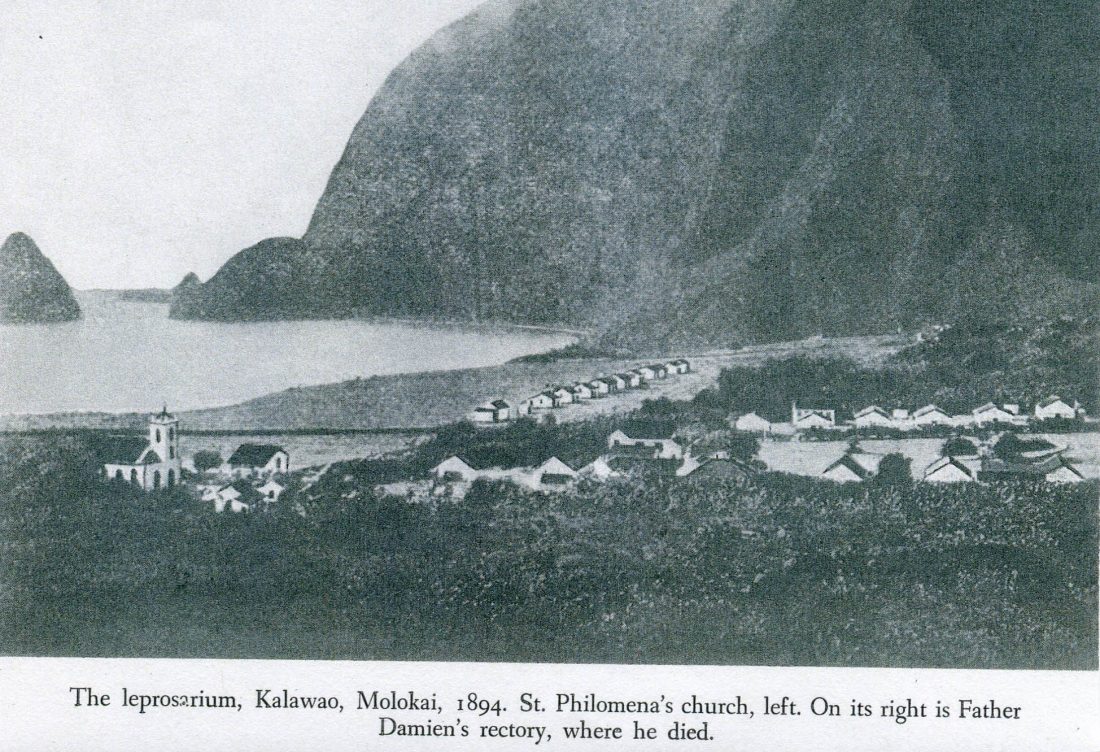
The story of Damien de Veuster is that of a typical 19th century Flemish peasant, that is, until he became a Catholic priest in the Fathers of the Sacred Hearts, a brotherhood certified by Pope Pius VII in 1817. In 1825, this brotherhood was tasked with the conversion of the peoples of Oceania or the South Seas, where they had made great progress in spite of the protestants by the time Father Damien went there.
Joseph de Veuster, the future Father Damien, was born and baptized on Jan. 3, 1840, in the Belgian town of Tremeloo. Going by the name of “Jef,” he was next to the last of eight children born to Francis de Veuster and Anne Catherine Waustere, upper class peasants who grew and sold grain.
Catherine was intensely religious and passed it on to her children who did not resist. When God told her to commit half of them to the service of God, they didn’t question it. As a young boy, Jef was already wandering away from playmates to hang around the local church. His schooling began at age seven, involving a daily four-mile round trip by foot to do it. He was ten when he made his first communion on Palm Sunday. By 13, Jef’s schooling was done, which meant returning full-time to work the family farm with his father.
“Work was practically a game for him. He was growing tall and strong. Soon he was taller than his older brother Leonce and so strong he could lift 100-kilo bags as though they were nothing. His father used to say he was handy and smart enough for four boys.” (The Heart of Father Damien, Vital Jourdain, 1955.)
They say that for Damien, hard work was a form of worship and that his physical prowess was literally remarkable but that his peasant dirt farmer appearance would give ammunition to his detractors, like Dr. Hyde.
In 1859, Joseph de Veuster joined up with the “Fathers of the Sacred Hearts” but was criticized about “his rudeness in manner and appearance and his gross ignorance of Latin or any other languages” said a superior. That could have shut the door on his hopes for the priesthood but his persistence finally gained him entry into the class of student novices and nothing was going to stop him now. On Oct. 7, 1860, Jef took his vows at the brotherhood’s headquarters at 31, Rue de Picpus, Paris, France.
In 1863, the “Fathers of the Sacred Hearts” were appealed to directly from St. Peter’s in Rome, to provide missionary reinforcements for Hawaii. Six priests and 10 sisters were chosen to leave for Oceania in October. Damien wasn’t one of them but his brother, Pamphile, was until Pamphile came down with typhus just before shipping out. With some fast footwork and talking and with his brother’s consent, Damien took his place just in time. Damien was one of those lucky maritime travelers who don’t get seasick.
Oct. 31 was the big day for these Catholics when they left Bremerhaven in their wake aboard the “R.M. Wood,” a ship flying the Hawaiian flag. It would be an incredible journey today but it was normal back then. They sailed south down the entire length of the Atlantic, to the ship graveyard called Cape Horn, then through the Straits of Magellan and then northwest crossing the endless Pacific for a long time. The entire voyage would take four and a half months. For the “R.M. Wood,” this was her eighth time running the Straits.
The Germans were operating this Hawaiian mission ship and they were all Protestants and for the first time in his life, at 23, Father Damien was surrounded by non-Catholics. It was not a volatile situation; in fact, everyone was civil and the majority sect politely indulged Damien in his attempt to convert them. He failed of course, but he had learned the lesson that we live in a world of alternative facts.
On March 19, 1864, the “R.M. Wood” rounded Diamond Head and was soon anchored in Honolulu harbor. After having survived several storms, Damien could write in his journal at journey’s end that “Joy has been the keynote … I made the voyage joyfully … I have never laughed so much as at sea.” That sounds like someone else: “I was so happy on board that ship … My heart literally sang; I truly care for nothing so much as for that,” said Robert Louis Stevenson about his voyaging. It’s too bad they never got to meet.
There were 40 missionaries in the field when Brother Damien arrived and a district called “Puna” had been selected by his superiors to be his personal sphere of influence. Puna is one of six districts on the Big Island and there Damien would spend several years becoming a seasoned priest. Then he moved onto other districts, Kohala and Hamakua, accumulating knowledge and experience along the way. By 1873, Damien might have assumed that he had seen it all, including a cataclysmic volcano eruption complete with earthquakes and tsunamis. But there wasn’t much that the Vatican could have taught him nor previous experience prepared him for, when it came to his next mission, the one the missionary said was his real mission, the one at Molokai.
In his story, “The Bottle Imp,” Robert Louis Stevenson calls leprosy or Hansen’s disease, “mai-pake”–“Chinese evil,” which is the Hawaiian nickname for the disease, presuming the Chinese were to blame, but its real origin remains unknown. By 1863 leprosy in the Hawaiian archipelago was getting out of hand and the “lepers” required government attention.
The Chinese had brought with them their beliefs and superstitions about this disease which mingled into the collective Island mindset so that when fear of the disease rose with an epidemic of it throughout the Islands, the afflicted were suddenly seen as subhuman beings for whom leprosy is divine punishment for engaging in necrophilia but not limited to that, but as punishment for all kinds of sexual license. By the 1880s, it was widely believed that leprosy was an advanced form of syphilis.
So after Jan. 3, 1865, by royal decree, if you were one of them, anywhere in the kingdom of Hawaii, you were an outcast subject to arrest, hunted down with dogs if needed, and forcibly deported by a government ship to a desolate strip of land surrounded by ocean and really high cliffs. It is still called Kalawao, on the northside of Molokai, the Island.
If you are the type that likes to study communities of people under conditions of stress, then you would have loved watching the leper colony at Kalawao descend through its stages of moral collapse. A big sign in red letters at the entrance to the place said: “Ade Kanawai ma reia wahi”–“In this place there is no law!” Kalawao was not a family friendly place. Vice seemed to be the main source of income among the inmate population for whom prostitution, including children, paid for a lot of room and board.
The depravities of this place have been listed more than once but there was a group who had not given up on decency. Among them were some hard-core Catholics who were longing for a chapel, but most of all a priest, a full-time 24/7 priest. They believed the salvation of their souls depended on it.
Father Damien answered their prayers. On May 10, 1873, he went to Kalawao to stay. He never stopped working until he died of the disease himself in April, 1889, at age 49. At the time, Robert Louis Stevenson was not far away and was on his way there to meet him. Upon hearing that Damien had passed on, the invalid author from Scotland decided to go there anyway.
To be continued.
Columns
Big meeting of the VIS
The Village Improvement Society has kept Saranac Lake beautiful over the years with the many parks throughout the ...
My first brush with history
Even though I was always a logophile and I taught English for a year or two, my first love in academe was ...
Image of the Week, from Historic Saranac Lake
5W Wednesdays, from Historic Saranac Lake
Making sure all bellies are full
I am obsessed with food. I’m not talking about just eating it, though that is a very important element. I make a ...