Vailima
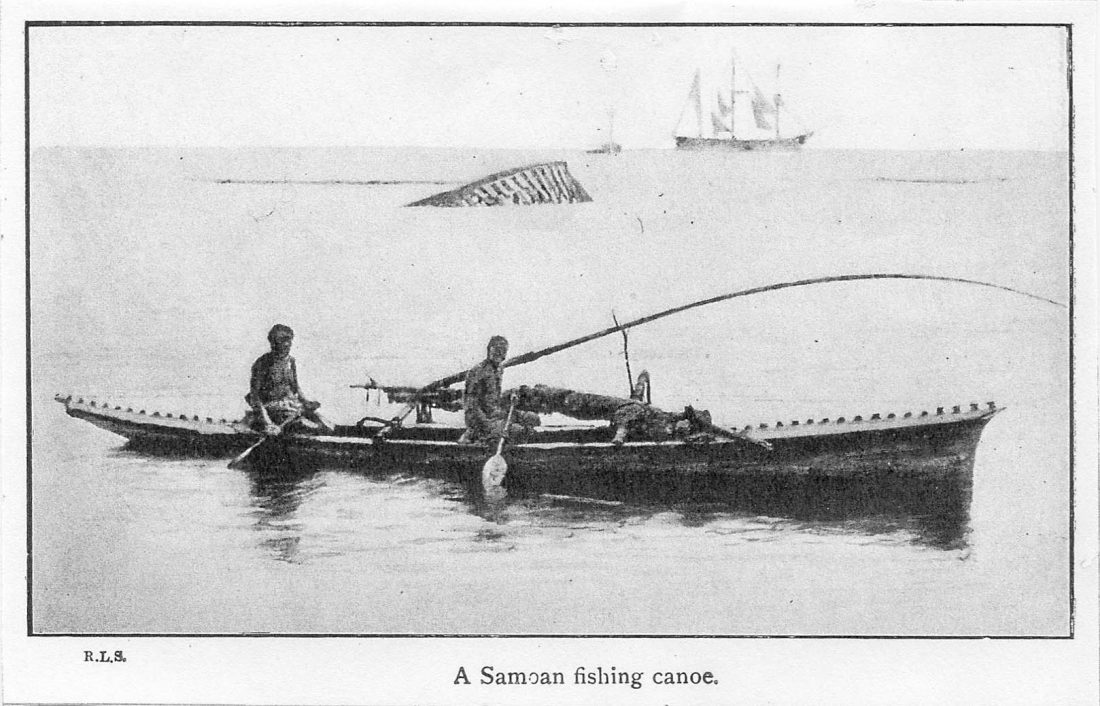
“I am so pleased with this climate that I have decided to settle; have even purchased a piece of land from three to four hundred acres … and shall only return next summer to wind up my affairs in England; thenceforth I mean to be a subject of the High Commissioner.”
— Robert Louis Stevenson to Dr. T.B. Scott, Apia, Jan. 20, 1890
Robert Louis Stevenson and his fellow travelers had been on the Samoan island called Upolu for less than a month when Louis realized from that brief exposure that everything Mr. Seed had told him about the place was true. Mr. J. Seed was a government official from the island nation of New Zealand when he had talked to a younger RLS at the latter’s family home in Edinburgh, Scotland, in 1875. Speaking directly to Stevenson’s health issues, Seed had told him that he had to get away from Europe, that the Navigator Islands (Samoa) were the best place for people with respiratory problems, that they presented an “absolute balm for the weary.”
There was another good reason to stay there. As a professional author, Stevenson needed a South Seas headquarters that provided reliable communication with the outside world. Samoa had regular mail steamers, Sydney to Auckland to San Francisco plus regular German service to Australia.
A cable entrusted to a mail boat’s purser would reach London via Auckland within a week. Only Honolulu could compete with that, but Stevenson didn’t like Hawaii because it was already too westernized and, he said, too cold. Louis was apparently finely tuned to tropical temperatures and had discovered that for him, warmth was the key to feeling good. Samoa seemed to have it just right.
However, settling down in a brand-new exotic setting where a degree of civilization could only be found in the row of buildings along the wharf, which was the town of Apia, could have been incredibly difficult for any white man new to the place unless he was in good with the Germans. Of the three western colonial powers–Germany, England and the U.S.–who were playing culture conquest there at the time, Germany temporarily had the advantage with their efficient Long Handle Firm, an economic branch of Berlin.
Fortunately, RLS had encountered an American, Harry J. Moors, from Michigan, as soon as he had arrived in port. Moors was a businessman with a Samoan wife who had established considerable influence in the Islands with a chain of trading posts and was in effect, a banker, import agent and local politician, all at the same time. It isn’t surprising that Moors also fell under the spell of the charismatic Stevenson persona and offered the new arrivals all the assistance he could provide.
Having made his momentous decision to settle in Samoa, finding a suitable location was next on the agenda. Stevenson already knew of one place from a conversation he had had in San Francisco with William Churchill, a former U.S. consul in Samoa. Churchill had described a plateau up the mountain behind Apia, reached by a steep path and well-watered by a number of streams, even two waterfalls and with a fine ocean view. Since Apia is on the windward side of the island, the tropical humidity up there is mitigated by a constant sea breeze. Another feature on this property was a dead volcanic peak called Mt. Vaea.
After inspecting a few other locales on the island, RLS decided upon Churchill’s recommendation, this shelf up on the mountain, three miles inland from the harbor and 800 feet above sea level. The land was covered with thick, impassible jungle which would have to be cleared at great expense. Soon it became known that this property came with a rather intangible asset that would guarantee a degree of privacy in this new and last home of the invalid author from Scotland. The whole plateau was believed by the superstitious local population to be haunted by “aitu,” demon ghosts of both sexes and very unpleasant who were led by a succubus, a female demon that kills men who have intercourse with it in their dreams.
And so it was that Robert Louis Stevenson commissioned Harry Moors to tackle the long and expensive task of turning jungle into plantation. Growing a cash crop was at the beginning part of the plan, since Stevenson’s wife, Fanny, was endowed with a powerful green thumb. In his book, “With Stevenson in Samoa,” 1910, Moors writes:
“After I had bought the Vailima land for Stevenson, it was arranged that I should build him a house upon it, a temporary structure, in which the family might live pending the erection of a more commodious building. It was a very cheap affair, with but three or four rooms. Meantime, Stevenson, accompanied by his wife and Lloyd Osbourne (stepson), went off on a jaunt to Sydney. It had long been his desire to visit Australia, and he thought this would be a good opportunity.”
RLS had another good reason to go to Sydney. His stepdaughter, Isobel Strong, better known as “Belle,” had gone there from Honolulu to wait for word from her family — pending their arrival, if they arrived — in Samoa at the end of their six-month cruise aboard the trading schooner Equator. She had refused to join them on the cruise so that her 9 year old son, Austin, would not be left alone in a boarding school. Many years later when Belle got around to writing her wonderful autobiography, “This Life I’ve Loved,” she recalled that happy reunion in Sydney’s Oxford Hotel:
“It wasn’t long before Louis, Lloyd and my mother were talking excitedly about their trip (Joe Strong, her artist husband, had preceded them to Sydney). Their most surprising news was that Louis had bought three hundred acres of land on an island called Upolu, one of the Samoan Group. The travellers burst into raptures about the beauty of the place; the rich soil, the five rivers that would give the name Vailima to their new possessions. The climate was perfection; the natives the handsomest they had met anywhere.”
Before illness struck RLS again in Sydney, he went to a tailor to replace his western style clothing that had not survived his many months at sea. The black cape with hat in the Saranac Lake collection have their provenance in that shopping spree.
It would take a lot of time, money and labor to clear enough jungle to build the first and then the second section of the main building. For over a year, Mr. and Mrs. Robert Louis Stevenson would live in the small temporary house Moors had built. In the meantime, Lloyd was sent back to the United Kingdom to oversee the very expensive task of shipping seven tons of furniture, etc. from 17 Heriot Row in Edinburgh, and “Skerryvore” in Bournemouth, halfway around the world via the Suez Canal. Stevenson’s mother, Margaret, would accompany him on the return trip and remain with her only son at Vailima until his death.
Vailima, was a palace by the South Seas standards at the time. If you wanted to build a rich white man’s house in Samoa, in 1890, you had to import everything. Sawmills and rolling mills were nonexistent. Every nail, sheet of iron, pane of glass and the best hardwoods, teak and mahogany, had to be imported from the Colonies or the U.S.
Today, Vailima is a museum showpiece. It opened in 1994, just in time to celebrate the centennial of Stevenson’s death. At the request of the Samoan people, three rich American businessmen took charge of its preservation after it was badly damaged by a typhoon in 1988. There is a third section today which was built after RLS was buried on the summit of nearby Mt. Vaea, in 1894.
The Vailima foundation has money, something the Stevenson Cottage, in Saranac Lake, has not had enough of since the Great Depression, with the exception of Mr. Albert Gordon’s wonderful contribution in 2004 which paid for the excavation of a cellar with a real foundation topped off with a central heating system which the Stevenson Society of America can’t afford to use. What they don’t have at Vailima is genuine Stevenson memorabilia from his last years there. The best assembly of RLS artifacts from Samoa in the world have been here in Saranac Lake, on Stevenson Lane, for over a century, one more reason why they call it the “World’s Finest Collection of Stevenson Lore.”
Columns
Anti-speeding tech has huge benefits for fleet operators
Over the past few years, I have written several articles on “Intelligent Speed Assistance” (ISA) and how it can ...
Shakshuka
Big meeting of the VIS
The Village Improvement Society has kept Saranac Lake beautiful over the years with the many parks throughout the ...
My first brush with history
Even though I was always a logophile and I taught English for a year or two, my first love in academe was ...
Image of the Week, from Historic Saranac Lake