
Grez, part III
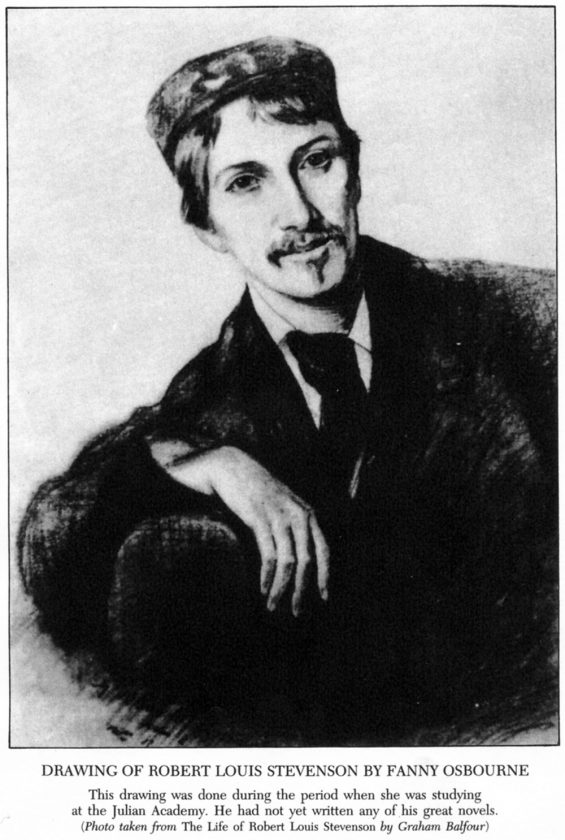
“So here for the first time Stevenson saw the woman whom Fate had brought half-way across the world to meet him. He straightway fell in love; he knew in his own mind, and in spite of all dissuasions and difficulties, his choice never wavered. The difficulties were so great and hope so remote that nothing was said to his parents or to any but two or three of his closest friends.”
So said Dr. Graham Balfour in his biography of his cousin, the Life of Robert Louis Stevenson, 1901. It is the first of its kind and apparently not very good considering all the attempts to outdo it, a list of which would make a book in itself. In his preface, Balfour explained that “Mrs. Stevenson requested me to undertake the task. The reason for this selection was that, during the last two years and a half of my cousin’s life, I had on invitation made Vailima (Stevenson’s home in Samoa) my home and the point of departure for my journeys, and, apart from the members of his own family, had been throughout that period the only one of his intimate friends in contact with every side of his life.”
In 1887, after the death of the author’s father, Thomas Stevenson, it was the doctor in Graham Balfour who had suggested a radical change in his cousin’s routine as a preventative health measure. In the words of Stevenson’s wife, Fanny, “We were soon ready to start for Colorado, recommended by Dr. Balfour as the most suitable place for my husband, and at the same time, offering the different surroundings that were thought necessary for his mother.”
The attempt by the so-called Stevenson expedition to execute the Balfour plan by going to the Rockies was thwarted by Fate which had instead sent them north where to everyone’s surprise, Robert Louis Stevenson and his family would end up in Saranac Lake, sharing the home of the Bakers for the winter of 1887-88. In a sense, what would become the literary shrine at the end of Stevenson Lane, began with an idea in the head of Graham Balfour in England over a 131 years ago. It is, therefore, altogether fitting that this other cousin of RLS ended his days as one of four British Representatives of the Stevenson Society of America in Saranac Lake who were intimates of the society’s namesake.
Getting back to his RLS biography, Balfour says, “But in the meantime life took on a cheerful hue, and the autumn (1876) passed brightly for them all until the middle of October, when Stevenson must return to Edinburgh, there to spend the winter.” “Transition–1876” is the title of Chapter VII in Balfour’s RLS book. In it, he gives attention most to the progress in his cousin’s chosen career, to be a paid writer, and says little about the new adventure Stevenson began almost immediately upon his return to Grez-sur-Loing at the end of his canoe trip in France with his friend, Bart. People still read about it today in Stevenson’s first book, An Inland Voyage.
Here in this picturesque French village with its castle ruins and medieval bridge “of many sterlings,” Robert Louis Stevenson succumbed to the one love in his life strong enough to be equal with his love of writing and she came with baggage. Mrs. Fanny Vandegriff Osbourne, though married, was legally separated. She had two children, had ten years on Louis, was American! And, of course, had no money. Cousin Bob had introduced Louis to Fanny earlier that summer in the garden behind Chevillons inn. If Bob had harbored a vindictive strain, his match-making here could be construed as a clever and cruel revenge on Thomas Stevenson, his uncle. Thomas had wrongly branded Bob as a “blight” and a “mildew” who was deliberately corrupting his son, Louis, and so was banished from his cousin’s presence with the advice “never to see him between the eyes again.” Fanny, who packed a derringer and rolled and smoked her own cigarettes, wasn’t exactly what Thomas and Margaret Stevenson were hoping for in a daughter-in-law. That might be why Balfour wrote, “nothing was said to his parents or to any but two or three of his closest friends.”
Louis had spent most of the summer of 1876 in his hometown, Edinburgh, Scotland, and some of it at Swanston Cottage, the family summer residence in the country. To judge from his own words, Fanny already had a permanent role in his daily mental activity, ever since their brief meeting earlier on that summer. In her autobiography, This Life I’ve Loved, by Mrs. Isobel Field, Stevenson’s stepdaughter, she said in reference to that meeting which happened right in front of her, “Years afterwards, he told me he had fallen in love with her there and then.”
According to Stevenson biographies and historical novels about Fanny, it wasn’t love at first sight of Louis for the future Mrs. RLS. She had an eye for Bob while the young men throughout the colony had eyes on her, “la belle Americaine,” Fanny’s village nickname. The summer of 1876 would be one of confused romantic waverings between Bob who was attracted to Fanny and felt conflicted because he had the same feelings for her daughter Isobel–‘Belle’–who also liked Bob until she discovered she liked Frank O’Meara, the Irish painter, even more. It got serious, serious enough for Fanny to intervene and ask Frank for his definition of commitment. Frank O’Meara, unlike most of the artists in Grez at the time, remained there to paint for many years. He died young but not before creating works which can be seen in collections around the world.
By late September, Fanny had come around to understanding that her attraction to Bob was perhaps infatuation, a most pleasant distraction from the grief that had brought her and her two children to Grez in the first place, that being the recent and agonizing death of her youngest son, Hervey, to disease. He was only five. Bob and Fanny were together much that summer and friendship bloomed on painting excursions in the forest and around the village, boating and swimming on the river with the other aquatic-loving ‘Anglais,’ hanging out in the garden of the inn after dinner and talking shop with the rest and even getting lost in the woods one night. A constant theme had developed in Bob’s conversations with Fanny, that when his cousin Louis returned to Grez, that fall, she should give him a close look. That she did and the rest is history. Readers wanting details in novel form can go to books like “A Romance of Destiny: Fanny Stevenson” by Alexandra La Pierre or “Under the Wide and Starry Sky” by Nancy Horan.
Here it’s enough to say that when Stevenson returned to Grez after his canoe voyage in late September, until his return to Edinburgh in November, Louis and Fanny were together much. Her kids, Lloyd, who called him ‘Luly’, and Isobel were sold on him immediately. Stevenson had a way with children because he remained a child all his life. In later years, Lloyd reflected that, “R.L.S. always paid children the compliment of being serious, no matter what mocking light might dance in his brilliant brown eyes and I instantly elected him to a high place in my esteem.” J.M. Barrie it was who discovered Peter Pan inside his thin-chested friend, R.L. Stevenson AKA The Penny Piper of Saranac.
Will H. Low, Stevenson’s American painter friend, sensed a change going on and said in his book, “A Chronicle of Friendships,” “Of the events of the next few weeks I was not a witness … and on my subsequent visits to Grez, an inkling of the state of affairs, in so far as my friend was concerned, dawned on me…and in our return to Paris, when later in the season Louis appeared, his daily pilgrimages from our quarter to the heights of Montmartre told the story clearly and for male companionship Bob and I were left alone.”
Back in Edinburgh, Thomas and Margaret, the parents of Robert Louis Stevenson, might have been wondering why their only son had a new forwarding address in Paris. Maybe he didn’t even tell them and with good reason, that he was spending more time at 5 Rue Donay and had started a new essay he would call “On Falling in Love.”
Columns
5W Wednesdays, from Historic Saranac Lake
Making sure all bellies are full
I am obsessed with food. I’m not talking about just eating it, though that is a very important element. I make a ...
Kugels and Gratins Celebrate Spring Festivals
Vehicle and traffic laws vary from state to state
If you are a regular reader of these weekly articles, you might have picked up on my call for vehicle and traffic ...
Park association opposes bill
Page one of the The Adirondack Daily Enterprise was jam-packed with local news on Monday, July 10, 1961. What ...
Dealing with swollen glands
Parents have recently been asking me some swell questions about their children having swollen glands. Let me ...