
Grez, part 1
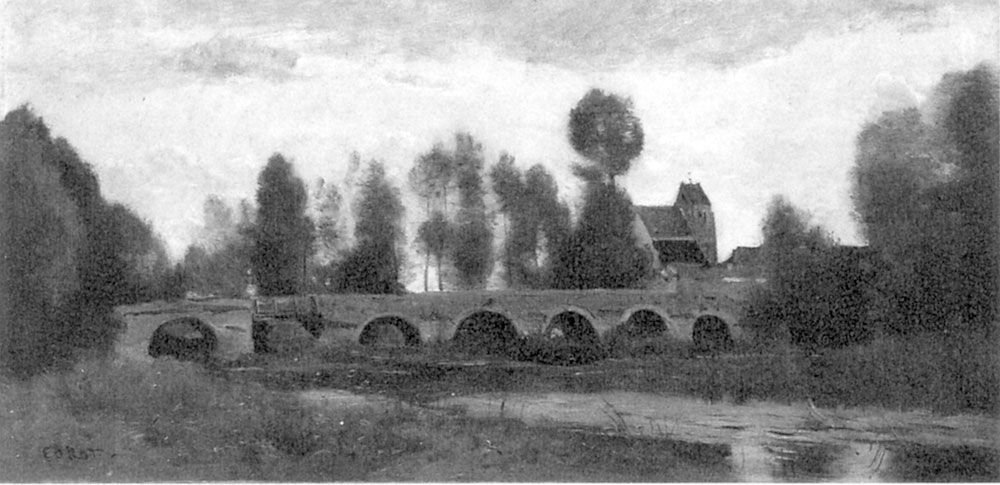
“The Bridge at Grez-sur-Loing” by Camille Corot
“Stevenson fought against all odds for the wife of his choice as he had done for his profession. From the first moment they met, at the little village of Grez in the forest of Fontainebleau … until their marriage in San Francisco three years later, he surmounted one obstacle after another.”
— Robert Louis Stevenson, Mrs. Isobel Strong (later Mrs. I. Field). 1911
—
The Stevenson Society of America was fortunate from the very start, in 1916, when the two stepchildren of Robert Louis Stevenson, namely, Lloyd Osbourne and Mrs. Isobel Field, became prominent members and primary donors to the world-famous collection of Stevenson memorabilia enshrined at Baker’s, better known as the Robert Louis Stevenson Memorial Cottage in Saranac Lake.
People who know the story of RLS feel right at home with Lloyd and Isobel because they are part of the story. For example, open up a copy of “Treasure Island” and you will see that Lloyd is the dedicatee and there’s a good reason for that. When his days were numbered on his island home down under, Louis was dictating many of his last words to Isobel, better known as “Belle,” his amanuensis. With the exceptions of their own mother and Stevenson’s mother, no one knew the author better than the kids — not even Sidney Colvin or W.E. Henley — because they shared in his adventures right up the very end on the top of Mt. Vaea, “under the Wide and Starry Sky.” In 1911, Belle gave us her own biography of RLS and in 1937 she published her autobiography, “This Life I’ve Loved,” an autographed copy of which sits on a shelf at Baker’s next to her parasol. She died in Santa Barbara, CA., at the age of 93, having outlived her second husband, Salisbury “Ned” Field, and her younger brother, Lloyd.
Belle was only 17 when she had her first encounter with Robert Louis Stevenson. She was with her mother, Mrs. Francesca–“Fanny”–Van de Grift Osbourne, sitting at the end of the very long table set up in the garden behind Chevillons inn beside the river Loing, which flows past the little French village of Grez, 45 miles southeast of Paris. What they were doing there and how they got there in the spring of 1876 became material for historical novels, the most recent of which is “Under the Wide and Starry Sky” by Nancy Horan, 2014.
At the heart of it was Fanny’s ambition to pursue art for her own gratification but more importantly, to give Belle a chance at it, too, while giving all three of her children exposure to European culture. Fanny and Belle were usually taken for sisters and studied art at the famous School of Design in San Francisco. When Fanny could no longer stomach the presence of her philandering husband, Sam Osbourne, she blew off protests and warnings from every direction and with her three children in tow– Belle (16), Samuel Lloyd (seven), and Hervey (4)–chartered a course east to start a new life in the Old World. And Fanny made Sam pay for it but it was a small budget which too often came up short and finally ran out.
Step One was the long train ride in nine changing trains from San Francisco to New York City. Step Two was boarding the steamship The City of Brooklyn bound for Liverpool, then to Antwerp, Belgium, their destination where Fanny knew no one and knew only English. Step Three backfired when she went to enroll at the Academy of Painting. After showing the director her art samples he told her that she should have been a boy because no girls were allowed in his school. Then came tragedy. Fanny’s youngest, Hervey, was stricken with a strange and ghastly disease that killed him slowly for months, during which time the family had moved to Paris in search of a miracle doctor. When the end finally came the boy’s last words were “Lie down beside me.”
Imagine that. Henry was buried on April 8, 1876, and it was on account of the magnitude of Fanny’s grief that an American friend and fellow art-student suggested the quiet village of Grez as a good place to retire for repairs. Belle recalls the occasion in her book when the friend, a Mr. Pasdesus, told her mother, “I thought of it for you because it was so quiet and peaceful.”
“That is what I would like,” said my mother. “I hope there won’t be many people there this summer.”
“It isn’t likely. Mr. Low–Will H. Low, the painter and the two Stevensons are often there. They are cousins, Bob and Louis. One paints and the other writes, neither of them very successfully, I imagine, but they are pleasant fellows. I think you would like them.”
“Louis Stevenson!” wrote Belle in her book. “That was the first mention of a name that would mean so much to us.”
Fanny and her two surviving children were early arrivals at Grez, the summer crowd had yet to arrive and the threesome had Chevillons inn pretty much to themselves for a spell and got friendly with the proprietors, Madame Chevillon and her niece, Ernestine. Belle helped Ernestine in the kind of chores that keep inns operating and “They taught me,” she said, “to make drip coffee, to turn a perfect omelette, to mix a salad, and when there was a roast I was allowed to turn the spit before the open fire in the taproom.”
“My mother found at Grez all that she wanted of quiet and beauty. She set up her easel by the river and started a painting of the old bridge backed by poplar trees against a gray sky. I was to see many versions of that composition, for artists came from far and near to paint it.” Meanwhile, young Lloyd, future president of the Stevenson Society of America, in Saranac Lake, was living to fish. He had learned from experience that for him, the best place to fish in Grez was from that bridge. According to his sister, Lloyd “sat there day after day with pole and line. The peasants, passing the little blond boy on the bridge would wish him good day and ask his name. Not understanding, he always answered, ‘Fish.’ Before long he was known to the whole village as ‘Petit Feesh.'”
“Then, when we were beginning to feel as though the place belonged to us, a stranger appeared; an artist, evidently … slim and dark … odd and foreign looking … a sort of gentleman gypsy, and were we surprised when he greeted us somewhat formally in English.” It was R.A.M. Stevenson, Cousin Bob, one of the “two Stevensons” their friend Pasdesus had mentioned. What was not apparent to Belle and her mother at first sight of Bob was his intent — to get rid of them.
Columns
5W Wednesdays, from Historic Saranac Lake
Making sure all bellies are full
I am obsessed with food. I’m not talking about just eating it, though that is a very important element. I make a ...

Kugels and Gratins Celebrate Spring Festivals
Vehicle and traffic laws vary from state to state
If you are a regular reader of these weekly articles, you might have picked up on my call for vehicle and traffic ...
Park association opposes bill
Page one of the The Adirondack Daily Enterprise was jam-packed with local news on Monday, July 10, 1961. What ...
Dealing with swollen glands
Parents have recently been asking me some swell questions about their children having swollen glands. Let me ...