‘A spirit intense and rare’: From the poem ‘RLS’ by W.E. Henley
-
- Illustration from ‘The Master of Ballantrae’ (Image provided)
-
- Illustration from ‘The Master of Ballantrae’ (Image provided)
Illustration from ‘The Master of Ballantrae’ (Image provided)
Robert Louis Stevenson was rarely seen in Saranac Lake in that winter of 1887-88. His Adirondack exile had been coincidental with his rise to stardom on this side of the Atlantic, and he was riding the crest of the American craze over his recent shocker of a novelette, The Strange Case of Dr. Jekyll and Mr. Hyde. And his friends back in England didn’t like it. Said Sam McClure, Stevenson’s second American publisher:
“Well, I went to London and there I found that most of Stevenson’s set was very much annoyed by the attention he was receiving in America, a most extraordinary spirit of hostility and jealousy. They were resentful of the fact that Stevenson was recognized more fully, more immediately, and more understandingly in America than in England at the time. It was a most curious evening … They had all believed at that time that every American was ignorant, that Stevenson deserved great praise and high consideration for his efforts, but that still we didn’t know anything and were simply gone wild without appreciating his real greatness!”
The American love of celebrity was going strong in 1887. Robert Louis Stevenson had only been in the limelight for 26 days when he arrived in Saranac Lake as reported in the newspapers. The author’s world had been turned upside down but in a good way. Who doesn’t want success? As small and skinny as Louis was, he had depth. He was too full of fundamental understanding and genuine humility to be taken in by the glitter of fame. From Baker’s he wrote about it to his college crony, Charles Baxter, a member of “Stevenson’s set” mentioned above by McClure:
“I know a little about fame now … I have been made a lot of here, and it is sometimes pleasant, sometimes the reverse; but I could give it all up and agree that was the author of my works, for a good 70-ton schooner and the coins to keep her on.”
Stevenson just didn’t like the attention. The money was welcome, but an adoring public was a little over the top and the competition for his attention had followed him from New York City to his “Hunter’s Home” in the great North Woods. Bertha Baker, one of the twin sisters sharing that home with the author, was 15 when she said this in a school essay:
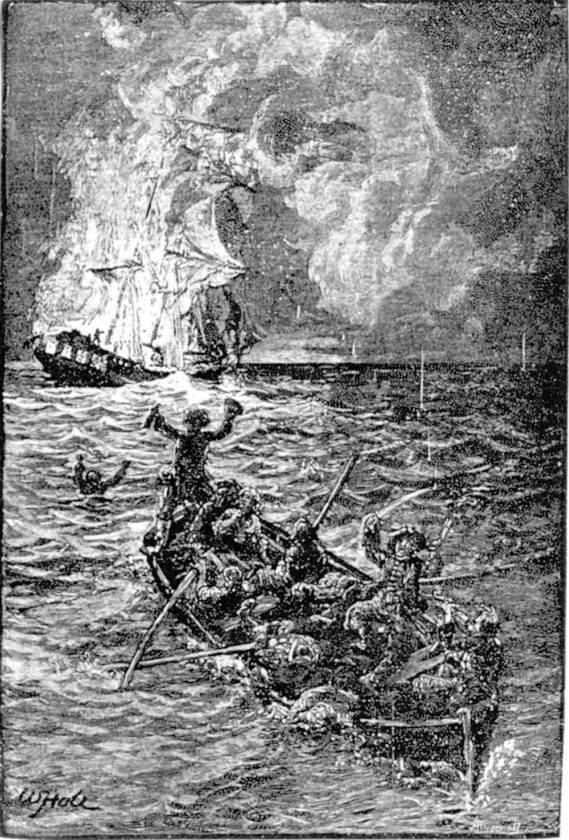
Illustration from ‘The Master of Ballantrae’ (Image provided)
“The author cared little for company and made few acquaintances. Many hearing of the presence of the distinguished novelist would call upon him but Mr. Stevenson always declined seeing them. Even well-known people would be turned away without an interview. He would often say, ‘I should think people would know that I am here for rest and do not care to be troubled,’ and to emphasize his statement he would don his reefer coat and fur cap and go off over the fields on his snow shoes.”
Note that Bertha specified “over the fields,” not downtown. Back then the tree line of the forest was farther up toward Baker Mountain and there was considerable space — fields, woods, river, pond and no people–solitude. Stevenson’s reception in the U.S.A. had given him a new appreciation for the word.
Tradition has handed down the number six for the number of times Saranac’s resident author, RLS, actually went downtown, which wasn’t much — the town that is. Three of those occasions allegedly involved visits to see his friend George Berkeley, the innkeeper who had brought the dog named Sport to the Hunter’s Home. There was also the well-known visit by the writer to his doctor’s laboratory on the corner of Church and Main. There the sight of scum in a Trudeau test tube had sent Stevenson out the door in a hurry, telling his host that “your lamp is very bright but to me it smells of oil like the devil.” And then there was the dinner party at which Dr. Trudeau and Stevenson were the guests of the wealthy Coopers on Main Street.
And finally, to make six, there was the church supper for St. Luke’s at the old Berkeley Hotel. Stevenson’s mother had joined the congregation and had told her new friends, including Mrs. Estella Martin, to expect her son to attend the event, knowing that it would increase ticket sales which it did. Naturally, Louis didn’t want to go when the time came, but his mother made him do it. Quoting again from “The Penny Piper of Saranac,” by Stephen Chalmers:
“Robert Louis refused to be a party to the party. ‘Good heavens!’ he exclaimed, ‘They might ask me to make a speech!’
“In the end the ladies had to kidnap him bodily. At first he was silent, even morose, when he took his seat at the supper table in the old inn: but suddenly the humor of the situation struck him and his chameleon-like mood changed color. He threw himself into the affair with a spirit that was more Stevensonian than churchlike. He not only proceeded to enjoy himself, but helped to make that church supper a memorable success: and before he escorted his mother home, he insisted upon making a speech.
“All record of that speech is lost — more’s the pity! Mrs. Martin does not remember just what he said but ‘It was – like him.’ No doubt it was!”
“It was — like him,” she said. One might explain away that remark as an example of rural mentality celebrity infatuation. A counter-claim could be made that the old farmhouse on Stevenson Lane is, in truth, the temple of a personality cult commonly mistaken for a literary museum. Several intimates of our subject lived long enough to join in the effort to establish Baker’s as a permanent memorial to him. Their motivation went deeper than admiration for his skill as a wordsmith and they would have understood exactly what Mrs. Martin meant when she said that RLS was so like himself.
“Character! Character is what he has,” said Henry James, of his friend Robert Louis Stevenson. If that character was here today, he would be an online sensation without writing a single book. RLS radiated something ineffable that people liked. So many of them wrote about the experience that it seems compelling to think that this skinny, smoking, coughing Scot was charisma on steroids incarnate.
Go online and see how long it takes to get tired of counting Stevenson biographies and spin-offs. The material is so rich that writers just can’t quit. In the prologue of one is a glimpse at the appeal:
“This life was active as a waterbug,
Romantic as an elopement,
Wide-ranging as a tramp ship,
Dramatic as a duel to the death.”
Voyage to Windward: The Life of Robert Louis Stevenson, J.C. Furnas
The marriage of Robert Louis Stevenson to the recently divorced Fanny Van de Grift Osbourne, 10 years his senior, has been a source of consternation for some writers, but for literature it was made in heaven. Few people realize or care how much of Stevenson’s writing was influenced by his secondhand family, namely Fanny and her children, Lloyd and Isobel.
Lloyd was 8 and Isobel 17, when their married but separated mother started seeing a younger man. An unpublished letter by Isobel in the archives at Baker’s takes you there:
“Louis Stevenson and I were sitting on the floor before the fireplace playing that old game of finding pictures in the coals. … It was years ago in France (1876). My mother had taken a little flat in Montmartre, that most picturesque part of old Paris, and here Louis had climbed four flights of slippery, waxed stairs to take her out to dinner. While she was dressing, he joined me on the hearth rug … Louis was in his mid-twenties – a vivid slender young man with yellow hair and blazing dark eyes. He was so vitally alive that other people seemed colorless beside him. No one ever said of R.L.S., ‘I don’t remember whether I ever met him or not.’ He made an instant impression that was unforgettable.”
People who were close to RLS or even not so close were very eloquent in their individual praises of his exemplary humanity. Those who lived to join the memorial project at Baker’s fused their collective recollections and distilled them into this summation incorporated into a 1920 revision of the Stevenson Society mission statement:
“His genius was so universal, his philosophy so boundless, that no one country can claim him, he belongs to the world.”
“His exquisite humor, his kindly sympathy and dauntless courage, coupled with his literary talent created for him a distinctive place in the mystic shrine of fame.”
Columns
Big meeting of the VIS
The Village Improvement Society has kept Saranac Lake beautiful over the years with the many parks throughout the ...
My first brush with history
Even though I was always a logophile and I taught English for a year or two, my first love in academe was ...
Image of the Week, from Historic Saranac Lake
5W Wednesdays, from Historic Saranac Lake
Making sure all bellies are full
I am obsessed with food. I’m not talking about just eating it, though that is a very important element. I make a ...