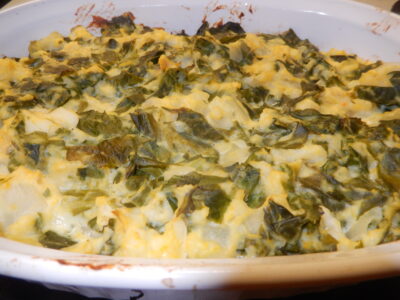
Go wild with ramps
Yes, it snowed last week. But daffodils are blooming. The grass is green; the trees are leafing out, shadbush is in bloom and flowers adorn gardens. Spring is in full swing even in the North Country. Walking through open woods at this time of year, you may see patches of wild leeks pushing up through last year’s decaying leaves.
Ramps or wild leeks (Allium tricoccum) grow in the rich, moist soil of hardwood forests from Georgia to Canada. They often blanket the ground on hillsides under beech, maples, hemlocks and oaks. The long, lance-shaped leaf and reddish stem, as well as the distinct garlic scent, help identify them.
These vernal greens belong to the large lily family, which includes more than 300 species. Garlic, onion, shallot and chives are in this family; so are wildflowers like the trout lily, which often grow in the same woods.
A fleeting spring delicacy, the wide, flat, rubbery leaves will die as soon as the trees above them form a leaf canopy blocking out sunlight, leaving behind a thin, bare stalk that will bear a cluster of small white flowers in mid-summer and dark blue seeds in early fall.
In the southern Appalachians, ramps have long been seen as a harbinger of spring. Springtime festivals celebrate the arrival of the pungent greens in mountain regions from West Virginia to North Carolina. According to The Encyclopedia of American Food and Drink, the word ramp comes from “rams,” or “ramson,” an Elizabethan term for wild garlic.
Traditional mountain-style dishes, like Ramps ‘n’ Taters and Ramp ‘n’ Sausage Casserole, are made with lots of pork fat. But ramps – sweet leeks with the added bite of garlic -are great in any recipe that calls for garlic or scallions. They add wonderful flavor to potatoes, pasta, or grain-based dishes. Both the leaves and the bulb can be used, but it’s best to leave the bulb in the ground so the plant can re-grow. The leaves are used like green scallion tops – both raw or cooked in salads, soups, and casseroles. They can be roasted, sauted, blanched, pickled, braised, or pured to make a pesto. The flavor of the greens is stronger than that of scallions, though they’re not as hot as onions, and the flavor lasts longer. If you eat too many – and especially if you eat them raw – your skin will give off a distinct garlicky smell, which may cause people to stay away.
To prepare, simply rinse the leaves, chop and add to dishes you’re making. They’re good added to salads – especially grain or pasta salads. They’re also great in egg dishes like quiche or frittata.
These first greens of spring are high in vitamin C and A, lutein, as well as many minerals (magnesium, calcium and selenium). They have diuretic, laxative and antiseptic properties, and contain the cholesterol-reducing compounds found in garlic and other alliums, as well as prostaglandin A1, a fatty acid known to be therapeutic in the treatment of hypertension. Native Americans were familiar with them, and used ramps to treat coughs and colds. They made a poultice from the juice of the bulbs to alleviate the pain and itching of bee stings.
Recently, promotion of ramps as a gourmet food by celebrity chefs has increased demand for the wild delicacy. As ramps become more popular, they can be found in fancy restaurants from Atlanta to Manhattan, gourmet specialty stores, and farmer’s markets. This increased demand has caused native populations to decline. Researchers at the University of Quebec were the first to notice this, leading to bans on harvesting the vulnerable plant in 1995. In North Carolina and Tennessee, the Smoky Mountain National Park banned the harvesting of ramps in 2002.
For this reason, it’s best to cut only the greens -?no more than one leaf from each plant – and leave the bulbs and roots in the ground. Good foraging goes hand in hand with conservation; mindful moderation is key. Never take more than you can use, or more than 1/5 of anything that is slow growing, because it can take many years for the plants to recover.
—
Potatoes with ramps and parsley
—
Ingredients:
2 medium potatoes
1 teaspoon salt
2 teaspoons butter
2 Tablespoons fresh minced parsley
2 Tablespoons fresh minced ramp leaves
—
Directions:
Peel potatoes (if desired). Cut into chunks and place in saucepan. Cover with water, add salt, and bring to a boil. Lower heat and simmer 15 to 20 minutes, until tender. Drain.
Add butter and toss to coat. Add parsley and ramps and stir to distribute.
Serve hot. Serves two to three.
Wild Spring Quiche
Ingredients:
Potato crust:
1 large potato (2 to 3 cups shredded)
2 Tablespoons butter, oil or combination
Quiche filling:
4 oz. mushrooms
1 teaspoon oil or butter
3 large eggs
1 teaspoon salt
1/4 cup cottage cheese
1/4 cup sharp Cheddar cheese
1/3 cup diced tomatoes with juice
1 cup coarsely chopped dandelion greens
1 cup coarsely chopped ramp greens
—
Directions:
Preheat oven to 375 degrees.
Place oil in bottom of pie plate. Swish to coat sides. Coarsely shred potatoes (peeling optional). A food processor is good for this. Place in pie plate with oil; mix lightly using hands, and pat into bottom and sides of a 9″ pie plate. Bake at 375 degrees about 10 minutes. Remove from oven and reduce heat to 350 degrees.
For the filling:
While potatoes are baking, slice mushrooms. Add butter or oil to skillet; add sliced mushrooms, cover and cook on low about 10 minutes.
In large bowl, beat eggs with salt. Beat in cheeses and tomatoes with their liquid.
Wash greens and chop coarsely. Stir into egg mixture.
—
To assemble:
Remove crust from oven. Arrange mushrooms on the bottom. Pour in filling and bake at 350 degrees until set, about 30 minutes. Serves three to four.
—
Author of the award-winning cookbook Garden Gourmet: Fresh & Fabulous Meals from your Garden, CSA or Farmers’ Market, Yvona Fast lives in Lake Clear and has two passions: cooking and writing. She can be reached at www.wordsaremyworld.com or on Facebook as Author Yvona Fast.
Columns
Big meeting of the VIS
The Village Improvement Society has kept Saranac Lake beautiful over the years with the many parks throughout the ...
My first brush with history
Even though I was always a logophile and I taught English for a year or two, my first love in academe was ...

Image of the Week, from Historic Saranac Lake

5W Wednesdays, from Historic Saranac Lake
Making sure all bellies are full
I am obsessed with food. I’m not talking about just eating it, though that is a very important element. I make a ...