Think your Harrietstown assessment is too high? Talk to the assessor
After town reassessment, assessor holding hearings to make corrections
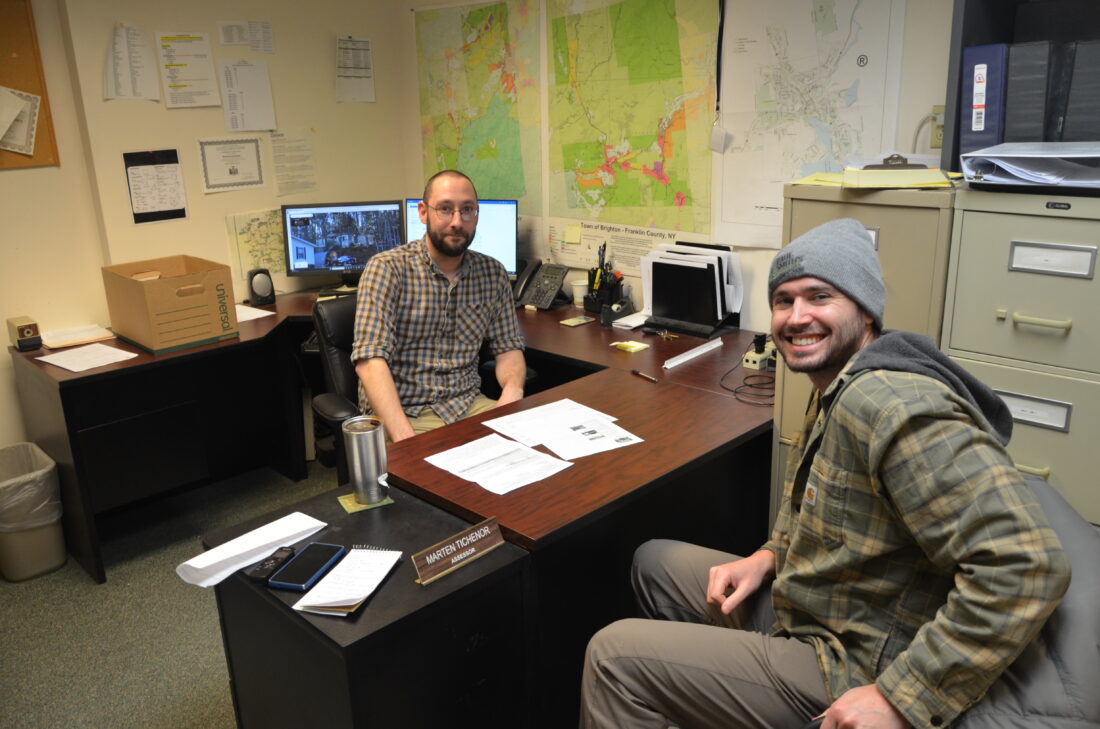
Harrietstown Assessor Marten Tichenor, left, goes over an assessment with town Councilman David Lynch on Tuesday. Tichenor will meet with town property owners for another week to discuss their recently reassessed home values. (Enterprise photo — Aaron Marbone)
By Aaron Marbone
SARANAC LAKE – Harrietstown property owners have around a week left to schedule an informal hearing with town Assessor Marten Tichenor to discuss their recently reassessed property value and try to get it lowered if they can present evidence that it’s higher than it should be.
The town recently reassessed the value of all of its properties for the first time in 15 years. Most home values have doubled since then. But, if someone believes their assessment is higher than they’d be able to sell their property for, they can bring in evidence to challenge the assessment. Tichenor said he’s used to this. Assessments are almost always wrong.
He cannot enter a house, so the assessment is largely based on exterior observations and his data falls apart when it comes to the interior.
If there’s a freshly painted house, it’s easy to assume the property is valued high. The inside might not be, but he doesn’t know that.
“If you didn’t see me in your house, I wasn’t in there,” Tichenor said.
At the beginning of March, property owners in the town got assessment impact notices with their tentative assessments. This includes the changes to their assessed property value as well as an estimated change in tax liability.
Tichenor calculated a home’s assessed value by collecting records of its size in square footage, gauging the quality of the home through its appearance and age and then using that data to find the recent sale prices of similar size and quality homes in the town to get the center value. This is all based on data up until July 1, 2025. Commercial property is also valued with how much income it brings in.
To set up an informal hearing with Tichenor to learn how individual assessed property values were determined, call 518-891-0436 or email assessor@harrietstown.gov. His office is in the basement of the town hall.
He’s spoken to more than 150 people total so far through 85 calls and 90 appointments. After he’s done with these hearings, he will finish creating the tentative tax roll.
He also held several information sessions leading up to the reassessment. The recordings of these information sessions, as well as other information about reassessment, can be found at tinyurl.com/3fpch67u. The information sessions are quite interesting, as they give an exclusive glimpse into the real estate market, the assessment process and how taxation works.
Tichenor cannot say if reassessing someone’s home will raise their taxes or not, but said it is usually roughly split into thirds, he said — around one third of homeowners’ taxes go up as a result of the reassessment, around one third goes down and around one third stays the same.
The town last assessed property in 2011, at the tail end of the 2008 recession and subprime mortgage crisis. Those assessments stayed at 100% up until 2020. But the coronavirus pandemic massively disrupted the market and rapidly increased the pricing of homes.
Property sale prices have doubled and are on their way to tripling since the start of the pandemic, Tichenor said.
Because people are paying way more for a home than they would have several years ago, the assessment of the home’s value is off.
This is also partially driven by inflation. As the value of the dollar declines, it takes more dollars to purchase the same home.
Right now, some homes in Harrietstown are assessed lower than they should be, some homes are assessed higher than they should be and some are approximately where they should be.
Tichenor said it is rumpled up like a bedsheet. His goal with the reassessment is to smooth it out.
However, he said home appraisal is an incredibly imperfect system. If someone thinks the impact notice or change of assessment notice is way out of whack with their true assessment, he said they should talk to him, because it probably is. It’s attempting to give a mathematical answer to a very human question.
He encouraged property owners to disagree with him. Assessments are largely based on subjective things.
It’s up to the public to double-check his work, he said. If he can’t prove why a property is assessed a certain way, he said that it shouldn’t be assessed that way.
He’ll ask for photos of the interior, square footage or a private appraisal.
Tichenor can still reduce the assessment, but he needs a valid reason to do so.
Assessment and taxes
When people come to him with an issue about their assessment, Tichenor said they sometimes tell him that they know they could sell their house for the amount he assessed it for, but cannot afford to pay taxes on that amount.
If people prove to him that they couldn’t get that amount if they sold it, he can reduce the assessment.
They have to show him damage to the home, out-of-date interior infrastructure or other issues, not just that their taxes are too high.
Tichenor said the town doesn’t do a reassessment to raise or lower taxes; they do it to rearrange how the tax burden is spread out and try to get closer to an equitable spread across the community. It does not allow the town to collect more in taxes. The town likely will collect more in taxes, he added, because its budget tends to rise annually to meet increasing costs.
Many people come to him with tax-related issues, not assessment-related issues. His office cannot offer tax relief. That is up to the budget-making entities – the town, county, school district or village.
“Tax relief needs to be sought from the taxing jurisdiction,” Tichenor said.
He’s encouraging people to get involved in the local governments. The village and the school district are both creating their budgets now.
The problem, as Tichenor sees it, is that people don’t show up to board meetings.
He feels people tend to see board members as being in an “ivory tower.” There are only about 15 people who really decide how people’s homes are taxed. They are accessible by email, at board meetings or in government offices, he said.
Government is a service, Tichenor said. If people feel they are not getting enough for what they pay, they should tell the budget-makers.
Tichenor said he feels bad for both the taxpayers and budget-makers. They’re all tightening their belts.
He said if the public feels it’s time for austerity budgets, they should tell the governments.
A sample hearing
Harrietstown Councilman David Lynch brought in his impact notice on Tuesday. He bought his home for $185,000 in 2021. It was assessed at $113,600. It is still assessed at that value. This reassessment will make that assessment practically double to $225,300, an increase of $111,700, resulting in an estimated $488 increase in what he’ll pay in town, county and school taxes next year, bringing it up to $2,557. This number is based on current budgets. Future budgets will likely increase that number. It also does not include village taxes, because those are not available yet.
On Tuesday, Tichenor brought up a sheet with homes similar to Lynch’s – nearby homes which were remodeled and then sold, like his was, and of similar size and build quality.
He asked Lynch a number of questions, trying to find issues with his home that he might not even know – What’s the foundation made of? What year is the boiler? Is the attic insulated? What era is the electric wiring from? What about the pipes? What material is used for the floor?
Tichenor said many homes in town are more than 100 years old and are well past their service life.
Homes assessed from $0 to $100,000 are typically homes that are “unusable” and need full renovation.
Homes assessed from $100,000 to $150,000 are typically usable, but small and not in great shape.
Homes assessed from $150,000 to $200,000 are typically usable, 1,200- to 2,000-square feet and need a bit of work.
Homes assessed from $200,000 to $250,000 typically need just a bit of work.
Homes assessed over $250,000 are average homes that people can buy and walk in without much deferred maintenance.
Tichenor reduced two assessments on Tuesday.
At one, the home looked fine from its landscaped exterior. He did a site visit with the owners, who showed him that, inside, the house was not livable. The prior owner died, the heat was off, the electrical wiring was old and the home had probably not been renovated in 50 years.
At the other one, he said though it was in good shape outside, the inside was extremely dated.
–
What led to the reassessment?
–
When multiple towns sit in a village or school district, the state assigns “equalization rates” to those towns to ensure they are paying equal amounts of the taxes to those villages or schools.
If a town has not been reassessed recently — as Harrietstown has — this raises the tax rate per $1,000 of assessed value. Because, compared to a town which has current assessments, Harrietstown’s homes are undervalued, there are fewer $1,000s of assessed value to tax. Currently, the town has an equalization rate of 65%. This reassessment should bring it up to 100%.
Broadly, Tichenor said, if a property’s assessment increases, then its taxes go up. New renovations and new buildings typically see their taxes rise the most, he said.
Tichenor said the lowest socioeconomic demographic suffers the most when there’s inequity in assessments as there is now. When the spread widens, the tax burden slides to one side — usually the side with lower incomes who cannot afford to upgrade their homes and increase their assessed value.
“What appreciates the least is often the homes of people with lower incomes,” Tichenor said. “The tax burden slides onto those lower-income or lower-value properties.”
But, if someone has a nice home, but not a large income, they’ll be impacted pretty negatively.
“We have low-income people who own high-value property,” Tichenor said. “That’s something unique to this area.”
This impacts people whose property appreciates the most – not always the wealthy. People of all income ranges whose properties have appreciated are getting sticker shock – from mobile homes to mansions. Some are worried they’ll lose their homes, others are worried it will ruin their plans to retire here.
People with higher incomes tend to call him more with complaints. People with a lot of money and expensive properties live paycheck to paycheck, too, he said, as their bills scale up just the same.
He also said inequities breed lawsuits and that the town tries to avoid overassements of wealthy people. They have the money to hire lawyers and sue the town. These lawsuits cost the town and its taxpayers a lot of money.
Market sustains
Every month, when Tichenor sees new home sales, they’re selling as high or higher than the previous month. And properties are adding hundreds of thousands of dollars in equity in a few short years without real renovation causing it.
He’s been waiting for the market to crash for two years now, but it’s not crashing.
Nationally, the housing market curved around two years ago, Tichenor said.
But the Tri-Lakes has a strong second home market driving competition, so it has not curved here.
As the second home market proliferated during the pandemic, he said wealthier people paid more and more for waterfront property. Other wealthy people who could afford those properties, but couldn’t compete with the fierce bidding moved to slightly less-expensive markets. This trickled down all the way to the lower levels of housing.
-What happens next
–
On May 1, the tentative tax roll is filed with the state, shortly followed by a notice of assessment change being sent to property owners.
May 26 is grievance day, when homeowners can formally challenge their assessments.
The grievance board is an impartial group of locals who essentially double-check Tichenor’s work. He said it’s easier to get a reduction in assessment now than through the grievance process.
Tichenor said he’s not adversarial. Grieving is part of the process. He even offered to help people fill out the form himself.
The final tax roll is filed with the state on July 1.
These new assessments will be reflected on a school tax bill first in September, in a town tax bill in December and on a village tax bill in June 2027.
Local News
Saranac Lake breaks record low temp
LAKE CLEAR — In a winter that’s not going out without a fight, Saranac Lake smashed another record low ...

Here’s the mail, it never fails
State Police seek public’s help with Rouses Point murder
ROUSES POINT — New York State Police are seeking the public’s assistance in connection with a homicide that ...
Wild Center awarded grant to revitalize ‘The Wild Adirondacks’ film for 20th anniversary
TUPPER LAKE — The Wild Center has been awarded a 2026 Conservation and Community Interpretive Grant from the ...
Think your Harrietstown assessment is too high? Talk to the assessor