The pit and the potential for new housing
Locals dream about proposed neighborhood at village sand pit and start to address hurdles
-
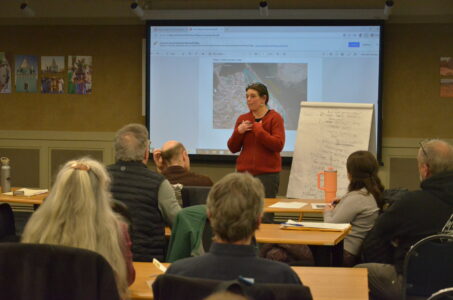
- Northern Forest Center Adirondack Program Director Leslie Karasin leads a discussion of the proposed project to put housing at the Saranac Lake village-owned sand pit last week. (Enterprise photo — Aaron Marbone)
-
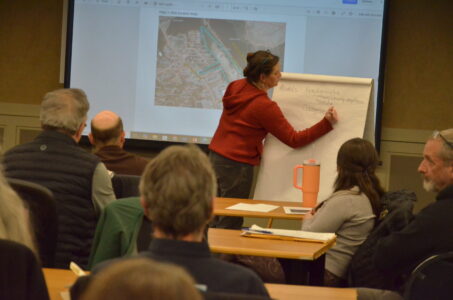
- Northern Forest Center Adirondack Program Director Leslie Karasin leads a discussion of the proposed project to put housing at the Saranac Lake village-owned sand pit last week. (Enterprise photo — Aaron Marbone)
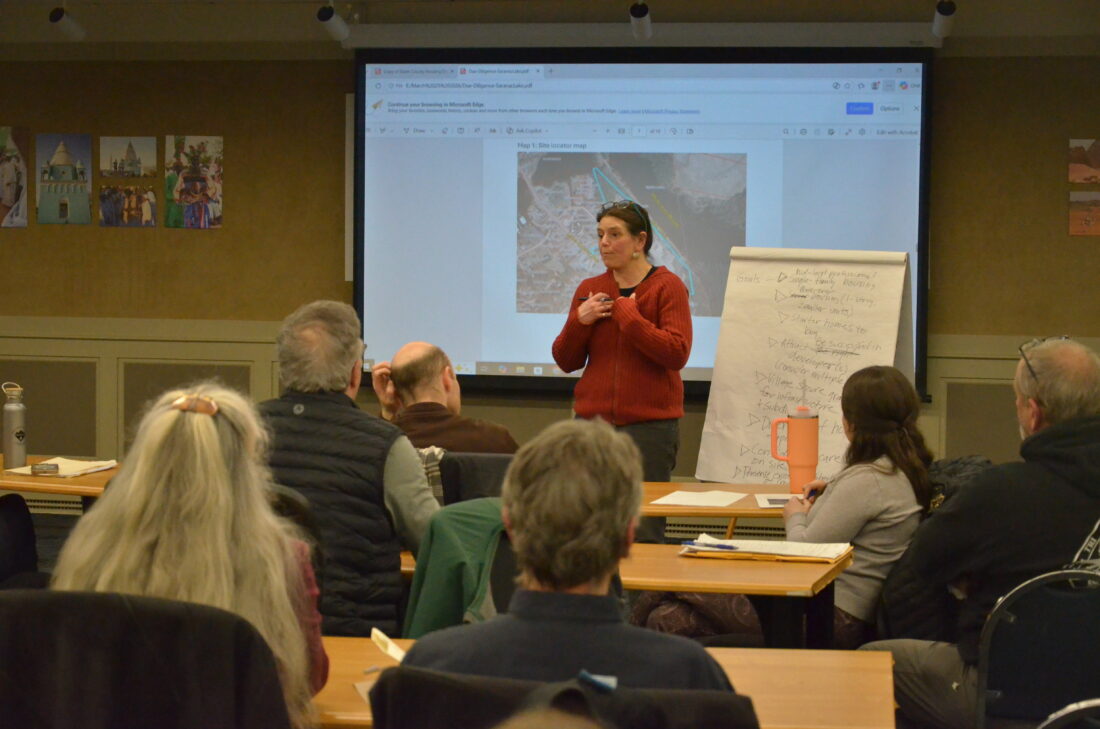
Northern Forest Center Adirondack Program Director Leslie Karasin leads a discussion of the proposed project to put housing at the Saranac Lake village-owned sand pit last week. (Enterprise photo — Aaron Marbone)
SARANAC LAKE – Around 30 people sat around on March 25, dreaming of what could potentially be a new neighborhood – built where the village-owned sand pit is currently.
The Saranac Lake Housing Task Force was holding a public session on a potential housing development at the 10-acre lot the village owns off of Will Rogers Drive. The project is still very early in its inception, and the people at the meeting had a variety of ideas and views on what the project could be, what it needs to be feasible and the big question – “What kind of housing?”
Task Force member and outgoing Trustee Matt Scollin said it was a great turnout for a weeknight and shows the interest people have in the project.
There are several obvious concerns and he said it’s good to get them out early. These are valid concerns, Scollin said, but he feels if they get creative, that they are also “solvable issues.”
He hopes people continue to pay attention and stay involved.
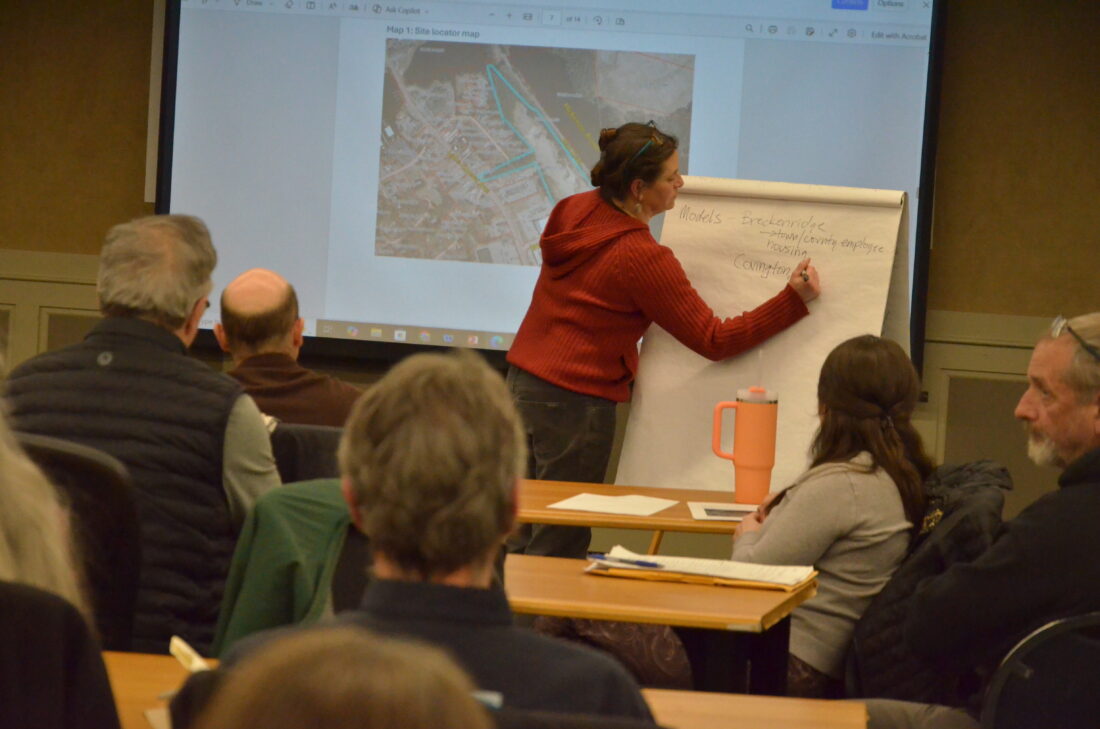
Northern Forest Center Adirondack Program Director Leslie Karasin leads a discussion of the proposed project to put housing at the Saranac Lake village-owned sand pit last week. (Enterprise photo — Aaron Marbone)
“The more that we can talk about these things early, the more likely we are to get broad-based support,” Scollin said.
For years, the pit – a long strip of land behind Aldi, McDonald’s and Carcuzzi running along the Adirondack Rail Trail and McKenzie Brook – has been mined for sand and stone for village projects and road safety during the winter. But it’s expected to run out in around two years.
As it nears the end of its life, the village is exploring the possibility of using the land for apartments or single-family homes.
The village partnered with the Northern Forest Center, which is doing free “due diligence” and “predevelopment” work on the possible project, through grant funding through a state Department of Environmental Conservation’s Adirondack Smart Growth grant, an Adirondack Community Foundation’s Generous Acts grant and private donors.
This potential project is still very early in its development. The type of housing proposed there has not been decided yet. It could be single-family homes, multi-family apartments, duplexes, condos or a mixture of types. Several people at the meeting last week advocated for a mixture.
There was also discussion of having mixed-use development there, with some commercial property like a daycare or other family resource.
Task force members said they need to narrow down these ideas. Right now, they have a blank slate.
If people have ideas, comments or questions, they can email slhousingtask@gmail.com.
NFC Adirondack Program Director Leslie Karasin, a Saranac Lake resident and employee of the New Hampshire-based nonprofit, said their next job will be to package this feedback for a consultant to sift through.
The requests for proposals for a consultant to do a conceptual master plan were due by Friday.
This consultant’s master plan – not an exact plan, but more of a general guide – would lead to requests for expressions of interest from developers who might want to take the project on.
The village could sell the land to a developer, partner with a developer, subdivide the land and that developer could either sell the final product or rent it.
Karasin said they’ll hold more public meetings in the future, where they can present multiple concepts for people to weigh in on. The village board will also evaluate the concerns people bring up.
–
The need
–
Task Force member Ann Cantwell-Telfer said the task force contacted multiple landowners whose properties were identified as having the potential for housing projects, but this did not pan out. Few replied and their sale prices were too high for affordable housing.
A village-owned property gives them more flexibility, she said.
Adam DeSantis, the Economic Development Director for the Regional Office of Sustainable Tourism, said they did a study that found that 158 to 207 new primary housing units could reasonably be expected to be filled each year for five years in the Essex County region – that’s an addition of 1,000 units in five years that could feasibly be filled with new residents, he said.
There is housing demand at all income levels, he said. The strongest market segment is those earning above 120% of the area median income. AMI for a family of four in Essex County is $91,000 and $88,000 in Franklin County, she said.
DeSantis said most state or federal housing development subsidies are for projects for people earning 60% AMI or lower. He said it is not feasible to build those kinds of projects.
Construction costs are at a premium around here – around $400 per square foot – which he added is related to the lack of a construction labor pool, which is caused in part by the affordable housing shortage.
The task force identified two bottlenecks in the housing market – growing families who cannot afford a larger home, which does not open up the smaller, cheaper unit they live in, and retirees who do not need the larger home they have, but who cannot afford to move into a smaller, newer home and free up a big house.
Peter Waldt said the sand pit is a large site and suggested the project focus on these two components – senior and starter homes, what village resident Tammara Van Ryn called “first homes and last homes.”
–
Concerns
–
Shawn Wales, a neighbor of the property, warned that digging down into the ground there, you hit water pretty fast.
The task force plans to work with the Adirondack Park Agency to determine where wetlands are. There are suspected wetlands along the northeast side of the property.
Several people questioned if the site was first for holding housing, but task force members said there’s always a way to make it work.
There’s a parable told by Jesus in the book of Matthew about a foolish man who builds his house on sand.
The property is a sand pit, but the village has been mining the sand for years. And, unlike homes of Biblical times, modern engineering has made sand an adequate foundation to build on.
Tammara Van Ryn had a concern about the tax implication of the project.
She said that people in the village are bearing the brunt of a vibrant Saranac Lake — that they’re subsidizing it for people who live outside the village and do not pay village taxes.
She wondered if the property would have more value if it were sold for commercial purpose, saying they could be forgoing tax revenue if they use it for housing.
One attendee said there’s a way where the village could do the infrastructure work, and then a portion of each sale would pay back the village for the work.
Van Ryn said if the village supports housing, the housing could support the village, by having units set aside for village employees.
Task Force member Steve Erman said there is a risk of the village spending a lot of time and money preparing the site before the people actually move in, and it not panning out or a developer taking advantage of the village.
A chief concern if the project moves forward is that the village Department of Public Works uses the 10.5 acres of land for snow storage in the winter.
DPW Superintendent Dustin Martin said, right now, the DPW has no other options for snow storage and materials stockpiling.
If the snow storage is moved further away from the village center, he said it may take longer to clear streets and sidewalks – several mornings instead of one morning.
This year, the pit is more than half-full of snow. In years of really heavy snow, like 2011, it gets completely full. That year, Harrietstown brought its snow blower from the airport to stack the load higher.
Martin said they can’t use the former landfill because it’s being turned into athletic fields, they can’t use land where they have a new sand mining pit near the wastewater treatment plant and tap water wells because of the possibility of salt contaminating the wells and they can’t use the land near the DPW garage on Van Buren Street because there’s lots of wetlands there.
Community members recommended a five-acre plot on Payville Lane behind the North Country Community College sledding hill where the local gas company has done a brownfield cleanup. Martin said they would need permission from the landowner, and the neighbors may not like the noise of early morning snow dumping. The large dirt berms around the sand pit provide a natural noise buffer currently.
Martin said the snow storage problem is a hurdle. He’s not opposed to the idea of using the sand pit for housing, but he said they need solutions to the problems it brings up.
–
Parking and pockets
–
The southeastern portion of town does not have as many amenities, people pointed out. It has several stores in its business district, but needs more stuff for kids there – a daycare, a recreation center, a playground.
Charlotte Lomino suggested having a daycare on the first floor of apartments, if that is the route they take.
Susan Waters said she finds the “pocket neighborhoods” designed by architect Ross Chapin “quite fetching.”
There would need to be more research on the traffic control needs if the project brings more car traffic to that end of town. People talked about the potential of advocating for the state Department of Transportation to install a stoplight at the intersection with Will Rogers Drive.
Wales, who lives on Crossfield Road, which bends behind the Best Western hotel and toward the project site, said he would not like having access to the sand pit on his road. There are other access points, and he said he wants to keep the existing neighborhood feel of Crossfield.
Megan Gorss said it “might be a pipe dream,” but asked if the planners could deprioritize vehicle parking at the site. With the rail trail right there, connecting the site to downtown, she felt that it would be an opportunity to maximize tax income by not squandering a bunch of space on a parking lot.
The 70-unit Saranac Lofts apartments downtown also deprioritized parking, though that project is not finished yet, so the viability of this kind of situation has not been tested yet.
Lomino mentioned that one-fifth of Saranac Lakers do not have a car.
From 2006 to 2012, the village was in talks with Walmart, Hannaford and Tractor Supply to turn the sand pit into retail space, but waited to get the full potential out of the mine and chose to not rezone it. In 2013, the village discussed turning it into mixed housing and commercial space.
The sand pit is in the Saranac Lake hamlet, the easiest land classification in the Adirondacks to build in.
Local News
Constructing collaboration
Early-season paddlers
The pit and the potential for new housing

Authors to discuss ‘The First Adirondackers’ at John Brown Farm

Expect hunger to rise as new SNAP rules take effect