
SUNY chancellor talks Reconnect program at NCCC
Housing shortage highlighted as region’s biggest hurdle to student, workforce retainment
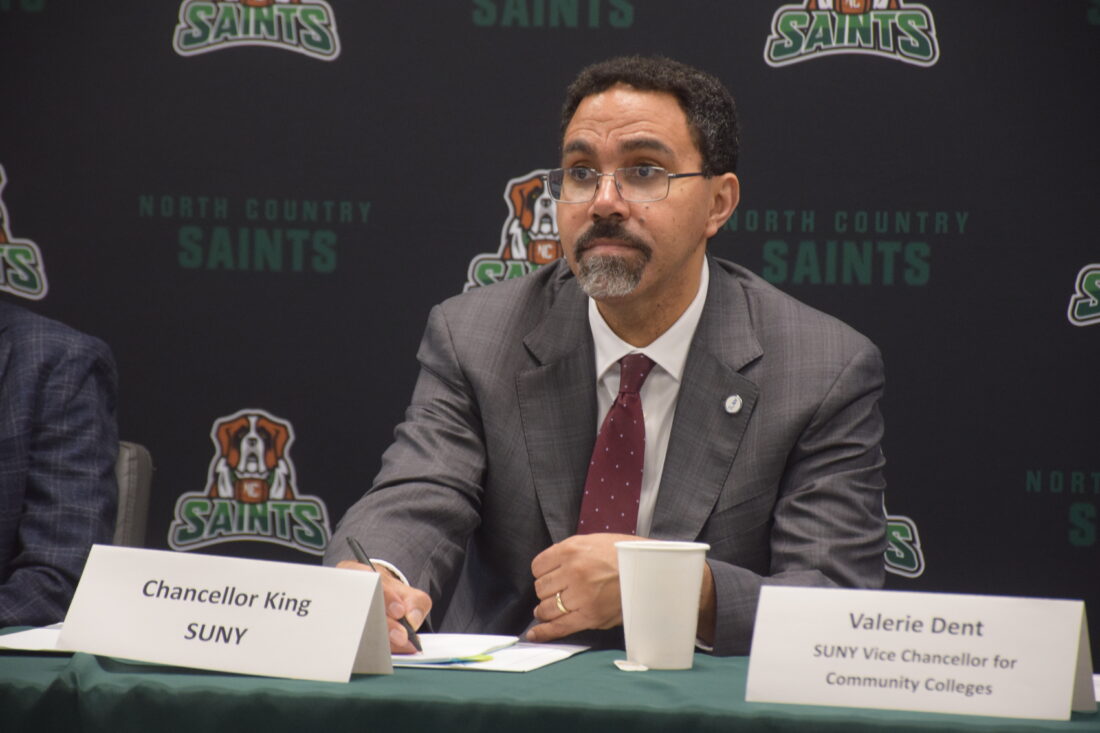
SUNY Chancellor John King listens during a SUNY Reconnect and regional issues roundtable discussion held at North Country Community College in Saranac Lake on Tuesday. (Enterprise photo — Chris Gaige)
SARANAC LAKE — State University of New York Chancellor John B. King Jr. made a stop at North Country Community College on Tuesday as part of the SUNY Reconnect Tour.
SUNY Reconnect offers free college — including tuition, books, fees and supplies — to New Yorkers aged 25 to 55 who do not have a college degree but are interested in pursuing an associate degree in “high-need” fields.
These include advanced manufacturing, artificial intelligence, cybersecurity, engineering, technology, nursing and allied health fields, green and renewable energy and pathways to teaching in shortage areas.
Gov. Kathy Hochul’s proposed budget — which remains under negotiation with the competing state Senate and Assembly proposals — calls for an expansion to SUNY Reconnect to include air traffic control and transportation, emergency management and logistics, as well as expanding nursing programs for adults who already have a previous degree, but want to go back to school to pursue a nursing.
Seven NCCC programs currently qualify for SUNY Reconnect. These include addictions counseling, cybersecurity and digital forensics, environmental science, environmental studies, health science, nursing — associate degree and radiologic technology.
The program has been credited with boosting enrollment at NCCC and campuses around the state.
SUNY Reconnect participants at NCCC receive financial aid and support services, including a single point of contact, extended hours and prep courses, to complete their associate degree. To learn more about SUNY Reconnect degree programs there, visit nccc.edu/reconnect.
During his visit, King — who served as the U.S. Secretary of Education from 2016-17 and the New York state Education Commissioner from 2011-14 — held a roundtable discussion with the college’s top brass and several current SUNY Reconnect students enrolled at NCCC.
College President Joe Keegan welcomed him as someone who “clearly understands the unique power of public higher education,” noting that during his tenure, SUNY enrollment has sustained three consecutive years of enrollment growth, buttressed with state budget increases. King earned his bachelor’s degree at Harvard, holds a law degree from Yale University as well as a masters degree in teaching and a doctorate in education, both from Columbia University.
It’s about as impressive of an educational background as one can hold, but for King, it almost never came to be. Growing up in Brooklyn, King’s mother died of a heart attack when he was eight and his father suffered and eventually died — when King was 12 — from what was, at the time, an undiagnosed case of Alzheimer’s disease.
King said in a 2016 U.S. Senate confirmation hearing that his father’s ailment made his home a “scary and unpredictable place,” and that the classroom was his refuge. He credited a pair of exceptional public school teachers for intervening and saving him from turning into a ne’er-do-well or violent youth.
“If not for them, I could not have survived that turbulent period, and I certainly wouldn’t be sitting before you today,” King said at the hearing.
“He gives credit where credit is due, and that is to the teachers that really shaped his life early on and his career trajectory,” Keegan said.
King began by asking the student panel what made them want to come back to school and pursue SUNY Reconnect. Dylan Smith, a current AAS nursing degree student at NCCC, spoke first, saying that the hybrid learning program’s schedule flexibility makes going back to school more enticing for adults who often have a myriad of life responsibilities that they are juggling.
“From what I hear from other students, it’s good,” he said. “They have very full lives and (education) adds to it, but they can fit that in — as far as child care and things like that — with just a couple evenings a week and a day a weekend. … It kind of opens it up to someone who might not do it.”
Jennifer Flint, a NCCC radiologic technology student, said that without the SUNY Reconnect program, she couldn’t have gone back to pursue that degree, something that began when a healthcare facility she had been working at unexpectedly closed. Some of her then co-workers were NCCC graduates that were taught by Becky LaDue and Scott Stringer. Despite being some distance away, the colleagues recommended NCCC to Flint because of its teaching quality.
“I applied, unsure of how I was going to make it work,” she said. “I live three hours away. I have a mortgage. I have a whole adult life outside of this and the Reconnect program really solidified that I could do this. It took a huge burden off of my plate. It actually allowed me to cut back hours at work so I’m able to dedicate more hours to my school work, which is very much a gift for that rad tech program.”
King said their stories are exactly what the program is meant to help serve, before opening the discussion to the rest of the room for ongoing challenges the region is facing.
Essex County Board of Supervisors Chair and town Supervisor Steve McNally, D-Minerva, spoke next. Essex and Franklin counties each contributed more than $1.4 million to NCCC’s $16.5 million budget for 2026.
He said that the biggest issue plaguing the county is affordable housing. He said it’s what any workforce or college student recruitment shortage usually boils down to — and that wages have woefully underpaced home price increases. This, McNally said, makes it increasingly impossible to sustain a functional economy regardless of educational opportunities. The shortage has grown so severe that it’s even pricing out relatively affluent earners.
“We’re to the point where it’s affecting everybody,” he said. “Our attorneys and people that (are in) these positions that start out with $90,000 are not finding (affordable housing). You can’t come to Essex County, make $90,000 and buy a house or find a place to live because everything’s turned to Airbnb.”
McNally said there’s no silver bullet and he doesn’t know what the solution is, but the numbers are jawdropping. In Minerva, with close proximity to the Gore Mountain ski area, he said 60% of the homes are not primary residences.
“Is that right?” King asked. “Wow.”
McNally laid the problem plain as could be.
“A house that used to sell for $200,000 and a $90,000 a year attorney could purchase no longer can buy that house because now the cost of that house is $300,000 because these people are going to use it six months a year and they’re going to rent it out the remainder of the year — so it gives them more buying power,” he said. “Housing is going to affect us all in this room at some point, and maybe not directly (but) especially if you have children or young adults who want to start their career. It’s very hard to retain those people in this area.”
McNally said both of his kids, who received a college education, moved out of the area for better-paying jobs and affordable living. He said he is extremely fortunate that they’re both still located within 100 miles of Minerva and he can see them on a regular basis, but said that tends to be the exception rather than the rule.
“We usually see them when they’re 65 when they come back,” he said sardonically.
Essex County Public Health Director and NCCC Trustee Linda Beers didn’t disagree with McNally, but added that the best hope, statistically, of retaining people here is having them get an education here.
“The science says that kids who go to school here stay here,” she said. “We have much better success when we grow our own. If you’re from here and you take opportunities to go to these, you usually stay here because you’ve already been rooted here if you’re in the (SUNY Reconnect) age group of 25 to 55.”
McNally said that while it’s a relatively higher retention rate, the lack of housing is still eating into it.
“I think you’re absolutely right,” King said. “The governor’s got a whole agenda to try to increase the housing supply, some of which she’s trying to push through as we speak.”
Local News
SUNY chancellor talks Reconnect program at NCCC
North Country students attend women in law event
WCSC awards scholarships to locals
SARANAC LAKE — The Women’s College Scholarship Club is accepting applications for $3,000 scholarships which ...
ANCA’s 2026 Climate & Energy Conference gathers innovators and communities in Lake Placid

SL Civic Center receives Stewart’s Holiday Match grant support
Tupper Lake VFD, neighboring departments put mattress fire to bed
TUPPER LAKE — Quick action in the dead of night by Tupper Lake volunteer firefighters and several neighboring ...