
North Country students attend women in law event
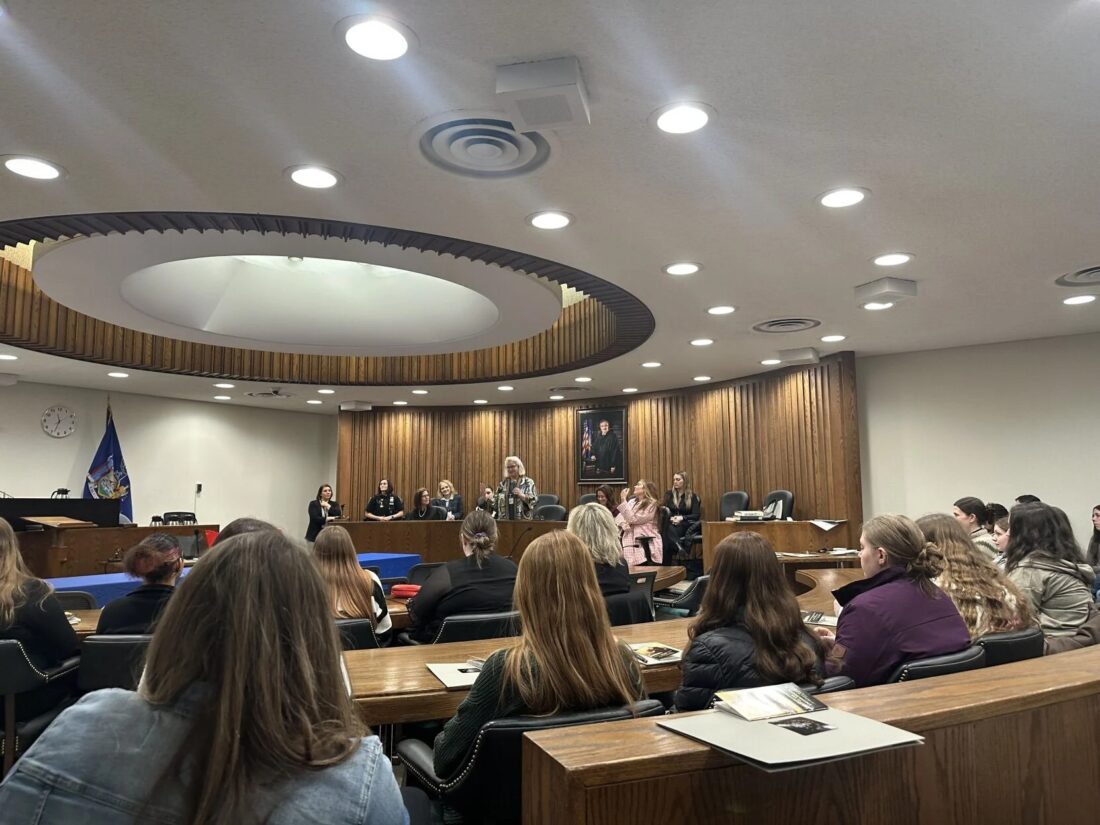
Clinton County Attorney and Stafford Owens Attorney Jacqueline Kelleher speaking to dozens of North Country students who attended the Women in Law event at the Clinton County Government Center on March 26. (Press Republican photo — Carly Newton)
PLATTSBURGH — Students from across the North Country attended a Women in Law program at the Clinton County Government Center last week to learn about potential future career paths after high school.
The program gave girls, who are preparing for college in the next couple years, a chance to learn about different jobs in law from women in high-ranking positions across the region.
Students from the Beekmantown, Boquet Valley, Brushton-Moriah, Chateaugay, Lake Placid, Long Lake, Malone, Northeastern Clinton, Peru, Willsboro, Salmon River, Saranac Lake and St. Regis Falls central school districts, as well as the Plattsburgh City School District, were in attendance.
“We decided we need to give high school students who might be interested in a career in law a little bit more awareness of what careers there are,” Douglas E. Gerhardt, one of the founders of the program, shared at the start of the March 26 event.
Gerhardt, a partner at Honeywell Law Firm in Albany, and Katrin Falco, of Falco and Morton, originated the program in Saratoga County in 2024 as members of the Adirondack Women’s Bar Association, a chapter of the Women’ s Bar Association of New York State.
Last year, they brought the event statewide with over 1,000 students participating.
This year, the event was held in 16 locations across the state and more than 1,200 students participated, a 23% increase in attendance from last year.
The Adirondack Chapter was the largest attended with over 150 students participating over two days in Saratoga Springs March 17 and Plattsburgh March 26.
The panel last week included women in a variety of law positions. It featured Allison McGahay, Supreme Court justice for New York’s Fourth Judicial District; Jacqueline Kelleher, Clinton County attorney and attorney at Stafford Owens Law Firm; Jennifer Mesec, Clinton County Court officer; Allison Mussen, assistant attorney general; Christine Peters, Clinton County administrator; Lynn Pucciarelli, associate court attorney for Judge Tatiana N. Coffinger; Marybeth Weeden, Clinton County Court reporter; Denise Durkin, chief clerk of the Supreme and County courts of Clinton County; and Abbie Lebrun, a third-year J.D. candidate at Vermont Law and Graduate School.
After the panelists gave a speech about each of their careers, students were given the opportunity to ask them questions
According to the American Bar Association, over the past decade, the percentage of female lawyers has increased slowly, standing at 34% in 2013 and growing to 39% in 2023.
The American Bar Association said male attorneys still greatly outnumber female attorneys, but that is gradually changing as more women, and fewer men, enroll in law school every year.
–
‘No set plan’
–
McGahay, who was the first woman elected to the Fourth Judicial District in 2022, said she did not envision a career in law when she was younger.
“When I got out of high school, I wasn’t interested in going to college. I wanted to work, and I was a waitress for approximately seven years. And I have to tell you, I was really good at it, and I really loved it. However, I got to the age of 25 and decided that I better get a degree if I wanted to have a good job, a good salary, some health insurance and maybe a retirement in the future,” McGahay said. “So I went to North Country Community College in Saranac Lake, and I took criminal justice courses. I loved them.”
From there, she got an internship and, eventually, a permanent job working at FCI Ray Brook. When she wanted to move up the ranks, McGahay was told she needed a four-year degree, so she went back to college.
At SUNY Oswego, she was asked about her interest in Albany Law School and decided to go there after sitting for the admission test.
“I tell you all these things just to let you know that there’s no set plan for who becomes an attorney. Nobody in my family was ever a lawyer or a doctor,” she said. “I wish you all the best as you follow your plan, but it might change along the way.”
–
Different roads to law
–
Unique pathways into law careers were common among the panelists.
“When I went to college, I really had no interest in being a lawyer,” Kelleher, who has been at Stafford Owens since 2000, said. “I kind of had a big mouth, I had a lot of comebacks, I guess, as a child. And so people said, ‘You know, you’d be a good lawyer.’ I was like, ‘No, I don’t really think I want to do that.'”
Kelleher started out attending community college, then got married and had kids before deciding to go to law school. After school, they decided to move to the North Country, and Kelleher sought out a job at Stafford Owens, which she got almost immediately.
For students considering a career in law, Kelleher advised them to expect the job to be ever changing as different issues arise over time.
“When I graduated from law school, employment law did not exist. You could be a labor attorney and do labor negotiations with unions, but there was no ADA (Americans with Disabilities Act), there was no FMLA (Family Medical Leave Act), there were no protections against sexual harassment and discrimination that were realistic,” she said. “And so when I got up here, there was no one doing that work. People started calling, and I said, ‘OK, I guess I can learn how to do this.’ And so now at our seven-lawyer firm, we have two lawyers who have more than 50% of their practice in employment law.
“I never could have imagined that when I was in law school,” she said. “It’s ever changing. It’s changing constantly, every day. It’s a great career, and there’s so many different aspects of how you can help people.”
–
More than just the law
–
Some of the panelists helped highlight how a law degree could be used beyond being a lawyer or judge.
Peters, who graduated from Vermont Law School in 2000, went on to work as the Clinton County Department of Social Services attorney for several years before becoming the director of legal and social services, supervising all the child welfare and adult services, as well as a legal unit.
“The job was created, and I got to make it my own, which was really great. And I got to be introduced to administration and running a large organization,” Peters said. “I kind of shifted, which is an opportunity for you guys to see that you don’t have to be a lawyer to be to use a law degree.”
After 12 years in the position, Peters became the commissioner of social services, which shifted focus on to more administrative and budgetary issues but still had oversight of a large agency with about 185 employees.
Then, when long-time Clinton County administrator Michael Zurlo retired last year, Peters applied and was hired as his successor.
“I became the first female county administrator in our county in October of last year, so I’m enjoying this job,” she said. “This is another pivot for me in law.”
–
Law careers beyond degrees
–
Panelists Durkin, Mesec and Weeden did not go to law school, but they helped show students how varied law careers can be.
Weeden said there is especially a growing need for court reporters, and most people don’t know about the job and interesting, demanding work they get to do.
“We very often have to do read backs during the trial and repeat what someone said. We produce the transcripts for when the appeals come through. Sometimes, like in a medical malpractice case, we have to do daily copy. So we take the entire record for the day, go home and then we have to produce it the next day,” Weeden said. “When I was in college, there was an article in the newspaper at the time saying we would be replaced by tape recorders, and we still cannot fill the positions they’re used for to this day. They used to want two years of on-the-job training on the field. Now, they are taking people right out of school, coming here and training them. It’s a fantastic career.”
Students were encouraged to sit in on a court case to get a better understanding of what goes on in court and behind the scenes.
That’s how Weeden knew she wanted to pursue a career as a court reporter.
“There was an article in the newspaper about a local court reporter, and there was an interesting, huge murder trial going on at the time that I came down and watched, and I just pictured myself sitting here one day,” she said.
As chief clerk, Durkin is also right where she wants to be. She said she and her staff help enter court cases, get them prepared for the judges and help them review and process information.
“We set court dates. We help them in any capacity that we can — reports, reports and more reports,” she said. “I can tell you, as a little kid, I always loved playing with wood, paper, playing business, playing everything, so this was a good trajectory for me.”
Durkin said her job, and many others, did not require a law degree. She said there are many important law positions that students should be aware of when deciding their futures.
“You do not need a college degree because some people just aren’t college material. But that doesn’t mean you can’t be involved in the court system, and I feel it’s very important to let some of these people know because it doesn’t mean you can’t be a deputy clerk, a chief clerk, you can’t be a district executive,” Durkin said. “I’m sure you will find, if you look through all of the ranks, that there’s plenty of people in positions of management that do not have law degrees, that do not have even a regular bachelor’s degree, so don’t discount yourself. Every single position in this court system — in the law enforcement field — they are all important.”
Local News
SUNY chancellor talks Reconnect program at NCCC
North Country students attend women in law event
WCSC awards scholarships to locals
SARANAC LAKE — The Women’s College Scholarship Club is accepting applications for $3,000 scholarships which ...
ANCA’s 2026 Climate & Energy Conference gathers innovators and communities in Lake Placid

SL Civic Center receives Stewart’s Holiday Match grant support
Tupper Lake VFD, neighboring departments put mattress fire to bed
TUPPER LAKE — Quick action in the dead of night by Tupper Lake volunteer firefighters and several neighboring ...