Lake Placid sugarbush sees best week yet
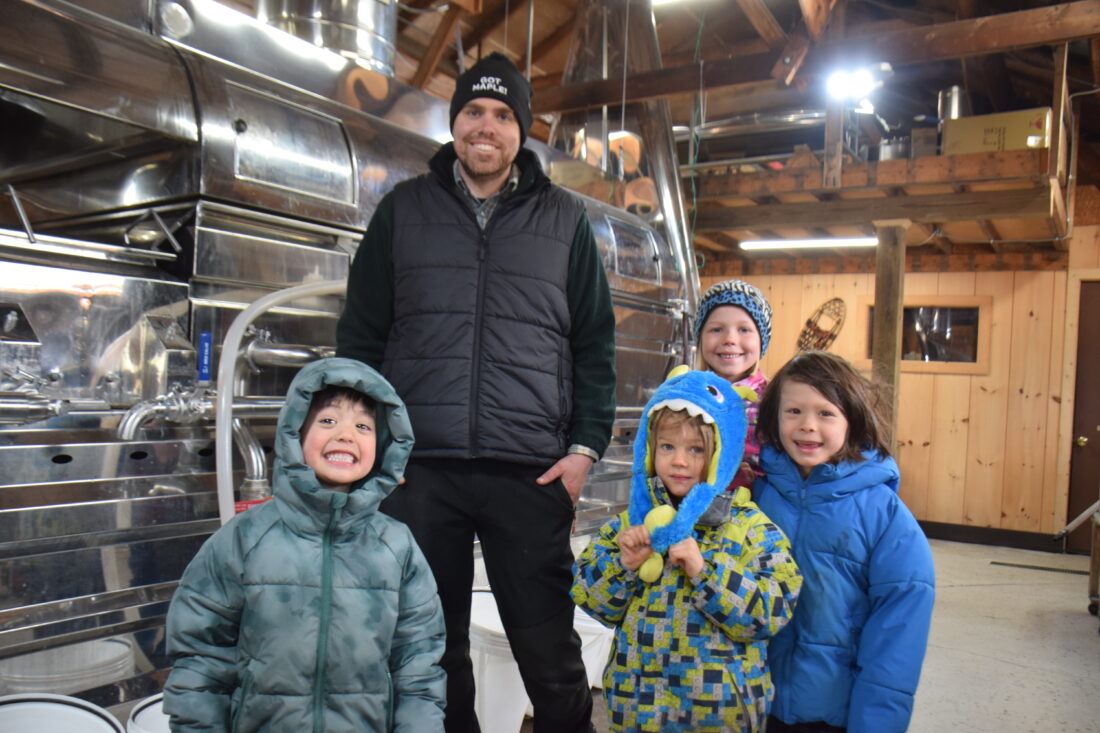
Enthusiastic members of a maple weekend tour group smile at Cornell University’s Uihliein Maple Research Forest in Lake Placid on Sunday. From left, Seneca, Director Adam Wild, Teo, Metta and Manny. (Enterprise photo — Chris Gaige)
LAKE PLACID — Local sugarbushes are firing on all cylinders, literally.
After a turbulent start to March which seemed to mercilessly oscillate between too warm and too cold, the weather finally its groove this week, producing several days of strong sap runs, according to Adam Wild, the director of Cornell University’s Uihlein Maple Research Forest on Bear Cub Lane.
“It’s been a great sap run this week,” he said. “Monday was our best sap flow of the year and it’s been pretty good through the week.”
Wild said production is currently sitting about halfway to the sugarbush’s annual goal, and fortunately, the next week or so looks favorable for sap runs locally. There’s a few warmer-than-ideal days, like today, but these look to be the exception rather than the rule.
It’s still too early to say with much certainty if this will be a good or bad year as Adirondack sap traditionally runs until mid to late April, and a sudden bout of warming before then could end production early and, conversely, another week or two of weather like this could be a boon.
He said sugarmakers south of here have largely reported solid seasons, hitting their goals as the production window begins to close there. As far as it being a good or bad season overall, though, Wild said that’s almost entirely dependent on how the weather shapes up to our north, with Canada accounting for about 70% of the world’s maple syrup production — and 90% of that figure coming from Quebec specifically. Since that’s a later season sap run window than around here, Wild said the jury’s still out.
“The very northern fringes of Quebec have not actually had any sap runs yet,” he said. “It’s still too cold.”
For this neck of the woods, though, Wild oversees one of the larger production operations. The research forest taps 6,500 of its own trees, along with producing syrup for a few thousand other trees between clients who bring their sap to be boiled there.
In all, Wild said he’s producing syrup from around 9,000 trees this year. And his goal, at least for his trees, is to get at least a third of a gallon of sap from each tree. It takes about 40 gallons of sap to produce one gallon of maple syrup.
There’s about 100 miles of vacuum pressurized tubing lines at the research forest, all of which is vulnerable to the usual suspects — branches falling, animals chewing, heaving from sudden temperature swing — but recent technology upgrades, such as wireless, battery-powered sensors help Wild and the other sugarmakers there quickly identify where within the vast network an issue has cropped up, leading to a faster fix and less sap lost.
“We can pinpoint and find those leaks much faster instead of spending multiple days hunting for them,” he said.
The research forest also uses reverse osmosis to remove close to 90% of the sap’s water content — before it hits the evaporator. If it wasn’t for that, Wild said they’d be boiling 24/7 the entire season and wouldn’t be able to keep up with the volume given their boiler capacity.
“It drastically saves on time and energy,” he said.
The research forest is also experimenting with chilling sap, with the goal of being able to preserve it longer before boiling for when there’s a high volume of sap coming in a short time, or generally for the sugarmakers’ scheduling convenience.
If left at room temperature, microbial activity in the sap gives it relatively short shelf life, causing the syrup to have off-flavors from the bacteria growth after it’s boiled, even if it’s safe to consume.
Wild said there’s not yet enough data to determine cooling efficacy, but it’s an interesting question that he hopes emerging scientific research will eventually answer.
Local News
Paul Smith’s College Adirondack Watershed Institute urges boaters to help stop aquatic invasive species this summer
Lake Placid sugarbush sees best week yet
SUNY chancellor talks Reconnect program at NCCC
North Country students attend women in law event
WCSC awards scholarships to locals
SARANAC LAKE — The Women’s College Scholarship Club is accepting applications for $3,000 scholarships which ...