Expect hunger to rise as new SNAP rules take effect
Food providers expect up to 12% of SNAP recipients to be kicked off program
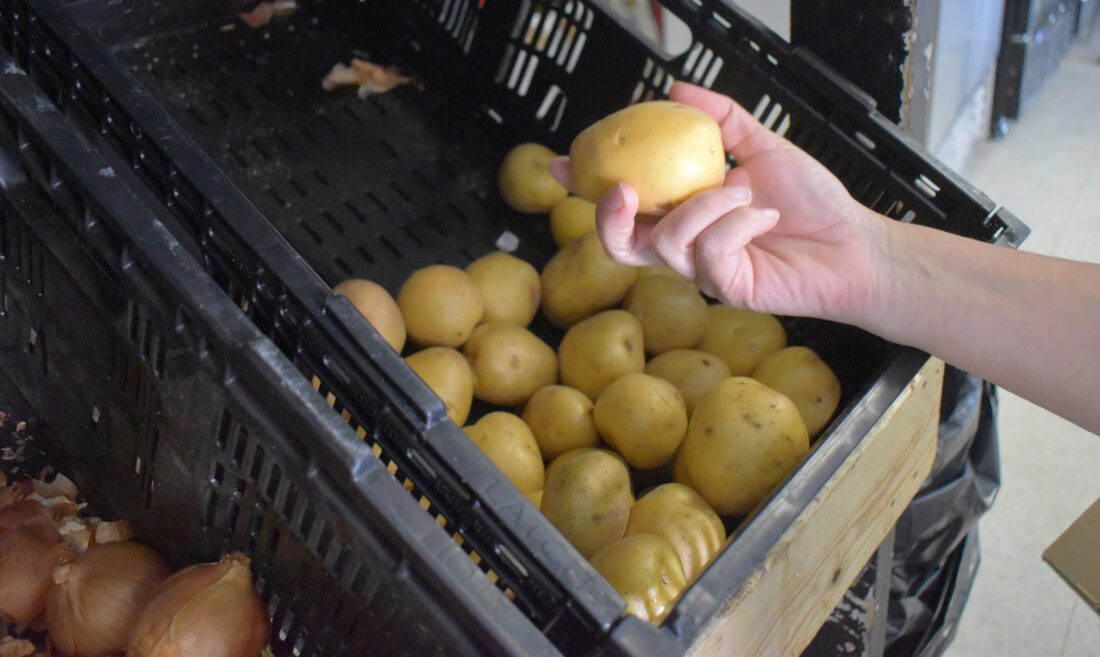
Susan Lintner of the Food Bank of Northeast New York holds a potato from a bin at the Sycamore Collaborative of Schenectady. About 40% of the food the bank distributes is fresh produce, which can be hard to come by for food pantries. (Gazette photo — Todd R. McAdam)
Katherine Green of Gloversville glanced into the basket, the usual range of proteins and carbs. Enough for three days for her and her three kids. Nothing special, today at Foothills Worship Center in Johnstown; it’s a day before the food pantry gets another delivery, and the coolers are nearly empty.
Green has a disability; she’ll be fine. So do two of her three kids, ages 18, 19 and 22. They’ll be OK, too.
But the third? The third has been looking for work all over town. “He puts job applications in, but it doesn’t work,” Green said. That one is going to have some troubles, like up to 9,000 other people in the upper Hudson Valley and eastern Mohawk Valley.
New federal regulations require most able-bodied people to either work or volunteer in order to receive Supplemental Nutrition Assistance Program money – food stamps. A waiver ended March 1 in New York, and the federal government gives recipients three months to get a job or lose the benefit.
The Food Bank of Northeast New York estimates that between 9% and 12% of SNAP recipients will be kicked off the program and will fall to what many SNAP already turn to at the end of every month: food pantries, including the Foothills Worship Center pantry that Green stopped by last week. That’s nearly 34,000 people in the 23-county region the food bank serves.
“How do we connect them?” asked Tom Nardacci, CEO of the food bank. Could people volunteer with the food bank or pantries to qualify, perhaps? And what if they lack transportation? “We’re still trying to figure it out.”
Nearly 75,000 people in almost 45,000 households in the eight-county Upper Hudson/Eastern Mohawk region received SNAP benefits in January, the latest data available, reports the state Office of Temporary Disability Assistance. Somewhere between 6,700 and 8,900 people may lose that assistance.
“Unemployment rates are atypically high,” said Susan Lintner, chief advocacy and engagement officer for the food bank. “The math doesn’t math. That further increases demand in communities without jobs.”
–
‘It’s like a beta test’
–
SNAP provides about $300 per person each month for food, the U.S. Department of Agriculture reports.
To get that help, under provisions adopted in 2025 as part of the One Big Beautiful Bill Act, recipients between 18 and 64 must work at a job or volunteer for 80 hours a month – about four hours per work day.
The provisions to exclude from the requirement people who:
-Cannot work because of a disability, such as Green’s.
-Are pregnant.
-Have someone under 18 in the household.
-Are veterans.
-Are homeless.
-Are 24 or younger and in foster care on their 18th birthday.
People who fail to meet the requirement will lose the SNAP benefit for three months and before getting the benefits back, will have to meet the work requirement for 30 days.
New York’s waiver to meet the requirement ended March 1, and applicants have a three-month window to get a job or volunteer situation, so the clock is ticking.
“I can’t imagine the domino effect the new regulations with SNAP will have on food pantries,” said Lynne Chesebro of Foothills Worship Center. “I understand they are trying to cut down on the abuse of the system, especially having seen the most recent arrests of violators, but many people will be looking for alternative ways to get assistance.”
But many agencies that provide food assistance still have questions. What constitutes acceptable volunteer work? Must it be with a 501c3? Could it be with a 501c4? How about a church group? What about a school or volunteer fire department? They don’t know.
What if a person has a job, but the hours are reduced? What if recipients lack transportation? And what if the recipients are 18, but still in high school? Do the kids have to give up extracurricular activities that can help with college acceptance or provide other educational opportunities?
“There’s such a gray area. I don’t know what the gap is, there are so many variables,” said Michael Finocchi, executive director of Catholic Charities of Fulton Montgomery. “It’s like it’s in a beta test. It might change in the next two months.”
–
Surge coming
–
Food pantries are gearing up for another surge in need. Need spiked last fall during a six-week federal shutdown, the longest in U.S. history, during much of which SNAP went unfunded, until federal judges ordered the federal government to use reserve funds set aside to fund SNAP in just such circumstances.
The pantries were getting through that pinch, but the need didn’t return to pre-shutdown levels.
Finocchi’s agency saw 365 new pantry users in 2025 from 280 new households from the SNAP loss last year, and more for the entire year.
“All together last year alone, it was 710 new people and honestly, I expect that to go up with the new regulations,” he said.
The SNAP shutdown saw the food pantry at Foothills Worship Center jump to 750 people served in November. And while that has dropped a bit to 566 recipients in February, that’s still more than the 355 of February 2025.
The Sycamore Collective projects a 10% increase in need this year, to 1.1 million meals, said Executive Director Aldo R. Juárez-Romero. That wasn’t the plan when the non-profit was created 60 years ago.
“The notion was that a few years later, we’d be out of a job,” he said.
They’re not.
–
Is more enough?
–
The one-house budget proposals in the state Legislature both increase spending on food programs in New York to $75 million from $65 million, advocates said last week at a media event at which state Health Commissioner Dr. James McDonald announced a new grant to subsidize food programs.
The latest effort is the third phase of a four-part infusion of cash, starting with direct distributions of food to hungry people during the SNAP shutdown, followed by distributions of food to the food pantries. The fourth phase, later this year, will combine distribution of food to both individuals and pantries.
Is it enough? Across the state, 2.8 million people get SNAP benefits; the work rules may bump 280,000 of them off the rolls. The state or private donors would need $84 million more than what it spent last year to fill the gap.
“Miracles are possible,” said the Rev. Dustin Longmire of Messiah Lutheran Church of Rotterdam, standing next to McDonald. The church’s food pantry feeds more than 400 people a week. “More often than not, it’s the worst that brings out the best in people.”
“More folks are hungry than at any time since the Great Depression in America,” Longmire said. “The fact that any of our neighbors is hungry in the richest nation in the world is a sin.”
–
‘Because we need’
–
Cheseboro of Foothills Worship Center picked up the phone while chatting.
“A hundred-fifty cases?” she asks. Someone wants to donate some food, probably a trucker whose shipment was rejected. Fresh produce, too, something the pantry is short of on its last day of the month.
It was 150 cases of parsley. Tasty. Good in salads and soups, but the pantry wasn’t going to be able to give all of it away before it spoiled.
“I hate rejecting anything,” she said. “But what are we going to do with 150 cases? The fresh produce you do get only lasts so long.”
Thirty miles away, Linter held a potato at the Sycamore Collective. A fresh, white, medium-starch spud best suited to steaming or boiling, but can also be mashed. It was next to a bin of onions. Volunteers had given out carrots, cabbage, apples, grapefruit and beets that morning.
Nearly 40% of the food the Food Bank of Northeast New York provides is fresh produce, she said, and it’s gold among recipients who would otherwise get frozen or canned food.
Green, in Johnstown, didn’t get that, but she’s not complaining. It was the last day of the month for the pantry, and like many pantries limits how often people like Green can come. She can get three days of food per person in her home – once a month.
And she’d gladly volunteer for it.
“It helps,” she said, even though she has to drive her daughter daily to a special program outside Fulton County – and pack her a lunch. “If she don’t bring a lunch or money, she don’t eat.”
She plans a bit of an Easter dinner for her kids; she likes to do that for all the holidays. She’ll cobble together something from what pantries can provide.
“That’s why we come here,” Green said. “Because we need.”
Local News

Constructing collaboration

Early-season paddlers
The pit and the potential for new housing

Authors to discuss ‘The First Adirondackers’ at John Brown Farm
Expect hunger to rise as new SNAP rules take effect