DEC releases High Peaks visitor management report
Calls for daily hiker caps and accompanying parking restrictions at several popular trailheads, study now up for public comment as DEC considers if and how to implement findings
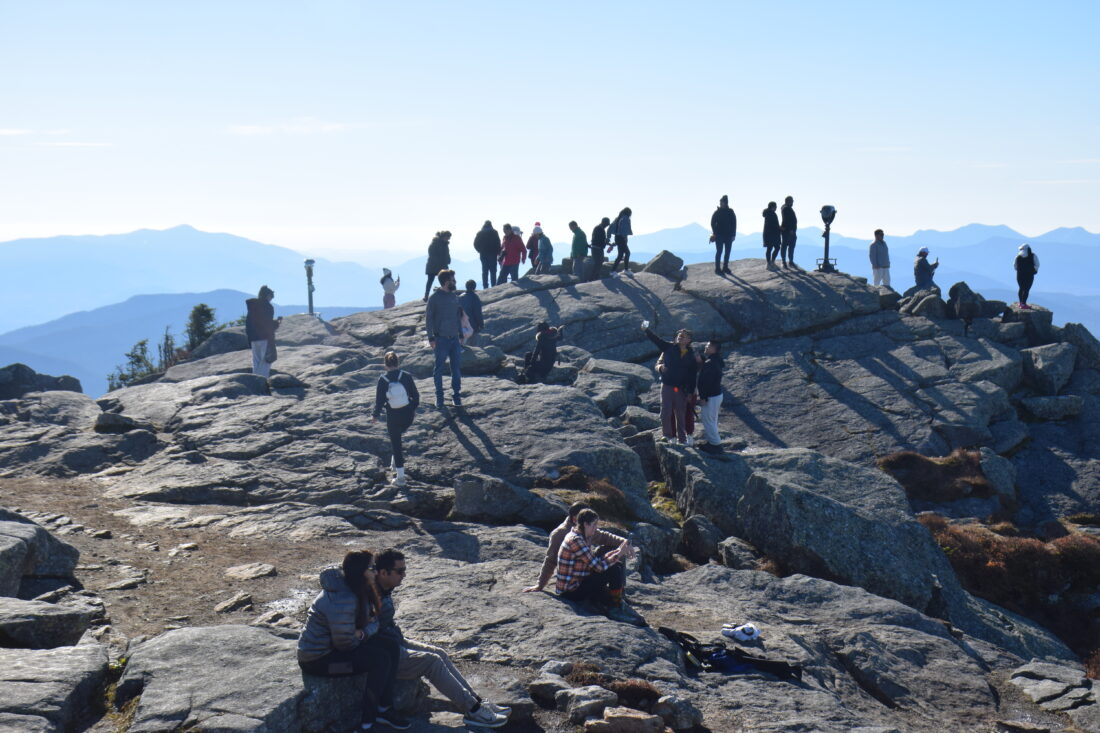
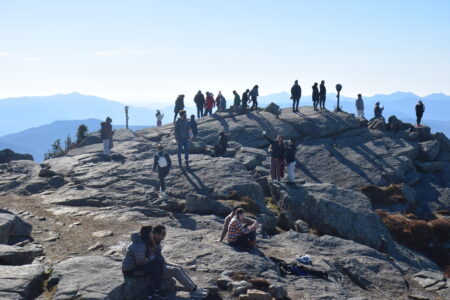
Crowds are seen on Whiteface Mountain's summit on Oct. 11, 2025. Whiteface, with its highway-serviced summit, tends to see drastically more visitors than other High Peaks summits, though crowded scenes like this aren't atypical on busy days at other popular hiking-only destinations like Cascade Mountain or Mount Marcy. The DEC is currently asking for public feedback for a study it released on Friday that suggests daily visitor caps and parking restrictions to limit the amount of hikers on the trails and summits in the High Peaks Wilderness at any given time. (Enterprise photo — Chris Gaige)
ALBANY — For four seasons and counting, summer and fall access to the Adirondack Mountain Reserve trailheads in St. Huberts — gateway to some of the Adirondacks’ most sought-after hikes like Indian Head, Gothics and the Wolfjaws — has been regulated by a parking reservation requirement.
It’s intended to curb overcrowding on road shoulders, parking areas and trails as visitation to the Adirondack Mountains has surged in the last decade or two. Proponents say it has offered a much-needed control valve on trail overcrowding and both the ecological and visitor experience degradation from that, as well as the traffic congestion and car versus pedestrian dangers that come with unfettered road shoulder parking, and that these problems were becoming unacceptable for trails and their infrastructure not designed or adaptable to handle this many people.
But it hasn’t been without controversy.
Opponents have countered that the parking reservations have unfairly boxed people out whose hectic lives often don’t afford them the luxury of planning a trip weeks in advance — when the registration opens — and aren’t chronically sleuthing online to monitor the parking website website for when someone cancels a reservation last-minute, or worse-yet, that people don’t cancel and just no-show, leaving wasted parking spaces for that day. It also makes it difficult to account for ideal or even safe weather conditions for hiking, which often aren’t known with reasonable certainty until a day or two before a planned trip.
As debates roiled on social media, online forums and perhaps even on the trails themselves over whether this parking system was fair — or whether restricting trail access was worthwhile to protecting against traffic dangers, trail erosion or the lack of a “wilderness experience” from crossing paths with so many people in the backcountry — supporters and opponents often seemed to agree on one thing: the AMR was a harbinger.
On Friday, that school of thought inched closer to reality.
The state Department of Environmental Conservation released a consultant’s report — whose two-year bid was awarded in 2023 and the study’s cover is dated “February 2025” — that among a myriad of other best practices recommendations, suggested further restrictions to four of the most popular High Peaks trailheads: Adirondak Loj at Heart Lake and South Meadows, both on Adirondack Loj Road, the Garden in Keene Valley and Cascade Mountain on state Route 73, though plans are underway to reroute that trailhead to the Mount Van Hoevenberg parking area.
The 121-page report can be viewed in its entirety at tinyurl.com/27apvarr. A sister report addressing these same issues in the Catskills can be found at tinyurl.com/6c9k3dvb.
It stops short of calling for a formal permit system to be used at all times during the season — what’s currently the case at the AMR — rather stating that it “may be necessary,” if other methods at keeping visitor numbers below recommended thresholds, such as clear and enforced no-parking zones, are unsuccessful.
The report’s visitation data shows that it’s not a season-long block, but rather weekends only and holidays where current visitation tends to exceed thresholds.
Regardless of how it happens, the report encourages daily visitor caps at most of these trailheads. On Adirondack Loj Road, that’s 400 people, including both South Meadows and the Adirondak Loj at Heart Lake. For Cascade Mountain — either on state Route 73 or at Mount Van Hoevenberg following the reroute — that is 240 visitors. The report doesn’t suggest a cap at the Garden, noting that the lot’s current size combined with the wide array of hiking trails and peak options seems to adequately disburse crowds, but that parking overflow in the nearby hamlet of Keene Valley is an issue in need of remedy.
These daily visitor caps are meant to reduce the number of people and groups passed during a hike, as well as those at the summit area at once, which the report refers to as “people per viewscape.”
The desire to reduce these is derived both from attempting to lessen the ecological impact from trail overuse — though the report calls for a formal ecological study to further examine these impacts, noting that its focus was the visitors’ experience, not the environmental impacts — and the negative experience many surveyed hikers report from passing or being passed by large numbers of other hikers as well as experiencing a summit vista area with a lot of other people.
This sentiment, while substantial, was far from unanimous, indicating that any range of action or inaction the DEC takes from here — like the debate leading up to it — will be controversial. Of hikers surveyed at the Adirondak Loj trailhead, just over half, or 51% reported that “having to pass or be passed by others while hiking makes their hike less enjoyable,” a figure that drops to 40% at the Cascade trailhead.
Stronger majorities — 71% of the Adirondack Loj survey group and 62% of the Cascade group — indicated that they feel it’s important to have opportunities to hike without seeing others for “at least some of the time,” while they are hiking, though this was not further quantitatively teased out in the surveys.
The report did, however, reference a 2021 DEC and Adirondack Park Agency draft management guidance plan, which calls for no more than two “intergroup encounters” — other hiking parties — every hour for 90% of groups within wilderness setting classifications.
The surveys were conducted at the Van Hoevenberg trailhead, at the Adirondak Loj parking area and the Cascade Mountain trailhead on state Route 73. Both were taken exclusively between Thursdays and Sundays from Aug. 4, 2023 to Aug. 20, 2023. The survey size was 217 at the Van Hoevenberg trailhead and 174 at Cascade Mountain, with 76% and 82% response rates, respectively.
The surveys also showed participants photo simulations of summit viewscape areas, asking if did or did not feel “crowded,” with increasing numbers of people in the photo. At Mount Marcy, a majority felt it was too crowded with 12 or more people in the viewscape, and at Cascade a majority felt it was too crowded at 14 or more people, though a notable 45% thought 12 people was too crowded there.
–
Public comment
–
The report’s release does not signify the DEC’s adoption of them. Rather, the agency plans to hold a public comment period where it is asking people to consider what management strategies in the report they like and want to see prioritized, and why, as well as management strategies they don’t like, and why.
The Adirondack Council, an environmental conservation advocacy group, praised the DEC for commissioning and releasing the study, though declined to offer substantive support or opposition until it’s had more time to review the findings.
“The release of the DEC’s Visitor Use Management Pilot Project recommendations for the High Peaks and Kaaterskill Falls regions mark a significant step forward in the state’s transition towards adaptive, data-driven management of heavily-impacted regions of the Adirondack and Catskill Parks,” Executive Director Raul J. “Rocci” Aguirre said in a statement. “These recommendations mark the first step in a longer process to reshape the way our state manages the Adirondack and Catskill Parks. It will help state officials safeguard our natural resources, strengthen visitor safety and providing for a world-class wilderness experience promised to all New Yorkers.”
Aguirre encouraged the DEC to maximize public comment opportunities, adding that the state’s investment and effort put into the report is a welcome difference in tone from the Adirondack Council views Washington, D.C. at the moment.
“At a time when the federal government is diminishing its leadership in wilderness protection and recreation management, it is good to see New York moving toward modernized management,” Aguirre said. “Implementing science-based modern management will serve the Park and people of New York well.”
Written comments on the report will be accepted through June 1 and can be emailed to forestpreserve@dec.ny.gov or mailed to or mailed to Josh Clague, NYS DEC, 625 Broadway, 5th Floor, Albany, NY 12233-4254. The DEC will also host a virtual public hearing at 6 p.m. on April 22. The registration link is tinyurl.com/ys24x8px. The Webinar number is 2823 523 9467 and the password is welcome1 or 93526631 when dialing in from a phone or video system.
“The reports represent one set of tools and recommendations that DEC will utilize in future land management decision making,” the agency said in a statement. “These independent consultant products will be evaluated alongside ecological assessments, trail and other recreational facility assessments, community input, statutory and regulatory requirements and other land management principals and partnership opportunities.”