
Wilmington board to revise, revisit manufactured housing code changes
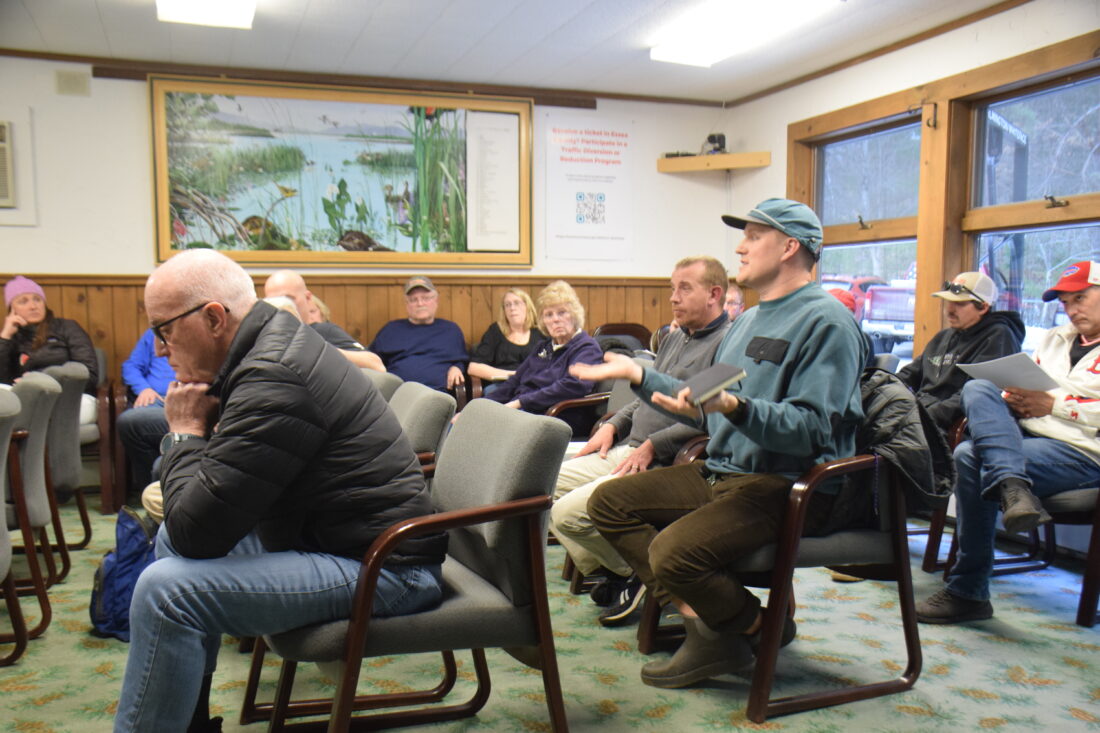
Evan Bottcher addresses the Wilmington Town Board at its Wednesday public hearing. (Enterprise photo — Chris Gaige)
WILMINGTON — The town board is going back to the drawing board after a spirited public hearing that saw several community members voice concerns to a proposed local law that would ease current zoning code restrictions on manufactured homes.
The intent of proposed Local Law No. 2 of 2026 is to make it easier for manufactured homes to be installed throughout the town by reducing the minimum lot size from the current 3 acres to what the code required for traditional, or stick-built, homes. In the hamlet area, colloquially considered the “center” of town, the minimum is one half-acre, increasing to one acre in the moderate intensity land, three acres in low intensity, five in rural use and eight-and-one-half acres in resource management.
It would also lower the minimum size of a dwelling unit from 500 to 300 square feet. The proposed law, as it was proposed going into Wednesday’s public hearing, is available on the town’s website at tinyurl.com/5hbxdx72.
The majority of public comments were in opposition to the law. Predominant concerns included that the definition of “manufactured home” was too vague and expansive, that it could have the unintended consequence of opening up more plots for secondary and vacation homes, that it could lead to buildings that would unfairly diminish the values of existing properties and that it would detract from the main corridor’s aesthetic appeal to residents and visitors alike.
Those who spoke against Local Law No. 2, stated that it would be disingenuous and false to equate their opposition to “looking down upon” those who live in trailers or manufactured homes. Several speakers said they either currently own, have immediate family members living in or have spent significant earlier portions of their lives in these types of dwellings — and that there’s nothing wrong, shameful or “less than” in doing so.
Rather, the negative externalities that come with lowering the manufactured home building lot size would, or could have the serious potential to, negatively impact the town’s character by promoting a “patchwork” of development, especially in the hamlet, rather than a cohesive aesthetic. Evan Bottcher, who owns the Hungry Trout Fly Shop on state Route 86 and the Adirondack Anglers Outpost building at Wilmington’s four corners, spoke on this, stating that it’s a concern that applies to far more than just manufactured homes, but that he feels this proposed law is a step in the wrong direction.
“The reality is, this is a tourist town and a tourist corridor,” he said. “Every study out there (and) experience of any other mountain town will show you don’t want to put certain types of properties — and it doesn’t matter if it’s a mobile home, stick built — we just had a $25 million KOA put in and it looks like s***. The town needs to step up and get in charge of the aesthetic of these things: how they look, how they’re built. I don’t care if it’s a mobile home or a trailer. I don’t care if it’s a McMansion or whatever it is.”
This concern is exacerbated by the absence of screening requirements that currently apply to residences across the board, Bottcher added.
“We cannot afford to open up further development and let someone screw up a lot on the main corridor,” he said. “Becuase we’ve admitted here, we have no control over what goes on the lot. We have no regulations on screening the lot. Someone could put whatever they wanted on the thing. The other thing: who’s controlling that lot to make sure it falls into the hands of a family who needs homes?”
Nearly everyone who spoke against the law also acknowledged the current housing shortage, and that trying to solve it is a noble endeavor — one that may not be accomplished by this law, mainly because there’s no control on who could buy building lots. Bottcher laid out a hypothetical that he said isn’t too hard to imagine in a town tucked under the slopes of one of the most storied ski mountains in the East.
“If I see a destination town that I don’t live in, I can’t access the property (but) I ski and I bike there all the time, if I see a realtor put a one acre lot up with a tiny home already on it (for) $150,000, I’m going to buy that to go play in. I’m not going to buy it to raise my family in Wilmington. Someone just gave me a ‘free’ little vacation plot,” he said. “In this way, we have no option to limit who’s buying these plots.”
Bottcher felt that the board was approaching the housing problem from what he referred to as “the best case scenario” mindset. He said the law would have such consequential zoning impacts for Wilmington that it demands a worst-case approach, with sober thought put toward any array of ways someone could take advantage of it for personal gain and with little regard for the town’s betterment.
Councilman Darin Forbes noted early in the discussion that the town’s current zoning ordinance makes little distinction for what counts as a “manufactured home,” and felt that it’s problematic that this proposed law did not do so either.
“Based on the language that we have in there, saying ‘manufactured homes,’ that does not differentiate between trailer, or a CrossMod or a double wide,” he said. “A manufactured home can be any of those things, so when you said it’s not talking about trailers, it very well could be.”
Wilmington’s code excludes “self-propelled recreational vehicles, travel trailers or modular structures,” as manufactured homes, but otherwise leaves the door open. The code’s definition is below.
“A structure, transportable in one or more sections, which, in the traveling mode, is eight body feet or more in width or 40 body feet or more in length, or, when erected on site, is 320 or more square feet, and which is built on a permanent chassis and designed to be used as a dwelling with a permanent foundation when connected to the required utilities, and includes the plumbing, heating, air-conditioning, and electrical systems contained therein,” it states. “The term shall include any structure that meets all of the requirements of Article 21-B of the Executive Law of New York State except the size requirements and with respect to which the manufacturer voluntarily files a certification required by the United States secretary of housing and urban development and complies with the standards established under Title 42 of the United States code.”
The code’s definition stipulates that “manufactured homes” must be built no earlier than 1976 — structures that were built before then are referred to as “mobile homes.”
Though board members have discussed possibly creating a more recent “cutoff year” for manufacturing — as building standards have improved, Forbes said the more apt distinction should be the type of structure, not the year it was built.
Cliff Holzer, who recently announced his candidacy for town supervisor, echoed this in a public comment.
“I don’t think there’s a lot of difference between a single wide trailer from 1998 to a single wide you’d buy today,” he said. “It’s going to look identical. Do we want a single wide trailer on the main corridor? I have no strong feeling either way, but I don’t think a lot of people understand: there’s a big difference between a manufactured home — modular, double wide — and a single wide trailer.”
Bottcher read aloud an email from his father, Jerry Bottcher, who is an alternate member on the planning board. Jerry said the town’s change to make it more difficult for manufactured and tiny homes wasn’t without reason — and it was important to remember that.
“Thirty years ago, we disallowed mobile homes because everyone was taking advantage of it,” he wrote. “Mother-in-laws moving in next door, neighbors totally unhappy, etc. There are numerous substandard lots in the area. You may run the risk of realtors buying them and putting in small tiny homes and selling them quickly. Additionally, I don’t know of anyone who’d be happy to have a 15- by 20-foot home move in next door. That is smaller than the size of the room you’re in now. Additionally, be sure a manufactured home is exactly that, and not a mobile home.”
Ed Wood felt the proposed law was too vague, which he said was a “glaring deficiency.” Wood then read a prepared statement, adding that he had been thinking a lot about the law in recent days and didn’t want to ad-lib his thoughts.
“The shortage of affordable housing is a problem many communities face in New York state, Wilmington is not unique in that respect,” he said. “What is unique, however, about Wilmington is its special character, its history, its image and natural resources. I understand the desire to address the affordable housing issue in Wilmington. This issue requires careful and serious thought — and a well-developed, detailed plan complete with standards for implementation that will not jeopardize or adversely affect the qualities that make Wilmington special.”
Wood, who said his educational background is in land use planning, said further revisions are needed.
“With all due respect, and I hope you don’t take any offense to this, the proposed amendment is not ready for prime time,” he said. “I’m just being blunt. As currently drafted, it’s shortsighted and seriously lacking in all the necessary standards and details.”
Town Supervisor Tim Follos said he didn’t take offense to it, and the hearing’s point was to gather ideas, concerns and reasons for support from the public.
“We heard from the public, which was the goal,” he said. “Obviously, we won’t be moving forward with it as it was written.”
Deputy Supervisor Laura Dreissigacker Hooker added toward the end of the hearing that an earlier version of the proposal had more details, but that those were taken out to “start clean,” with an initial public hearing, and then move to build those out based on public feedback.
Follos said that an earlier version included site plan reviews and screening, but feedback he heard prior to Wednesday was largely centered around those continuing to be an unfairly high burden for manufactured homes.
“We decided to just present the most straightforward version of what we’re trying to accomplish and see what the public thought,” he said. “My takeaway is that the public opinion is mixed and there won’t be 100% support for whatever we ultimately come up with. But we will now move in the other direction and try to address a lot of the thoughts and concerns and comments that were raised last night.”
Bottcher encouraged the board to table these proposed changes until after the comprehensive plan is updated, which Wilmington is currently in the process of, though nowhere near the finish line, according to Follos, who estimated it would take at least another year-and-a-half and doesn’t plan to wait.
“I am as aware as anyone that these can be politically thorny issues,” he said. “We were elected to deal with politically thorny issues and accomplish things. Kicking the can down the road for three years, making an excuse, is not acceptable to me. My sense is that it’s not acceptable for the rest of the board.”
The proposal wasn’t without its defenders. Pat Winch, who sits on the town’s planning board, said the rate at which community members continue to be priced out is dire, and demands a timely solution.
“We’re losing families at an alarming rate,” she said. “Just off the top of my head, I know five families that had to leave.”
Fellow planning board member Carol Wiebe thought “tiny homes” were a great idea, especially for seniors who no longer need as much space, and applauded the proposed law for decreasing the minimum dwelling space.
Julia Daby said that perhaps the proposal could be amended to require a permanent foundation, but that at the end of the day, there needs to be a way to make for more affordable housing in Wilmington, and the surge in home prices has made it exceedingly difficult for successive generations of families to continue in Wilmington, losing the town’s character in the process.
“If you’re putting restrictions on something that’s affordable and attainable for them, then they are the ones who are going to struggle,” she said. “We’re going to struggle because our kids won’t be able to live here. We’re going to struggle because we won’t see our grandkids. That’s sad.”
Council Member Hanna Cromie said at the end of Wednesday’s meeting that both sides made salient points. Moving forward, she said she was amenable to including site plan or screening requirements in future drafts.
“I certainly feel like I’m being priced out of Wilmington a little bit, and this could be something that helps to alleviate that,” she said. “But I also can see the concerns of the worst case scenario of what would happen. It’s not always going to be that best case scenario that everybody’s thinking of.”
Forbes said he was open to revising the codes to allow manufactured homes to the moderate density-zoned areas of town, which would bring down the minimum acreage from three to one acres, provided there’s a site plan review. He also reiterated that, although the discussion grew heated, opposition to the law should be confused with animosity toward those with less means.
“I don’t think anybody in this room is here to put people down,” he said. “That’s really not the point of what anybody’s talking about here. One of my things is I’ve failed to understand how this is going to address the housing crisis, and this is how it’s being sold.”
Forbes added that much of the price problem is location, location, location — less so than the structure that sits on it.
“Chances are, if that lot is affordable, a young family already would have bought it and maybe built a small house. It’s probably going to open up the doors for more people out of town to buy that lot and put something cheap in and use it as a vacation rental.”
The board voted to leave the public hearing and comment period open at least until its next meeting, which is currently slated for April 14. It’s unclear when the proposed law’s next version will be released. Written comments can be emailed to townclerk@townofwilmington.org.
Local News

Fishin’, swingin’ and climbin’

SLCSD proposing $39.7M budget
Wilmington board to revise, revisit manufactured housing code changes
Historic Saranac Lake announces grand opening of the expanded museum
SARANAC LAKE — Historic Saranac Lake announced the grand opening of its expanded museum campus, with two events ...
DEC: 2025 hunting season second highest statewide bear harvest on record
The state Department of Environmental Conservation announced on Monday that hunters harvested an estimated 1,759 ...
IDA approves Tupper’s OWD PILOT
TUPPER LAKE — The Franklin County Industrial Development Agency board voted to approve a 20-year PILOT agreement ...