
Wilmington board sets sights on affordable housing zoning changes
Advocates cite crippling housing crisis, opponents warn of ‘trailerfication’
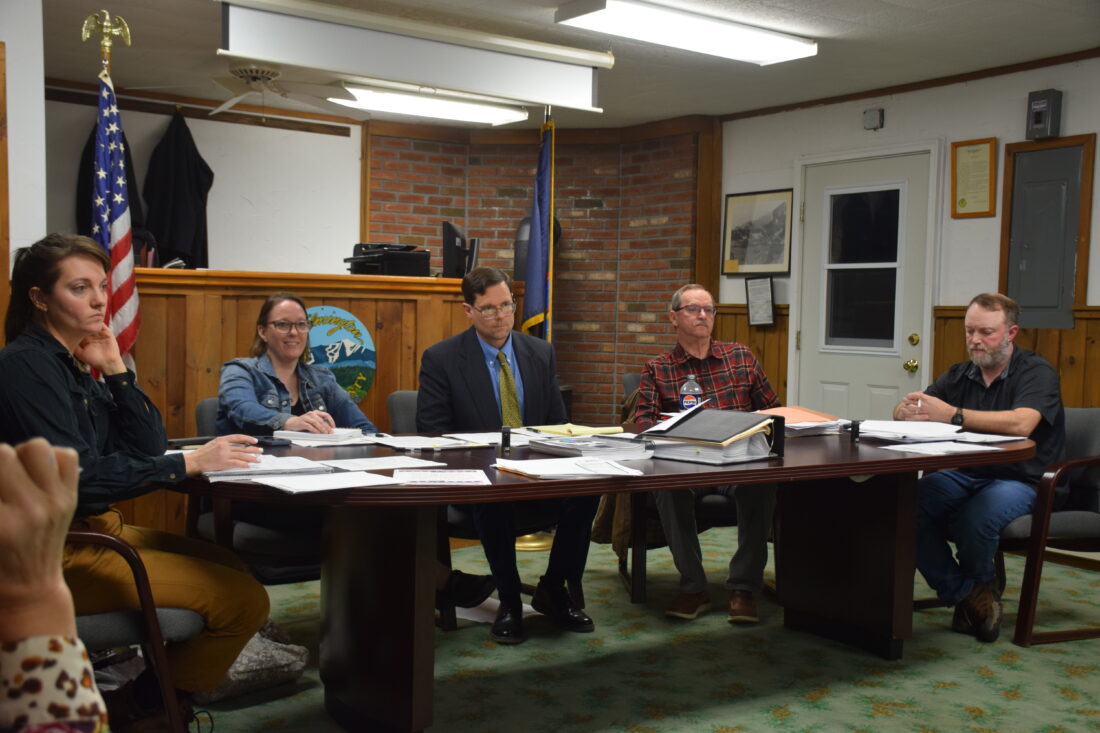
The Wilmington Town Board is seen at its March 10 meeting. From left, Council Member Hanna Cromie, Deputy Supervisor Laura Dreissigacker Hooker, Supervisor Tim Follos, Council Member Randy Winch and Council Member Darin Forbes. (Enterprise — Chris Gaige)
WILMINGTON — On the heels of enacting changes intended to curtail large retail development and beef up screening requirements for commercial projects, the Wilmington Town Board is eyeing revisions to the zoning code once again.
There is a public hearing on the proposed Local Law No. 2 of 2026 at 6 p.m. on Wednesday, March 25 at the Wilmington Community Center. The law’s intent is to make it easier to install manufactured homes through friendlier zoning regulations.
The proposed law would lessen the amount of lot size needed for a manufactured home. It also seeks to decrease the minimum square footage of a “dwelling unit” from the zoning code’s current 500 square feet to 300 square feet.
Proponents say these will help address Wilmington’s housing shortage by making it easier to install relatively inexpensive, but structurally sound and aesthetically unobtrusive, manufactured or mobile homes in more places than where they are currently allowed — and that the housing shortage there has grown extreme, pricing out many would-be full time community members and demanding action.
Opponents counter that the types of dwellings the proposed changes would allow for will have an adverse aesthetic effect on Wilmington, especially in its hamlet area, and that the current zoning codes sufficiently allow for them in the town’s outskirts.
–
Current codes
–
The current zoning ordinance requires all manufactured homes, regardless of where in the town they are, to sit on a minimum of three acres. Traditional houses, meanwhile, have a sliding scale of minimum acreage dictated by the various land use classifications that exist throughout Wilmington — hamlet, moderate intensity, low intensity, rural use and resource management.
Though each classification — which is subject to Adirondack Park Agency review outside of the hamlet area — comes with its own set of rules, the minimum building lot size for a residential dwelling increases toward the “outskirts” of Wilmington. This is common throughout the park. In the hamlet area, colloquially considered the “center” of town, the minimum is one half acre, increasing to one acre in the moderate intensity land, three acres in low intensity, five in rural use and eight-and-one-half acres in resource management.
Given that many of Wilmington’s residences exist in the hamlet or moderate intensity zones, the current zoning ordinance generally imposes a higher lot size burden on manufactured or mobile homes than traditional homes.
This is intentional. It was part of a 2013 zoning code overhaul that sought to make Wilmington more upscale, in part, by effectively relegating manufactured and mobile homes to the outskirts of town, given that most of the residential building lots in the hamlet and moderate use areas are below three acres to begin with.
–
Supply and demand, a common story
–
Town Supervisor Tim Follos, who supports Local Law No. 2, said it was an understandable move for the town at the time, but things have since changed — drastically. He said as second-homes and short term rentals have grown in Wilmington since the coronavirus pandemic, housing supply has woefully underpaced demand.
It’s hardly an unheard-of situation in the Adirondacks, though it’s particularly acute in Wilmington. The town of about 1,200 was already, even in the context of Essex County, small, and its housing stock limited. Meanwhile, Wilmington’s immediate proximity to the Whiteface Mountain ski center and a surrounding plethora of year-round recreational gems make for marquee STR selling points to vacationers.
These factors combined led to skyrocketing home prices. The Zillow Home Values Index — an imperfect but ballpark estimator that takes into account home sale values, frequency and other market factors throughout the region — shows Wilmington’s median single family home index at $396,211 in February, 2026, the most recent month data was available, up from $211,571 in March 2020, an increase of 87.3% in nearly six years.
The index estimates, during the same time period, a 91.4% increase for the median price of a single family home in Jay, an 84.4% increase in Upper Jay, a 68.3% increase in Keene, a 63.3% increase in Tupper Lake, a 58.7% increase in Saranac Lake and a 13.3% increase in Lake Placid, which saw a similar rise during the pandemic before prices actually fell from a median high of $454,955 in June 2023 to $328,913 in February 2026.
It’s unclear what combination of factors may have caused this outlying estimate for Lake Placid — and indeed the Zillow model is just one estimate that may not be fully accurate — though the village and town have been successful at completing two large-scale workforce housing projects, Fawn Valley and MacKenzie Overlook, which added 82 price stabilized units to the market during that time.
–
Hurdles and potential
–
For its part, Wilmington has run up against headwinds in its attempts to build affordable housing. An approximately 10-acre parcel across from the former Wilderness Inn on state Route 86 was purchased for $90,000 by the town in 2019 using grant money — well below market price, according to then Supervisor Roy Holzer.
The plan was to construct six housing units in three townhouses to be rented to households at or below 80% of the area median income. While the project was met with initial enthusiasm, progress has been slow and stymied by various bureaucratic and regulatory hurdles.
Deputy Supervisor Laura Dreissigacker Hooker, who made affordable housing a cornerstone of her campaign when she was first elected to the town board in 2023, said that while that project will hopefully eventually play a key role in combatting Wilmington’s housing shortage, Local Law No. 2 takes a different approach to a problem where she said an all-hands on deck mentality is needed.
“When I ran for office in 2023 I said, ‘Hotel-like structures are being built to house locals, while homes are being turned into STRs and used as hotels,'” she said. “Almost everyone who grew up here had a house with a yard for kids and pets to play in. People who want to live and work here full time deserve that same space of their own. While apartments and townhouses are valid solutions, I have some other ideas.”
Dreissigacker Hooker said the zoning changes in Local Law No. 2 could create an “expedited way” to encourage new, affordable home ownership in Wilmington.
“We should discuss altering the current three-acre lot minimum for manufactured homes, and to ask for the allowance of tiny homes (under 500 square feet), while giving the zoning and planning board the ability to review designs and proposals,” she said. “This would help construct new housing in a timely and more affordable way.”
Follos said he views zoning restrictions as an obvious place to start when it comes to continuing the push for affordable housing in Wilmington. For one thing, Follos said this proposed change — while its ultimate effects will remain inherently unknown until time passes with the new codes in effect, should the law be adopted — eschews many of the obstacles the town had run into thus far.
“We’re not relying on grants from the state. We’re not relying on things that will take 20 years to accomplish. We’re doing something that the town alone can achieve,” he said. “It could add one unit a year to the town, it could add four or five. I don’t think it’s going to unleash a tidal wave of manufactured housing in Wilmington. But it will make a difference, and we’ll see how much of a difference it does make.”
Follos doesn’t see this as a of carve-out for manufactured or mobile homes. Rather, it’s holding them to the same development regulations as any other residential dwelling.
“We are treating manufactured homes the same as other homes,” he said. “They will be held to the same standards as other types of dwellings. Currently, they are held to a different standard. A more rigorous standard. A standard that makes it much harder to install them or for people to live in them in Wilmington — and our goal is to treat them the same.”
–
Perils and eyesores
–
Council Member Darin Forbes, often the lone dissenting voice on this town board, said he has significant concerns with the proposed law. He is worried it could lead to a proliferation of trailers all throughout the town, which would detract from its aesthetic appeal. Forbes also felt it’s at odds with Local Law No. 1, which contained the retail development restrictions.
“I think it’s a bad road to go down,” he said. “I feel like sometimes they bite off their nose to spite their face. They sit there and they say they don’t want to look at a big monstrous building, but yet they’ll allow trailers in the center of town?”
Forbes added that the 2013 zoning language helps to preserve the aesthetics, and as it’s currently written, there are already options for manufactured home locations, and there’s reasons for not expanding them into the center of town.
“(The) idea behind it was to try to make Wilmington more upscale and invite families and things like that, but not necessarily bring it down to trailers in the center of town,” he said. “There’s plenty of lots on the outskirts of town where people can have trailers, and they’re more than welcome, but we were trying to discourage trailers in the center of town.”
Forbes said he’s amenable to compromising with the other board members to undo the three-acre restrictions in the “moderate intensity” zones, bringing them to one-acre minimums with special use permits, but was adamant against lowering it to the 0.5 acres.
He pointed to a currently open lot at the “four corners” in the hamlet — the intersection of state Route 86, the Whiteface Veterans’ Memorial Highway and Bonnieview Road — as an example of a location he feels would be an “injustice” to erect a manufactured home.
“If there was a trailer sitting up on the top of that stone wall as you’re driving right into the center of town, and that is the first thing you’re looking at at our main four corners, I feel like that would be a detriment and an eyesore to town,” Forbes said.
Though Forbes acknowledged he doesn’t have a lot of political leverage on this board — his one vote not being enough to stop a local law’s passage when a simple majority is needed and the other four members are often ideologically united — he feels his opinion speaks for a large portion of the town’s people, and that it’s important for him to bring those to the table.
“I am kind of the lone vote on a lot of these issues, so I’m trying to make sure to represent the people who are coming to me and get that feeling out there,” he said. “They said there were a few years where they lost in a lot of three to two votes and they felt like there was never any compromise. And now it’s a four to one vote and I don’t feel like there’s any type of compromise. I mean I can make valid points right down to very common sense, factual items and there does not usually seem to be a whole lot of compromise when it comes to this stuff.”
Forbes, who figuratively and literally sits in the same seat as Follos when he was in the minority during the last board, hopes the other members will take his opinions into consideration, but isn’t confident.
“I’m trying to be moderate and flexible with people, but again, it doesn’t really seem like they’re trying to work with me on a lot of that stuff,” he said. “They have their ideas and they want to push them through as is and not really discuss. I’ve had many people who support me come to me and say, ‘That’s one of the dumbest things that they can do,’ — if they invite trailers all over into the center of town.”
–
Puzzle pieces
–
Follos and Dreissigacker Hooker vehemently disagreed with that the notion that this law would turn Wilmington into a trailer park, and that these adverse aesthetic impact concerns, while understandable, often fail to take into account the engineering and architectural improvements that the manufactured home building process has benefitted over the last decade or so, much less the severity of Wilmington’s current housing shortage.
Follos said today’s manufactured homes often look “indistinguishable” from traditional homes occupying similar footprints. Dreissigacker Hooker echoed this, speaking from firsthand experience.
“Manufactured homes have come a long way over the years and are a wonderful, viable option for those looking to have a turnkey, brand new home that is not a fixer upper,” she said. “All for a fraction of the cost of a new build. I should know, I own one.”
Dreissigacker Hooker also said the financial appreciation, and sense of community, that can come from outright home ownership, even if it’s a small structure on a small parcel of land, are not insignificant benefits.
She said it sets Local Law No. 2 apart from a lot of the other affordable housing initiatives, where owners are often locked into a set of deed restrictions that, while understandable and in fitting with the projects’ concept of keeping the price affordable, are a different long-term path as fee simple ownership, and it’s good to put the latter as an option on the table, while remaining affordable.
Dreissigacker Hooker also heralded the law’s dwelling unit minimum square footage decrease as being conducive for allowing “tiny homes,” which are usually 400 square feet or less, to become a living option in Wilmington. She said that while they’re not for everyone, they should be an option and, for many, are a piece of the puzzle when it comes to solving the housing crisis.
“Tiny homes are also an excellent way to literally get people’s feet in a door,” she said. “Not everyone needs an enormous home. Perhaps they’re just starting out, or are a single person who wants a small space, or can only afford a tiny home. This law also addresses their needs. Also, these homes can be a starter home, and be added onto in the future as funds and time allows. There is a tiny home movement afoot, let’s seriously consider why.”
–
Public hearing
–
Follos said that while he feels a majority of the town board is currently committed to the spirit of Local Law No. 2, anyone who agrees, disagrees or simply is curious about the law should attend Wednesday’s public hearing, and make their opinions known.
Public hearings are a crucial part of considering and shaping local laws, Follos said, and if there’s widespread opposition, he wants to hear it. The proposed law, as it’s currently drafted, is not set in stone, he said.
“If we hear at the public hearing a lot of opposition to it, we will definitely be looking at ways to compromise, to show the people who oppose it that we understand their concerns and move in their direction,” he said. “We will listen to what the public says. If there is a ton of opposition, we will recognize that and if we eventually pass it, we will modify it to reflect the comments and what the people who are willing to take the time to attend the meeting and speak prioritize.”
The law, as it’s currently proposed, is available in its entirety at tinyurl.com/5hbxdx72.
Regardless of how the local law ultimately shakes out, Follos said not taking action on Wilmington’s current housing situation would be dereliction of his duty. It’s hard to think of an issue that’s more core to the community’s fabric, and that the straits couldn’t be much more dire than they are now.
“When it affects someone else, it’s a housing shortage,” he said. “When it affects you or a member of your family, it’s a housing crisis. I think a lot of people are not aware of just how severe it is. But, at least four members of the town board are aware of it.”
Local News
Wilmington board sets sights on affordable housing zoning changes

Thousands take to Van Ho to watch XC World Cup
DEC closes seasonal access roads due to ‘mud season’
SARANAC LAKE — Two state Department of Environmental Conservation regions are closing snowmobile trails and mud ...

OWD proposed PILOT public hearing tonight in Tupper
Saranac Lake man pleads guilty to predatory sexual assault of a child
SARANAC LAKE – A Saranac Lake man is expected to spend 25 years to life in prison after pleading guilty to ...
APA to lease Saranac Lake building for 43 years
SARANAC LAKE – The village of Saranac Lake has agreed to lease its downtown 1-3 Main St. building to the ...