Wastewater treatment plant grant
St. Armand gets grant to make plant meet state effluent regulations
-

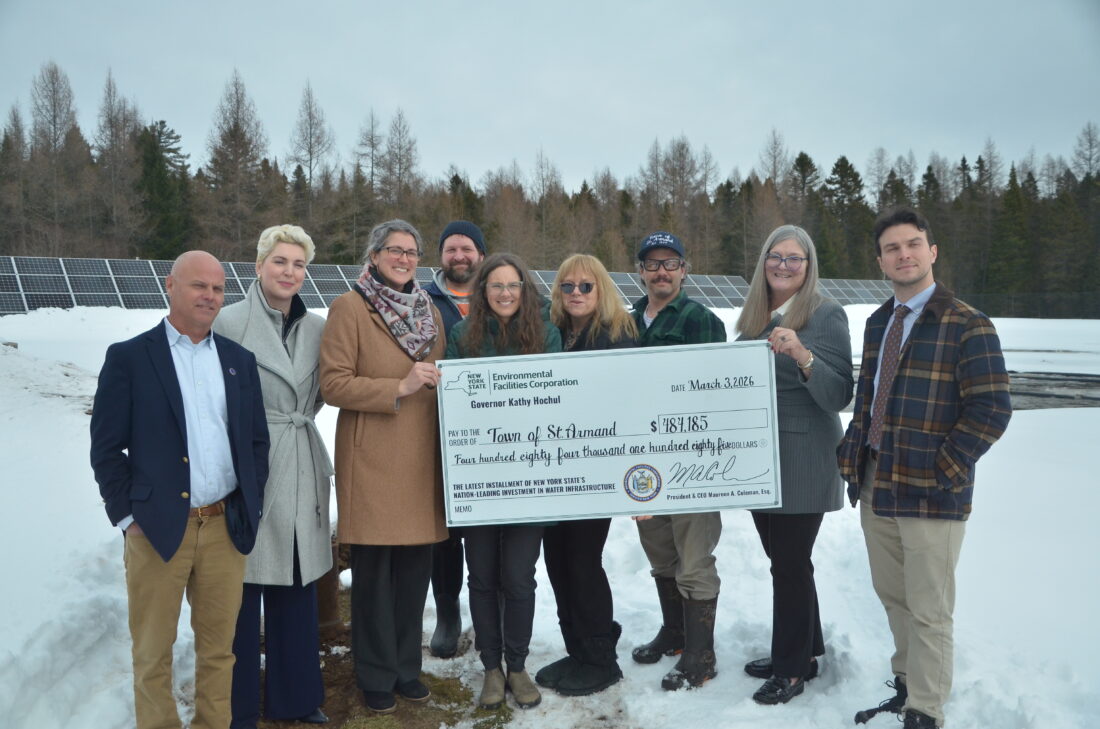
- A group of state and St. Armand town officials standing in front of the town’s wastewater treatment plant grin an hold a $484,185 check the town got, representing a grant it received from the state Environmental Facilities Corporation Communications for a disinfection upgrade. (Enterprise photo — Aaron Marbone)
-
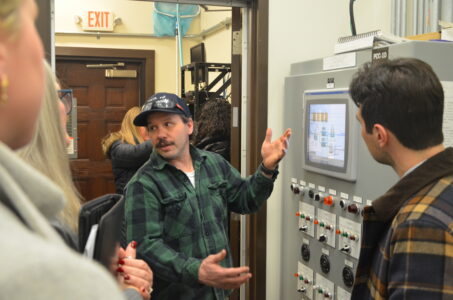
- St. Armand Wastewater Superintendent Josh Woodruff shows off how the wastewater treatment plant works to several state officials on Tuesday. (Enterprise photo — Aaron Marbone)
-
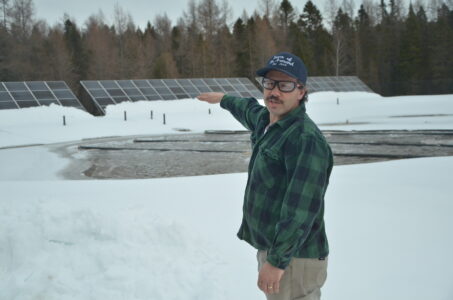
- St. Armand Wastewater Superintendent Josh Woodruff points to one of the “lagoons” where wastewater churns for a month before being further treated and discharged into the Saranac River and Sumner Brook. (Enterprise photo — Aaron Marbone)
A group of state and St. Armand town officials standing in front of the town’s wastewater treatment plant grin an hold a $484,185 check the town got, representing a grant it received from the state Environmental Facilities Corporation Communications for a disinfection upgrade. (Enterprise photo — Aaron Marbone)
BLOOMINGDALE – “Say WIIA!” state Environmental Facilities Corporation Communications Manager Heather Cameron said as she snapped a photo of a group of state and St. Armand town officials.
They were standing in front of the town’s wastewater treatment plant holding a giant $484,185 check representing a Water Infrastructure Improvement EFC grant the town recently got for upgrades at the plant.
A change in state regulations requires that the town add a new layer of seasonal disinfection to the treated liquid waste it releases back into the Saranac River and Sumner Brook. The project comes with a nearly $2 million price tag, and with just over 300 sewer ratepayers in the town, it would be a heavy financial lift.
But, St. Armand town Supervisor Davina Thurston said with this award, the town has the cost around 90% covered by grants, meaning residents will not have to pay much for this state mandate.
–
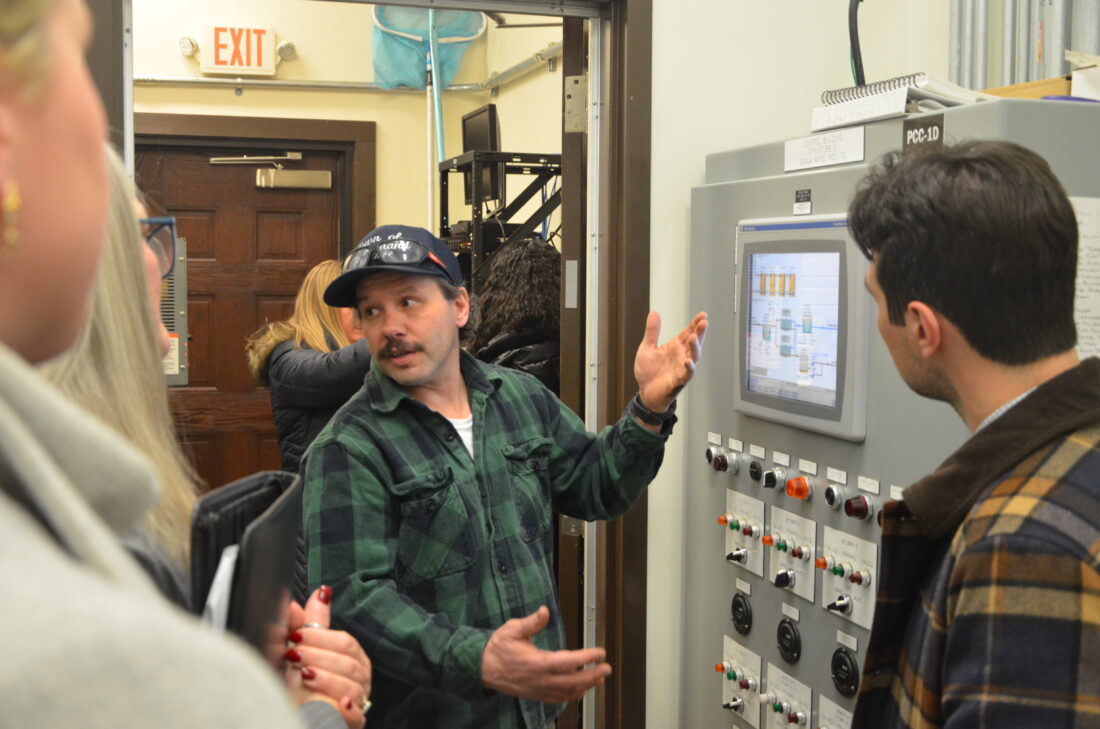
St. Armand Wastewater Superintendent Josh Woodruff shows off how the wastewater treatment plant works to several state officials on Tuesday. (Enterprise photo — Aaron Marbone)
What needs to change
–
Behind the crowd of grinning officials, large pools of brown water bubbled and frothed. The solid sewage waste was removed at a different location and brought to the transfer station.
The wastewater spends a month churning in these “lagoons,” allowing bacteria to “eat” and break down the organic contaminants like phosphorus, nitrates and ammonia. This is an ancient process – one that the Romans used, Wastewater Superintendent Josh Woodruff said.
In the summer, he said these pools are resting grounds for snapping turtles, ducks, geese and the occasional deer. Then, the liquid is treated with chemicals before it flows through clarifiers and is discharged into the Saranac River and Sumner Brook.
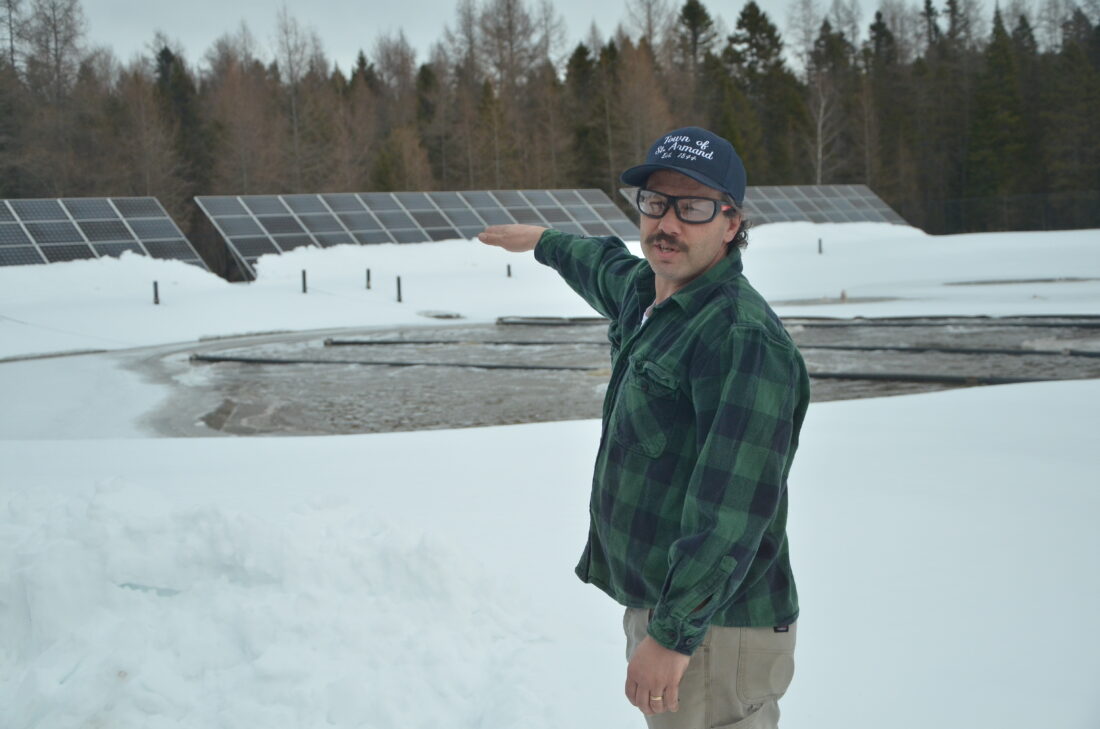
St. Armand Wastewater Superintendent Josh Woodruff points to one of the "lagoons" where wastewater churns for a month before being further treated and discharged into the Saranac River and Sumner Brook. (Enterprise photo — Aaron Marbone)
The town has a permit from the state Department of Environmental Conservation allowing it to discharge treated liquid waste into the waters. Around a decade ago, the DEC modified this permit to require another level of disinfection to improve the water quality of the discharge.
Woodruff said regulators often amend permits to keep up with new science on recommended levels of things like phosphorus, coliform and E. coli in the effluent.
As a wastewater operator, he’s always thinking of the downstream users of the streams – the children swimming, the fish and Lake Champlain below.
Woodruff said the plant already meets those new limits. This addition will allow him to not need to use as many chemicals, and set the plant up for anticipated future regulation changes.
Thurston said their numbers are good and there is nothing wrong with the effluent.
The DEC is requiring the town to do seasonal disinfection in the summer because the heat causes more microbes to grow.
Thurston is hoping to be able to do ultraviolet light disinfection instead of chlorine. She’d like to avoid needing to keep buying chemicals for years into the future.
Woodruff said UV is a safer process, more eco-friendly and cheaper to install up-front.
He said the plant addition is expected to come online by 2028. The town has an extension from the DEC to file its final design plans in December.
–
Paying for it
–
The project is estimated to cost $1.8 million in total.
Thurston said since she was elected in 2019, the town has been building a capital reserve by charging ratepayers $10.50 per unit, per quarter. The town set aside $300,000 for engineering for this new project. Most engineering work cannot be covered by grants, but needs to be done first in order to apply for grants.
Cameron said EFC is “New York state’s water infrastructure bank” using federal Environmental Protection Agency grants and state money to give grants to communities to help them affordably undertake water infrastructure projects.
EFC President and CEO Maureen Coleman said these are not expensive projects, but because of St. Armand’s small base of ratepayers, they are large for the town. Woodruff said St. Armand only has around 315 sewer users.
The town was officially awarded the grant in December.
This is an “enhanced” grant. Usually, the state will cover up to 25% of a wastewater project. The state has created these enhanced grants for small, rural communities – allowing the state to cover up to 50% of the project cost.
The grant will allow the town to construct storage tanks, channels and a 200-square-foot building for the disinfection process.
The town has also received a $1 million grant for this project, and got $250,000 in “hardship funding” because of an income survey it did last year.
Thurston was singing the praises of Essex County Community Resources Director Anna Reynolds for her hard work getting the town these grants. Reynolds said her team does a great job of tracking down and applying for grants.
“They are amazing,” Thurston said. “Without Anna and her team, we would just flounder. … Whither away and die, I suspect.”
–
Other water grants
–
Coleman said EFC partially funded the construction of the treatment plant in 2017. She was excited to see the facility kept so nice almost a decade later.
This plant cost $5.79 million. The town got a $2.79 million loan from EFC for that project. Thurston said the ratepayers will be paying off the debt from this wastewater treatment plan for a very long time.
A few months after the plant came online in 2017, the town got the notice from the DEC to do seasonal disinfectant.
Gov. Kathy Hochul proposed $3.75 billion for water infrastructure projects over the next five years in her executive budget. The budget is currently being discussed in the state Assembly and Senate. It is supposed to be passed by April 1.
If this $3.75 billion proposal makes it to the final draft, it would put an additional $250 million into water infrastructure grants annually – increasing from $500 million to $750 million annually.
Coleman said WIIA grants have saved ratepayers $7.2 billion since 2015 by providing money for water projects, keeping their rates lower.
Local News

Having the time of their lives
Saranac Lake trustee candidates speak at forum
SARANAC LAKE – Three of the candidates running for two open village trustee seats on the March 18 ballot – ...
Flock blocked
Treachery in the backcountry
Safety risks led Army branch to drop support for howitzer testing in 2023
The risk of projectiles ricocheting into state Route 9 and I-87 led the U.S. Army branch contracting with a private ...