Tupper town board tables ethics motion after spirited discussion
Councilors push for state guidance to address conflict of interest accusations
-

- Tupper Lake Town Councilman Adam Boudreau speaks at a Feb. 10 town village joint meeting at the Tupper Lake Emergency Services building. (Enterprise photo — Chris Gaige)
-

- Tupper Lake Town Supervisor Rickey Dattola speaks at a Feb. 10 town village joint meeting at the Tupper Lake Emergency Services building. (Enterprise photo — Chris Gaige)

Tupper Lake Town Councilman Adam Boudreau speaks at a Feb. 10 town village joint meeting at the Tupper Lake Emergency Services building. (Enterprise photo — Chris Gaige)
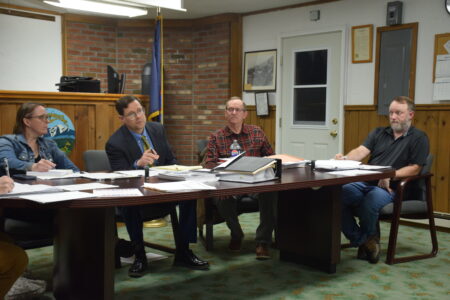
TUPPER LAKE — The tension could be cut with a knife. In the end, though, the board adjourned, no closer to taking action on the matter than when the meeting began.
It will have to wait another couple of weeks, at least.
On one hand — a downtown businessman, Steve Jellie, who for the last year-and-a-half or so has frequently accused Tupper Lake town Supervisor Rickey Dattola of self-dealing, corruption and co-opting at least two town employees in these endeavors.
On the other, Dattola, who says these claims are nonsensically false, stem from a personal vendetta and are tantamount to defamation — all the while distracting and derailing the town government and its staff from performing administrative duties.
And in the middle? A pair of newly elected town councilmen, Adam Boudreau and Owen Littlefield, who are pushing for the town to seek an opinion on the matter from the state comptroller’s office for its recommended “next steps” on how the town government ought to address the accusations against Dattola. Boudreau made the push to do so, and Littlefield appeared supportive of it throughout the discussion.
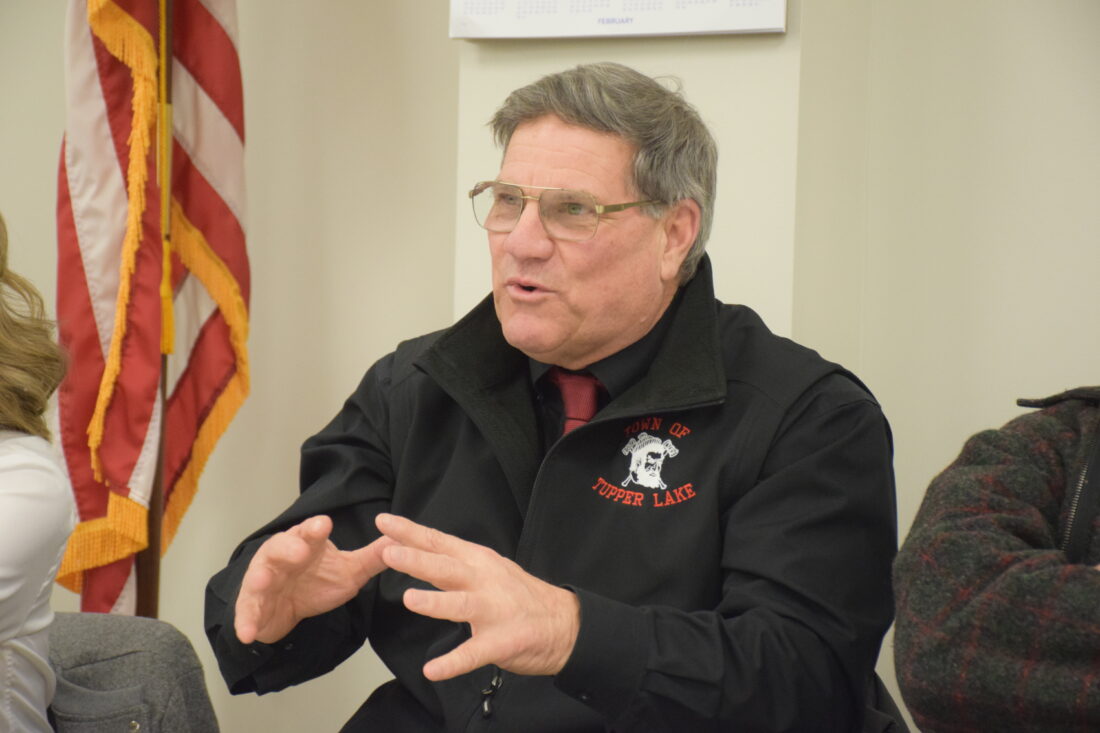
Tupper Lake Town Supervisor Rickey Dattola speaks at a Feb. 10 town village joint meeting at the Tupper Lake Emergency Services building. (Enterprise photo — Chris Gaige)
Although no vote was taken at Monday’s meeting, Dattola opposed the board formally asking the state for guidance, stating it would amount to extra work, heartache and expenditure of resources when, as he believes, it’s not needed. Councilwoman Crystal Boucher said the board needed to do something to address these concerns, but seemed undecided at Monday’s meeting whether that should be the state, something in-house or a local task force.
Ultimately, on Boucher’s suggestion, the board tabled taking any action until its next meeting.
Boudreau stated at the meeting that — although Jellie has been the most consistent and outspoken — these are concerns he hears often from numerous other community members.
While Dattola believes Jellie to be a bad actor here, Boudreau was adamant that the wide variety of community members who have raised these concerns to him were “1,000%” doing so in good faith.
Boudreau said that he is not accusing Dattola of any wrongdoing. At Monday’s meeting, he said he believes the supervisor “has the town’s best interests at heart” and works hard as a public servant.
At the same time, though, Boudreau said these are serious accusations, and need to be looked into by an outside entity. At Monday’s meeting, he suggested that be the state Commission on Ethics and Lobbying in Government, but clarified on Wednesday that subsequent research indicated to him that the state comptroller is a more apt choice for this ethical guidance, given that the former mostly handles that for statewide or state-level officials and institutions, while the comptroller does so for local governments.
“And whatever they have to say? We follow their lead,” he said.
Boudreau said conducting an “in-house” review is not acceptable, and would do little to restore a public perception that he feels is in a bad spot at the moment. He and Littlefield — with Dattola, Larkin and Boucher in agreement — didn’t want to hire a private law firm for the investigation at this time, given the presumably high cost to taxpayers.
–
Dattola blasts accusations
–
After Boudreau made his pitch for action, Dattola said he wanted to clear the air on where he said Jellie’s accusations stem from — a 2024 property acquisition by TOLA Enterprises, Dattola’s company, of the remaining property at the Tupper Lake Business Park from the Franklin County Industrial Development Agency.
Dattola said that the town had nothing to do with the sale, since it changed hands from a county agency to his private company.
“This all stems from a letter that was written by my attorney to the planning board, on a piece of land that we bought from the Franklin County IDA,” he said. “And I want to make that perfectly clear. The town of Tupper Lake has absolutely nothing to do with that piece of parcel that we bought. Nothing. So the idea that somehow there was some collusion or there was some fancy thing going on is just not true.”
Dattola added that the allegations are both baseless and were made with ulterior motives.
“This is about certain people that dislike me, and are causing a lot of trouble,” he said. “The unfortunate thing about this whole thing is that the only people that are suffering are our staff and our legal counsel.”
The letter in reference was written by Kirk Gagnier, who is both the town attorney and has represented Dattola’s company. In it, Gagnier — who Dattola said was representing TOLA, not the town of Tupper Lake, in this capacity — asked the town planning board to approve on-site septic systems on the property instead of it joining the village wastewater system, and included reasoning and documentation for this.
Jellie had obtained Gagnier’s letter through a Freedom of Information Law request. For his part, Jellie said there is more than just this one matter that sparked his concerns, such as property tax valuations and the totality of Gagnier serving as both the town attorney and representing Dattola’s business in matters before the planning board, but that the letter was one of them.
Dattola countered at the meeting that this letter being a problem doesn’t make any sense, as the septic systems save the municipal water district money and all of its other ratepayers money, as the costs of extending the lines to this property would have been costly — with much of that passed on to the district.
“So, the lawyer wrote a letter, which I didn’t think was going to have any problem, because we were asking the district not to do what a district does,” Dattola said. “It would be extremely expensive. It would have to go through wetlands, which would be extremely expensive, and it would cost the district a ton of money. Now, I don’t know how many people are in that district, but it would cost everyone in the district money.”
Dattola added that not only was Gagnier’s letter not a smoking gun — but it showed the private company was acting in good faith and for the betterment of the other ratepayers — and that it’s not even conceivable how self-gain could be had. Furthermore, the town planning board in this case wasn’t the sole authority, Dattola said, with the state Department of Environmental Conservation and Adirondack Park Agency reviewing the matter.
“It’s just simply stating that the planning board says, ‘Yes, it’s OK with us,'” he said. “We still have to abide by APA rules, and we have to get DEC permission,” he said. “There is nothing that my company gained from. There is nothing that we asked to gain from, and this is strictly, strictly, a personal vendetta.”
Dattola then said he opposed seeking state ethical guidance on this due to his claim that there had been no wrongdoing coupled with the time, energy and resources it would consume.
“I think all that’s going to do is take a lot of time and energy away from what we should be doing,” he said. “We should be talking to the village about the sanding. We should be talking about the train station. We should be doing all that stuff.”
–
Board discussion
–
Boucher spoke next, expressing exasperation at how much these accusations are derailing town government — and that something needs to be done to meaningfully address them, beyond Dattola’s attestations that nothing wrong had been done.
“It’s affecting all of us, it’s not just you. We see it, we get the emails. It affects us,” she said. “Public perception is not good. As much as we know what sort of individual that person is. You’ve got those that buy into it.”
She said she didn’t want to sit back and have it look like the board is sweeping it under the rug, that looks even worse.
“What can we do to show that we are as above-board, that we are legit across the board?” she asked. “Yes, it’s frustrating that we get those emails and that it’s taking away from the other, but I don’t think we can totally ignore that it’s going on.”
That’s when Dattola suggested an in-house review.
“If two board members want to go and look at things, and if they want to get somebody from the community to go and look at it, that’s a different thing,” he said. “To start it off with the state, I’m just telling you, it’s going to take a lot of time.”
Boucher said she understood that concern, and said local review was a possible idea, or at least a starting point.
“Something that we can say, ‘Hey, we’re listening to you. Here, we’re addressing it, this is what we’re doing, get them off our back for a while,'” she said. “So we can do what we need to do.”
Dattola then said he accepts a lot of the blame for the current situation, stating that he should have addressed these accusations when they were first raised.
“I should have said something a lot earlier,” Dattola said. “There were things being said. People were coming into the office. I sat down with people. Every single person I sat down with and explained it to said, ‘Oh, OK, Oh, I understand.’ You know, I should have said something. I should have spoken to the media. I should have.”
Boudreau pushed back against an in-house and/or local review, stating that unless it’s an outside entity reviewing this and providing ethical guidance, its credibility will be dead upon arrival.
“I don’t know what the next steps are — I know it cannot continue like this. It can’t,” he said. “It’s not just Mr. Jellie, as I’ve said before. I have heard about it when I am at the Brewski, when I am out having dinner with my wife. I just want it, cards on the table, done and over with.”
Boudreau said the reputational damage that’s accruing in light of the board, at least so far, not taking any action makes doing so a high priority for him.
“It is hurting the town staff,” he said. “It is hurting the reputation of people at this table. It’s hurting Kirk Gagnier, it really is. It’s hurting the perception of the town. So I’m open to ideas, but what we can’t do is say, ‘we’ll take care of this in-house.'”
Dattola said bringing in an outside review would cause “a lot of heartache.” Boudreau said it already has, to which Dattola said this would be “a lot more,” that it will make for a lot more work for the town staff, and would probably require the town to hire another attorney.
“Kirk can’t represent himself,” he said.
With that on the table, Dattola then invited the board to make a motion on the matter if it wanted to, at which point Boucher suggested tabling it until the next meeting.
“Put some ideas together,” she said. “What else is there that we could do? And then come back with ideas, instead of making a huge decision right now, now that everybody knows where we all stand.”
The board members all agreed they were OK with that. Boudreau then said he didn’t appreciate Dattola’s framing that seeking outside guidance on this as something that would “rock the boat.” Boucher said she didn’t see Boudreau’s actions as doing so.
“The bottom line is these decisions were not made by me or Owen or Crystal,” Boudreau said.
“What decisions?” Dattola asked.
“I’m saying that Kirk is being called into question and upset about it,” Boudreau answered. “You obviously just made a public statement upset about it. It has to be taken care of. It has to be. … The innuendo that somehow the town board is going to cost the town a lot of money and put a lot of people through a lot of heartache isn’t necessarily a fair statement if it’s something that has to be addressed regardless. It’s not like we’re doing something because we want to.”
Dattola took issue with that.
“Yeah you are, yeah you are,” he said. “I mean you can’t sit there and say –”
“I didn’t make those decisions, Rick,” Boudreau interjected.
“What decisions?” Dattola asked again.
“I didn’t make the decisions you made, or Kirk made, as the town attorney,” Boudreau said. “I’m saying I didn’t make those back then (in 2024).”
Boudreau later clarified to the Enterprise that he was referring to having Gagnier represent his business while also serving as the town attorney.
“The IDA sale seems to be very contentious,” he said. “It wasn’t necessarily the sale of the property itself, it was Kirk’s involvement in the sale as an attorney for TOLA Enterprises and, as Rick had mentioned, it’s something that he said he probably should have addressed earlier.”
Boudreau added that he wasn’t alleging any wrongdoing, but that those actions combined with it not being addressed earlier precipitated the need, as Boudreau sees it, for the town board to take steps — vis-a-vis outside, independent review — to ensure that this representation was handled properly, as Dattola claims it was.
“Article 18 in New York State Municipal Law is very clear with land use matters or disclosures of public officials in land use matters when they are coming across the government that they’re elected to, and also for town attorneys,” Boudreau said. “It’s just a matter of making sure we are crossing our ‘t’s, dotting our ‘i’s.”
He added that a town attorney also representing a supervisor in their private business does not inherently constitute misconduct, and that it’s not unheard of for such cases in rural areas.
“I also understand the Adirondacks are made up of small towns,” he said. “There are only so many attorneys. There are only so many private sector businesses. I get that there will be some overlap, and the (New York) Association of Towns is pretty clear about that as well.”
–
Jellie responds
–
Jellie told the Enterprise that he appreciated Boudreau bringing the motion and that doing so took some courage.
“It is long overdue and took a lot of courage considering the history of the town supervisor’s reaction when his methods are challenged,” he wrote in an email. “The town supervisor’s watered-down characterization of the problems at hand and his attempt to deflect blame toward engaged taxpayers is unfortunate, but not unexpected.”
Jellie reiterated some of the concerns he’s spoken on at previous town board meetings.
“Since taking office, the town supervisor led the defunding of the village police department, employs the town attorney and town assessor as his personal staff, cut code enforcement services by 75% and outright refuses to proactively engage efforts to revive the Tupper Lake School District from the deep financial crisis it faces,” he wrote. “In addition, the previous town council left the property valuation and tax assessment process in disarray, which is resulting in many people, including some local elected officials, not paying their share.”
In an email addressed to the town board and copied to the Enterprise and Tupper Lake Free Press, Jellie said Boucher’s meeting comments were “unfortunate” and amounted to “personal gibberish,” but that he was relieved that she said the board needed to take action.
“Comments like ‘we know what sort of individual that person is,’ or ‘you got those that buy into it’ or ‘get em off our back’ or ‘maybe their other little followers will,’ truly indicate a lack of recognition that there are real issues however, I am relieved that Councilor Boucher finally acknowledges, ‘we cannot do nothing,’ any longer,” he wrote.
Jellie vowed to not give up his persistence on pressing for answers on these issues.
“While I am certainly not the only concerned taxpayer, I will not be intimidated or dissuaded from raising issues of public concern because some elected officials disagree with me,” he wrote. “Town Councilor Crystal Boucher would do well to remember that I am the sort of ‘individual’ that fights for what I believe in, and my ‘little followers,’ have not ‘bought into’ anything; they see the same inappropriate actions and behavior for what they are. If Ms. Boucher’s intent is to simply ‘get them off our back,’ then she may have missed the duties and responsibilities she signed up for, and perhaps it is time she reassesses her commitment to the taxpayers instead of her complicit loyalty to the town supervisor.”
–
What next?
–
Boudreau said he intends to make a similar motion to what he did on Monday, except that he will recommend the town reach out to the state comptroller instead of the New York state Commission on Ethics and Lobbying in Government.
He hopes a majority of the board will vote to move forward.