Treachery in the backcountry
Thaw and heavy rain make for dangerous trail conditions last week throughout the High Peaks
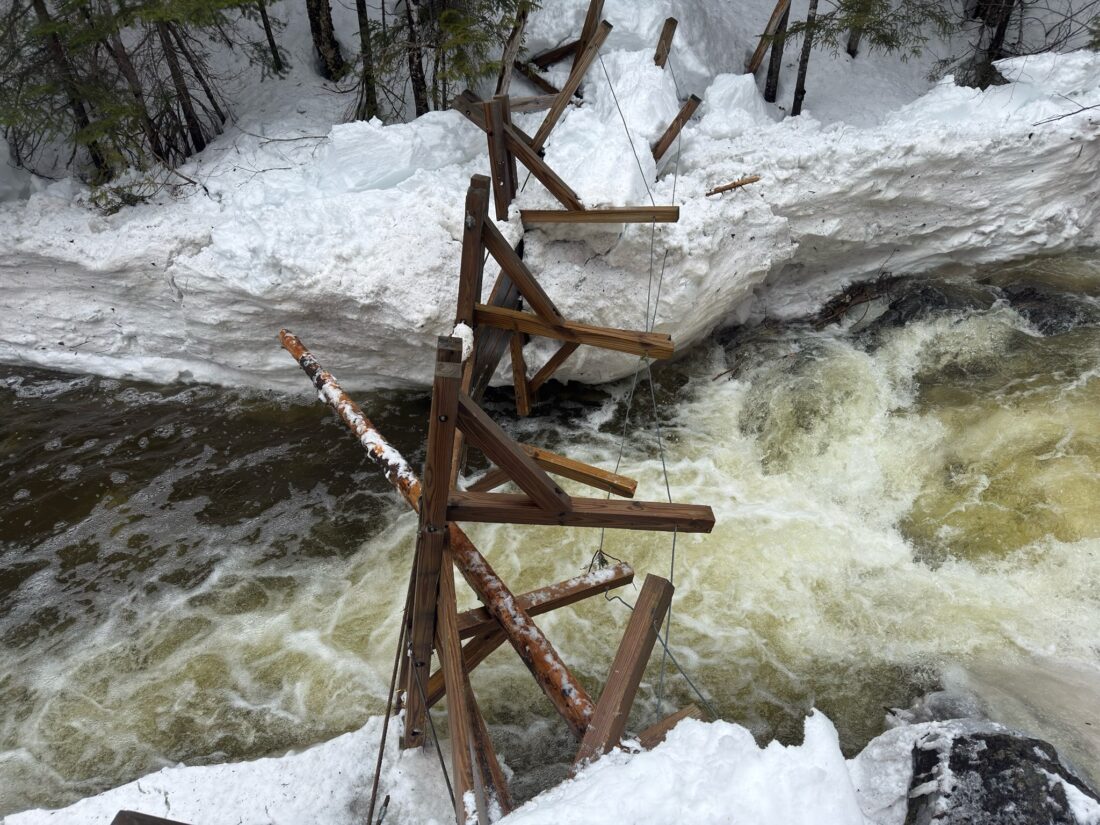
A washed out footbridge is seen over Calamity Brook in the High Peaks Wilderness. Without the bridge, access to the Flowed Lands, Lake Colden and numerous surrounding High Peaks from the Upper Works trailhead in the town of Newcomb has been cut off. (Provided photo - New York state Department of Environmental Conservation)
LAKE PLACID — While warm sunshine has made for a pleasant past few days out and around the Tri-Lakes’ communities, it’s been a completely different reality in the backcountry.
The early March thaw has wreaked havoc on the hiking and skiing trails, with melting snow creating sloppy, cratered-out and sink-prone trails. Meanwhile, rapidly-rising creeks are roaring throughout the High Peaks, creating dangerous water crossings, many of those had been frozen solid as recently as a week ago.
The state Department of Environmental Conservation reported that a footbridge over Calamity Brook — designed specifically for high water — washed out earlier this week. This has cut off access to the High Peaks from the Upper Works trailhead, in the town of Newcomb.
“As of now, it’s a soft snowpack with high water and strong currents,” said Nate Fischer, the Adirondack Mountain Club’s (ADK) trip planning coordinator.
Fischer was staffing the High Peaks Information Center on Tuesday. Located at its Heart Lake property, ADK’s High Peaks Information Center offers some of the most up-to-date reports sourced from first-hand accounts from the backcountry.
Fischer said that the high-water reports have been ubiquitous, even in spots where it wouldn’t be expected.
“Even some of the smaller brooks and streams that usually aren’t noteworthy, those water levels are getting pretty high, those currents are really picking up,” he said.
Hikers or skiers who know they have a watercrossing(s) along their planned route should be prepared to turn around, he said, adding that stream levels can turn on a dime, and what may have been safe to cross a day or ago could no longer be the case. Even as it can be frustrating to turn around, high water presents an extraordinary risk, not only for drowning, but secondary consequences if one were to make it out of the water.
Hypothermia can set in quickly when clothes become soaked in water, and falling into a creek could also soak any backup layers stored in a pack — posing a serious danger, especially if the submersion is far from the trailhead.
The decision to turn around can be as much of a mental juggernaut as it is driven by physical realities. Recreators often find themselves combating “summit fever,” or a desire to push through the top, even as the conditions make doing so objectively irrational. Being prepared to potentially turn around in advance, and having those expectations from the onset, can make it mentally easier to do so.
The DEC, in its backcountry information page, flagged 10 High Peaks area trails as being particularly susceptible to high water. These include:
The Round Pond Trail to Dix, crossing of the North Fork of the Boquet River.
The Phelps Trail, crossing of Johns Brook above Bushnell Falls.
The Mr. Van Ski Trail crossing of South Meadow Brook.
The Van-Hovenberg Trail to Marcy Crossing of Phelps Brook above Marcy Dam and at Indian Falls.
The Lake Arnold Trail crossing of the Opalescent River (floating bog bridges).
The Herd Paths to Street and Nye mountains, crossing Indian Pass Brook.
The Indian Pass Trail (north and south) crossings of Indian Pass Brooks.
The Calamity Brook Trail crossing at the High-Water Bridge, over Calamity Brook.
The East River Trail crossing the Opalescent River before Allen Mountain Trail Junction and also outlet of Flowed Lands.
The Northville Placid Trail crossing of Seward Brook near the Ouluska Lean-to.
Water levels in the backcountry and across northern New York are expected to increase today as a storm tracks across the region, delivering what meteorologists at the National Weather Service’s Burlington, Vermont office predict that there will be an inch of rainfall by midday Thursday before colder temperatures return.
A flood watch has been issued for Essex, Franklin and Hamilton counties through 2 p.m. Thursday.
The soft snow has made trails particularly prone to post-holing, or sinking deep in the snow below what a firmer pack had previously supported. Fischer said this makes wearing snowshoes or skis all the more imperative. On top of that, it’s a state rule that snowshoes or skis must be worn in the High Peaks Wilderness whenever the snowpack on the side of the trail is 8 inches or more. Forest rangers can issue tickets with a $250 fine for violators.
Even with proper footwear, the softer, sloppier snow tends to take considerably more effort to walk through compared to the firm packed-powder that had characterized Adirondack trail conditions much of the past couple of months. Fischer said people should give themselves more time than normal to plan for a winter trip while these conditions remain in place, and turn around if their energy levels are draining or if it’s getting later in the day.
With cooler, below freezing conditions expected to return Wednesday night and remain in place the rest of the week, Fischer said trail conditions can change quickly, with slush turning to ice. Just as the weather throws the kitchen sink this week, Fischer advised the same approach when it comes to trail gear.
“For recreators, it’ll be all forms of traction,” he said. “Both the (skis and) snowshoes, as well as potential microspikes and trail crampons for those sections of trail that are just sheets of ice.”
Even when the colder weather returns, Fischer said not all trails’ water crossings will refreeze, and that looks can be deceiving.
“It’s hard to say if it’s going to be enough of a freeze to really resolidify water crossings and resolidify some of the trails as well,” he said. “Or if it’s just going to be a, looking at the water crossings, just kind of a thin kind of crusty snow.”
As mild as the past couple of days have been, Fischer suspected that winter is far from having its final say — making it all the more important that those planning to venture into the backcountry stay apprised of the latest conditions.
“The conditions here can change so rapidly, especially up high, that we still might have a pretty good stretch of winter ahead of us,” he said.
The DEC regularly updates its backcountry information page with trail closures. That can be accessed at tinyurl.com/5ejy9vev. ADK’s High Peaks Information Center also provides trail reports to the public at no charge. The center is open in-person or via phone, 518-523-3441, during its regular hours. Those are from 7 a.m. to 3 p.m. Sunday through Friday and 7 a.m. to 5 p.m. on Saturday. For more winter hiking safety tips from the DEC, visit tinyurl.com/93n73478.
Local News
Flock blocked
Treachery in the backcountry
Safety risks led Army branch to drop support for howitzer testing in 2023
The risk of projectiles ricocheting into state Route 9 and I-87 led the U.S. Army branch contracting with a private ...
Slush and smiles at 3P
Fishin’ tradition