St. Armand BESS project faces resistance, others amped up
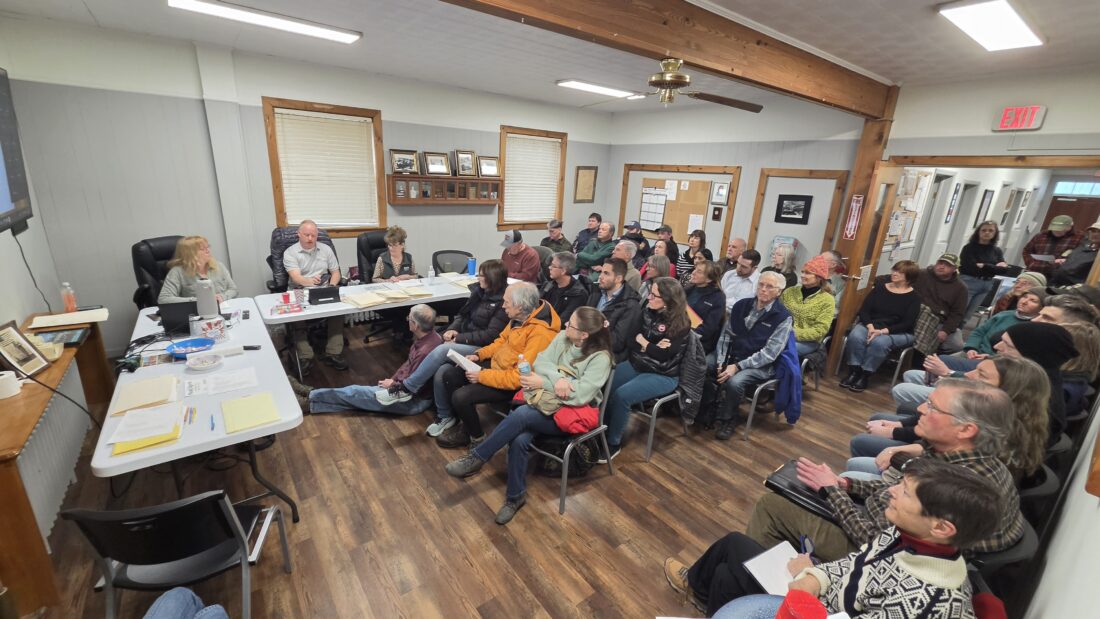
A crowd of St. Armand residents packed the town hall on Thursday as the town board discussed a moratorium on battery energy storage systems. (Enterprise photo — Aaron Marbone)
BLOOMINGDALE – The St. Armand town council passed a one-year moratorium on the installation of battery energy storage systems on Thursday, an effort to give the community more time to research this new technology and decide whether or not they want one in their town.
The energy company Carson Power is proposing the BESS grid upgrade at a National Grid substation on Trudeau Road, on the hill near the Mount Pisgah Ski Area.
Thursday’s meeting drew a large crowd, which spilled outside of the meeting room and into the hallways.
Locals are split on if they want a BESS in town. Some are concerned that it would pose a severe risk if it catches fire. Others say they feel confident that it’s safe and will bring benefits.
Most of the people opposing the project are the ones who live directly near the proposed site.
“I think if I asked any of you if you wanted this in your backyard, I don’t think I’d see one hand go up,” neighbor Carol Reyell said.
Sure, fires are rare, she said. But if one happens and burns her home, she’ll be “really pissed off,” she said.
Fire department chiefs at the meeting said they feel confident that they are able to handle these types of potential fires.
The project would place four units of lithium ion phosphate batteries – likely the Tesla Megapack 2XL – adding up to 20 megawatts of power capacity at 199 Trudeau Road, a parcel of private property behind the substation, to the right.
Energy storage facilities gather extra energy from the grid during low-demand times and hold it for peak-demand times. This allows energy derived from renewable sources like solar or wind to be held in storage for times when the sun isn’t shining or wind isn’t blowing. These batteries charge overnight when there’s low demand and low cost. They don’t discharge every day – or even on most days – but are used on high-demand days to use the grid more reliably.
Representatives from Carson Power did not speak much during the meeting, except for when people directly asked them questions.
Carson Power Vice President of Development Andrew Gordon said they are planning a public information session on April 29 at the Mount Pisgah Lodge at 5 p.m. to answer more of these questions.
Town Supervisor Davina Thurston said the moratorium is not the town saying “no” to the facility. The town could end this moratorium at any time.
“You elected us. We represent you,” Thurston said. “If we are hearing from a majority of the St. Armand residents that you don’t want this, then you don’t got this.”
After the moratorium passed, St. Armand Councilwoman Donna Whitelaw suggested the town form a committee to share information to educate the public, do a survey of residents’ opinions and make an informed decision.
The problem lies in what information to include and how that information is framed. There’s a lot of information, councilmembers said, and to present the pros and cons – all sides of the debate – would be difficult to do succinctly. They plan to develop this at their next meeting.
Rob Reyell, a neighbor of the proposed site, spoke at Thursday’s meeting and said he was representing a “hard-core group of residents” who oppose the project. He said they circulated a petition and got 165 signatures.
Several people in this group mentioned that most people they talked to about the proposal did not know about it yet.
Thurston said that’s part of why the town passed the moratorium – to give people more time to hear about it and generate opinions.
Tim Jackson recommended the town use the moratorium to get leverage and set expectations for the project. Thurston said that is the other reason they passed it.
If these facilities are eventually deemed desirable, she said the town would pass a local law with rules and regulations and develop a building permit for this type of structure. The town does not have a zoning code, so Thurston said this was the only way they could get more time to understand the new technology and gather information about the pros and cons of housing one of these battery stations in town.
The Adirondack Park Agency and the state Department of Environmental Conservation would also likely be involved.
These facilities have been controversial elsewhere in the Adirondacks due to fire and environmental concerns. The first such facility in the Park was just approved by the APA last month – a Carson Power facility in the town of Northampton on the southeastern edge of the Adirondack Park.
Details of the project, and reports on energy storage battery facility safety can be found on the town website at tinyurl.com/55636dev. To read more about the project and previous discussions about the proposal, go to tinyurl.com/3662t7z2.
–
Fire and water
–
Neighbors’ main concern is if the system catches fire.
Fires in BESS facilities are rare, but these types of batteries can experience “thermal runaway,” in which heated cells catch fire and create their own oxygen, making extinguishing the flames very hard. These types of fires cannot be extinguished with water and can emit dangerous compounds like hydrogen cyanide and hydrogen fluoride.
But research on thermal runaway in the batteries Carson Power is proposing at this site has found that “they do not release toxic gases sometimes associated with the failure of lithium-ion batteries.”
Advocates for BESS have also said that battery safety is getting better and BESS fires do not pose a threat more serious than other types of fires.
“One fire is all it takes,” Reyell said.
He said the land on the hill is dry, calling it a “tinderbox.” There have been forest fires there before.
Tom Hesseltine, a direct neighbor to the site of the proposed project, said he was offered $100,000 per year by Carson Power to put the facility on his property, but turned it down because of his safety concerns.
Hesseltine said he does not trust the companies. When electric cars catch fire, he said all those companies probably “downplayed” the risk.
Reyell felt Trudeau Road was not the right location for a BESS facility – being a wooded residential area. He said there are no fire hydrants up there and not enough infrastructure.
Other people mentioned that nearby, there’s the Northern Lights daycare, Adirondack Medical Center hospital, Adirondack Arc houses and the local BOCES school.
With BESS fires, firefighters don’t actually fight the fire. They focus on asset protection – keeping it from spreading.
Carson Power would fund the Bloomingdale Volunteer Fire Department for the new training and tools its members would need for these kinds of fires. Carson Power representatives said battery fires don’t take much special gear.
Saranac Lake Volunteer Fire Department Chief Michael Knapp said they can handle these kinds of fires “easily” – it just takes “copious amounts of water.”
Bloomingdale Volunteer Fire Department Chief Mike Woodruff said electric vehicle fires take 50,000 to 80,000 gallons of water before they go out. If a BESS facility caught fire, it would be a “long day.”
Woodruff said that fire departments must evolve with society. As there are more batteries everywhere with each passing day, he said they have been doing new training to meet the new firefighting needs.
He feels that the installation of large-scale batteries is inevitable, so they’ve been preparing.
The system would be in the SLVFD district. Woodruff said they have good mutual aid sharing with local departments.
“I don’t have any reservations as to whether we would be able to mitigate the situation,” Woodruff said.
“If it happens, we’re going to give it 100%. We’re going to get the job done,” Knapp said.
Larry Sweeney, who is part of this neighbor group, said he’s concerned that a fire could wash heavy metals into the watershed, which also drains into the Saranac River.
Alan Roberts said all their homes are on well water.
“The same thing can happen if one of your houses catches on fire. It’s the same possibility,” Woodruff said. “It’s the same contaminants coming out of your house as is going to come out of this battery.”
Everybody has battery-powered appliances, tools and vehicles in their home, he said. When there’s a house fire, they release harmful chemicals.
A member of the public said it was a “matter of scale.”
Another member of the public said it’s no different than the Aubuchon hardware store burning.
Woodruff said the contamination from a house fire could be worse because firefighters would be extinguishing that fire with water, pushing the chemicals into the ground. A BESS fire is not fought with fire. He said they just let it burn out fully, to ensure that it does not reignite.
Megapacks have a failure rate of two-tenths of a percent.
“Testing demonstrated that flammable gases vent from the MP2/2XL cells during thermal runaway; however, they do not release toxic gases sometimes associated with the failure of lithium-ion batteries,” according to a 2023 report from the Fisher Engineering firm.
A report by the Fire and Risk Alliance firm – commissioned by the American Clean Power Association and titled “Assessment of Potential Impacts from BESS Fires” on the town website – looked at several dozen BESS fires. It concludes that none of the cases had contaminant concentrations that posed a public health concern or necessitated further remediation.
“This finding includes airborne contamination sampling conducted on-site, off-site and within nearby communities, as well as relevant sampling of water from firefighting activities, suppression system run-off and groundwater testing in specific instances,” the report states.
Saranac Laker Alison King read a statement from Michael Richardson from the environmental nonprofit Third Act in support of the project. Richardson said batteries are safer and cheaper than fossil fuels and that batteries are important for electric expansion.
King said, to her, these batteries are the future. She said their failure rate has dropped by 98% over the past years, and that most fires are due to older technology.
Fuel prices are going up, she said, and electric costs will continue to rise. A BESS would keep them lower for the region, she said.
Denise Griffin said that something needs to be done to address the increasing electric demand. She felt the town does not need a moratorium and urged the council to not delay the project.
Diana Strablow asked everyone to keep an open mind to the possibility that the benefits outweigh the risks.
She said transmission line bottlenecks have been a problem for years. They are expensive to upgrade. Batteries are cheaper, she said.
If fossil fuels continue to contribute to climate change, she said, wildfires would become more common here. She felt these fires would be more dangerous than the potential of a BESS fire.
Strablow said New York has strict safety regulations on BESS facilities, and that people probably wouldn’t say no to a hardware store, which would pose a bigger threat in a fire.
She said she’s not 100% in favor of a BESS, but would be if they have the proper information and take the right precautions.
–
Why here?
–
Electric is more and more in demand, so the grid needs increased supply.
These battery energy storage facilities are being proposed and built around the state to help the electric grid meet increasing demand quickly, without taking years to build new energy production power plants.
Peter Waldt asked why Carson Power was looking at this location.
Carson Power representative Gordon said BESS facilities need to be near grid substations, and this substation is one of the only ones in the region with the strength to support such a facility. It’s all about voltage levels and loading thresholds, he said.
In the direct region, the substations next to the Bloomingdale Volunteer Fire Department and at the corner of state routes 3 and 30 are not big enough. The closest substation with adequate strength is in Ray Brook.
“This is a substation that screams that it requires batteries,” Gordon said.
The substation screams all right, neighbors said. They said they’ve been burned by National Grid at this site before, when the electric company expanded the substation unexpectedly and underhandedly. They said National Grid broke promises to them and that the increased electric hum from the station even makes it difficult to sleep at night with the windows open.
Alan Roberts said he has “quality of life” concerns about adding a BESS system and wondered if it would be detrimental to their property values.
When the BESS fans are on full blast, Carson Power Development Operations Director Owen Hooper said, to someone standing within 10 feet of the facility, it would sound like someone running a vacuum cleaner in the next room — 67 decibels. Sixty decibels is around the loudness of normal conversation and 70 decibels is around the loudness of a vacuum cleaner.
When the company applies for an APA permit, he said the agency will have them do a sound study. Anything more than a six decibel increase — approximately a doubling in the intensity of sound — would require the noise be mitigated with a sound wall, he said.
In December, a fire at an energy storage facility owned by Convergent Energy and Power in Warwick burned for several days as multiple departments worked to contain it. Water intrusion during a storm may have caused the fire, according to officials.
In New York, there have been five battery storage facility fires since 2023, one in Lyme, one in East Hampton and three in Warwick. None were owned by Carson Power. The recent fire in Warwick was due to an unauthorized and non-compliant system, according to village officials there, and should not have been operating.
Several years ago, a battery energy storage facility was proposed by Rev Renewables in Raquette Lake, but severe public opposition led to the plans being dropped. The town of Long Lake had also passed a one-year moratorium on these facilities after public opposition grew.
If the project is approved, Carson Power would develop the facility and then sell it to an owner/operator.
The lease from the landowner is tied to the 20-to-25-year warrantee on the batteries. After the batteries serve their life, the lease could be renewed with new batteries or the site could be decommissioned.
The BESS debate is set to last for a while in St. Armand. Rob Reyell said his group of neighbors will continue to oppose the proposal.
Local News
Independent candidate for NY-21 wants to expand House to 6,600 members
Brian R. Rouleau, an independent candidate who is seeking to represent northern New York in Congress, would like to ...
Two finalists in search for new SLCSD superintendent
SARANAC LAKE – There are two finalists in the running to become the Saranac Lake Central School District’s ...
Organizers scramble to fix shuttle delays on opening day of World Cup skiing
LAKE PLACID — The Olympic Regional Development Authority added to its fleet of shuttle buses Saturday to deal ...

‘Brink of collapse’
Police: Tupper Laker flees authorities four times in a day before eventual capture
TUPPER LAKE — A wanted Tupper Lake man evaded authorities not once, not twice but three times in one day. It ...