
St. Armand battery facility debate charges up
Public hearing, moratorium vote coming Thursday; power company reps seek to calm fire fears
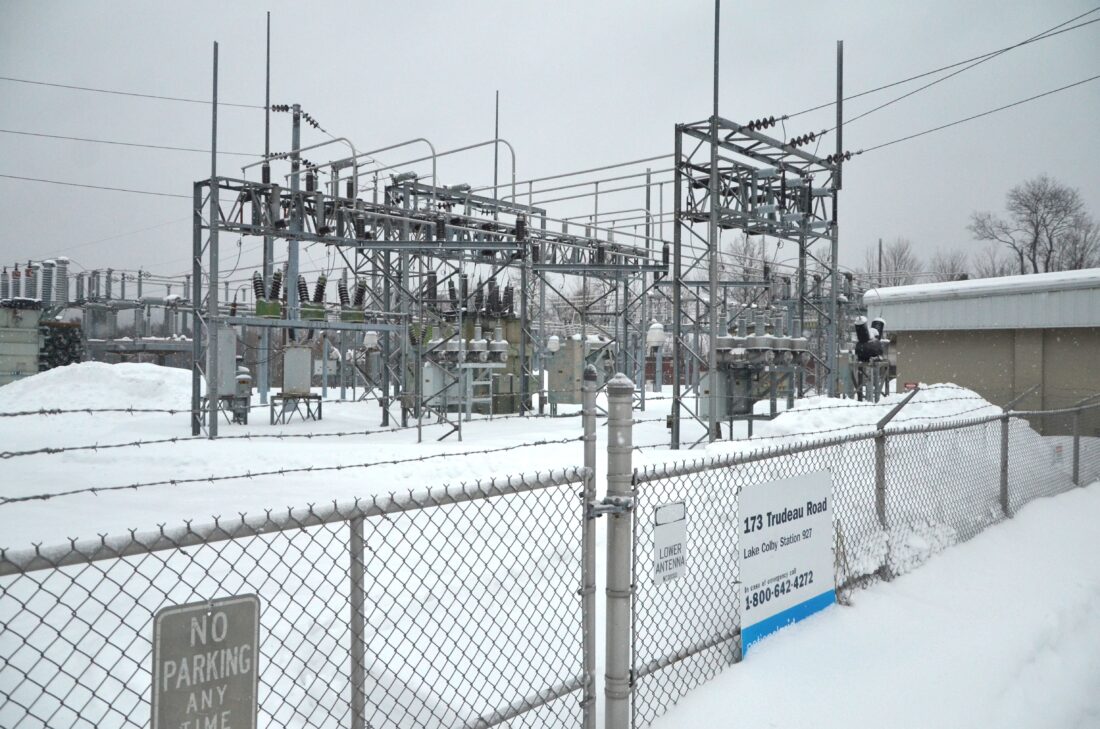
The National Grid substation on Trudeau Road in Saranac Lake, where a energy storage battery facility has been proposed. The St. Armand town board will vote on a potential one-year moratorium on these facilities at its meeting on Thursday. (Enterprise photo - Aaron Marbone)
SARANAC LAKE — The safety, benefits and concerns encircling the new technology of battery energy storage systems were discussed in-depth at a well-attended St. Armand town board meeting last month.
Representatives from Carson Power – the energy company proposing one of these facilities on Trudeau Road — attended the meeting, seeking to assuage residents’ fears of the potential fire hazards as they propose the grid upgrade on the hill near the Mount Pisgah Ski Area.
The St. Armand town council is also seeking to pass a one-year moratorium prohibiting these types of facilities.
The board unanimously called for a public hearing on the moratorium, which will be held on March 19 at 5:30 p.m. at the town hall at 1702 state Route 3. The board will vote on the moratorium at that meeting.
The meeting will be streamed on GoTo Meeting at meet.goto.com/256062789 or by phone by calling 872-240-3212 and using access code 256-062-789.
To install the GoTo Meeting app before the meeting, go to meet.goto.com/install.
Details of the project, and reports on energy storage battery facility safety can be found on the town website at tinyurl.com/55636dev.
These battery energy storage facilities are being proposed and built around the state to help the electric grid meet increasing demand quickly, without taking years to build new energy production power plants.
Energy storage facilities gather extra energy from the grid during low-demand times and hold it for peak-demand times. This allows energy derived from renewable sources like solar or wind to be held in storage for times when the sun isn’t shining or wind isn’t blowing.
Town Supervisor Davina Thurston said a moratorium would not be the town saying “no” to the facility. The town does not have a zoning code, so Thurston said this was the only way they could get more time to understand the new technology and gather information about the pros and cons of housing one of these battery stations in town.
At the meeting last month, residents and town council members expressed concerns over fires at these BESS facilities.
Carson Power Development Operations Director Owen Hooper asked the board to reconsider doing the moratorium, or to do a six-month one instead. He said it will be six months at minimum before they could get a permit from the Adirondack Park Agency and that there are federal and state incentives the company can pass on to the community, which could be smaller if the town waits.
He told the board to let the company work with the community, instead of the town spending time being the intermediary.
“Lean on us,” he said.
Thurston said they could end this moratorium at any time. She wants the neighbors, two towns, one village and four fire districts to feel secure if the town allows the project.
These facilities have been controversial elsewhere in the Adirondacks due to fire and environmental concerns. The first such facility in the Park was just approved last month – a Carson Power facility in the town of Northampton on the southeastern edge of the Adirondack Park.
If these facilities are deemed desirable, Thurston said the town would pass a local law with rules and regulations and develop a building permit for this type of structure. The APA and the state Department of Environmental Conservation would also likely be involved.
–
Reasons for proposal
–
The project would put four units of lithium ion phosphate batteries – likely the Tesla Megapack 2XL – adding up to 20 megawatts of power capacity at 199 Trudeau Road, a parcel of private property behind the National Grid substation, to the right.
The facility would be privately owned and sell power into the electric grid.
Hooper said, according to New York Independent System Operator — the non-profit corporation which operates the electric grid — the state will need 4,000 more megawatts by 2030.
Electric is more and more in demand, he said, so the grid needs increased supply.
To do this, they either build more power plants and more transmission lines — which Hooper said takes years and is not easy in the Adirondacks because of their big environmental impact — or build batteries.
“The only technologies that are deployable today are wind, solar and batteries,” Hooper said.
Solar and wind would not be good in the Adirondacks, he said, because they require clearing a lot of land.
These batteries charge overnight when there’s low demand and low cost. Hooper said they will not discharge every day – or even on most days – but will be waiting for high-demand days to use the grid more reliably.
Carson Power Development Operations Manager Riya Kurian said the batteries would have benefits for the region.
She said the North Country has long lines and limited redundancy, its winter reliability is low and the electric use load fluctuates with tourism. Batteries would make the local grid more resilient, have fewer outages, not need as much maintenance and prevent emergency peak events.
Kurian said batteries reduce strain on transmission lines allowing them to have a longer life.
These battery facilities need to be within a mile of a substation and substations with capacity are typically in more developed areas.
Hooper said the batteries can benefit electric bills – but indirectly.
When Nation Grid goes to the Public Service Commission to ask for a rate increase to cover operating costs, those rates are largely based on projected infrastructure spending, Carson Power spokesperson Ben Colombo said.
“Battery storage reduces peak demand and can defer or avoid expensive grid upgrades,” Colombo said. “Storage is not a guarantee of lower bills, but it is a tool that helps limit cost growth and keep rates low over time.”
It won’t lower the bill, but the rate might not go up as fast.
“It stabilizes the price of power, so that as demand goes up, and we don’t have more supply, it prevents pricing from matching that demand increase,” Kurian said.
–
Fire concerns
–
Fires in BESS facilities are rare, but these types of batteries can experience “thermal runaway,” in which heated cells catch fire and create their own oxygen, making extinguishing the flames very hard. These types of fires cannot be extinguished with water and emit dangerous compounds like hydrogen cyanide and hydrogen fluoride.
Hooper said the new battery systems they are proposing undergo rigorous testing and that any fire should not spread from cell to cell. He also said the new batteries don’t produce fumes more toxic than a structure fire.
In December, a fire at an energy storage facility owned by Convergent Energy and Power in Warwick burned for several days as multiple departments worked to contain it. Water intrusion during a storm may have caused the fire, according to officials.
In New York, there have been five battery storage facility fires since 2023, one in Lyme, one in East Hampton and three in Warwick. None were owned by Carson Power. The recent fire in Warwick was due to an unauthorized and non-compliant system, according to village officials there, and should not have been operating.
Hooper said fires get big headlines, but also said that as technology and safety progress, there are fewer of these incidents, even as more batteries are put into use.
He said, by law, Carson Power can only use batteries that meet fire code and have been tested to not have a high possibility of thermal runaway.
“The system will be required to comply with all applicable New York State Fire Code requirements, including UL 9540 listing and UL 9540A large-scale fire testing,” Colombo said.
Tom Hesseltine, a direct neighbor to the site of the proposed project, said Carson Power approached him with the request to lease his land first and he turned them down because of the fire danger. He said the area is filled with dense, scrubby pine and lots of blowdown. He’s concerned about if the fire spreads to the woods and then to the neighborhood. On a dry, windy day, he said a fire could be catastrophic.
Hooper said the units are now designed to not let fire leave the module.
“There’s no way to be 100% risk-free,” Hooper said. “There is absolutely a risk of a fire at a battery storage facility. It is in the tenths of a percent.”
If there is a fire, he said firefighters don’t actually fight the fire. Members focus on asset protection — not letting the blaze spread any further than the battery system.
Hooper said at other sites, Carson Power paid for a 10,000 gallon cistern on site to give firefighters a water source to cool down the surrounding land and prevent spread.
Councilman Ray Tempestilli asked if Carson Power would fund the Bloomingdale Volunteer Fire Department for the new training and tools its members would need for these kinds of fires.
Hooper said they are required by law to fund these things, and that commitment lasts into the future if the state requires new equipment with regulations down the line. He said the trainers would come here.
He said they’d ask local departments if there’s more materials they need, but added that battery fires don’t take much special gear. He said traditional SCBA is fine to use.
“It is no different in the off-gassing, contaminants, anything from any normal structure fire. There has been no site remediation occurred,” Hooper said.
A 2023 report from the Fisher Engineering firm, shows this.
“Testing demonstrated that flammable gases vent from the MP2/2XL cells during thermal runaway; however, they do not release toxic gases sometimes associated with the failure of lithium-ion batteries,” the report states.
Lithium ion phosphate batteries do not have lots of sulfuric acid in them like others do, Hooper said.
A report by the Fire and Risk Alliance firm – commissioned by the American Clean Power Association and titled “Assessment of Potential Impacts from BESS Fires” on the town website – looked at several dozen BESS fires. It concludes that none of the cases had contaminant concentrations that posed a public health concern or necessitated further remediation.
“This finding includes airborne contamination sampling conducted on-site, off-site and within nearby communities, as well as relevant sampling of water from firefighting activities, suppression system run-off and groundwater testing in specific instances,” the report states.
Hooper said when a “worst case failure” was purposefully triggered in the Megapack in testing, it took around eight hours to burn out. The Megapacks are engineered to not allow thermal runaway to spread fire to the entire facility, but keep them contained to individual cells.
He said Carson has had no failures to its facilities, and that Megapacks have a failure rate of two-tenths of a percent.
Carson Power is building a battery facility one mile from his own home. This one is larger than the one proposed here, and he said he’s not concerned about it.
Hooper said the facility would pose the exact same risk of spreading as a structure fire or a brush fire, and would be fought the same way.
The facility would be set on gravel, with a metal fence around it and an offset of trees from the fence. Hooper said there would be 24/7 monitoring of the system with sensors and infrared cameras.
Hooper said the 2XL Megapack model has been tested for a year.
Tempestilli felt that was not enough time to find a “worst-case scenario.”
Hooper said that battery storage facilities were tested to much lower standards 10 years ago than today.
Tempestilli said he had concerns about harms down the line and about what will be discovered about BESS facilities 10 years from now.
He referenced the carcinogenic PFOA “forever chemicals” – which were widely used for decades, but their harm was not known or publicized until years later.
Tempestilli had concerns about potential unknown long-term effects that aren’t known now. There wasn’t much Hooper said to calm that fear.
Hesseltine asked if the batteries would break down over time and become more risky.
Hooper said that time wouldn’t change the result.
Hooper gave Hesseltine and Tempestilli credit. He said in all the presentations he’s given to towns, no one else has asked these forward-thinking questions.
Hooper said the batteries are significantly less efficient in the cold, producing fewer megawatts when the temperatures dip below zero. But, he added, natural gas power plants have the same efficiency problem in the opposite direction – producing less in the heat.
–
Noise and future
–
Carson Power would develop the facility and then sell it to an owner/operator.
The lease from the landowner is tied to the 20-to-25-year warrantee on the batteries. After the batteries serve their life, the lease could be renewed with new batteries or the site could be decommissioned.
Hooper said they are required to return the property as they found it. They are required to put away money for the lifetime of the site to cover the estimated cost of decommissioning.
Hesseltine asked about noise. The substation is loud already, he said.
Hooper said the fans on the units are the main cause of noise. At full power on a hot day, he said, to someone standing within 10 feet of the facility, it would sound like someone running a vacuum cleaner in the next room — 67 decibels. Sixty decibels is around the loudness of normal conversation and 70 decibels is around the loudness of a vacuum cleaner.
When they apply for an APA permit, he said the agency will have them do a sound study. Anything more than a six decibel increase — approximately a doubling in the intensity of sound — would require the noise be mitigated with a sound wall, he said.
Several years ago, a battery energy storage facility was proposed by Rev Renewables in Raquette Lake, but severe public opposition led to the plans being dropped. The town of Long Lake had also passed a one-year moratorium on these facilities after public opposition grew.
Local News
112 mph wind gust clocked at Whiteface Monday
St. Armand battery facility debate charges up

With bronze in hand, Farquharson reflects on 2026 Olympics
No shock: Electricity prices dominate Cashman town hall

Saranac Lake village election today
Crown Plaza becomes Grandview Lake Placid
LAKE PLACID — After nearly six decades as a franchised hotel with IHG, the Crowne Plaza Lake Placid is being ...