SLCSD budget and board election approaches
Two board seats up for election, Martin announces reelection campaign, budget strained by energy costs

The Saranac Lake Central School District offices and high school are seen in April 2025. (Enterprise photo — Aaron Marbone)
SARANAC LAKE – Election and budget season for the Saranac Lake Central School District is coming soon, with a vote on both May 19, the time to get on the school board ballot now and the discussion of the budget already starting.
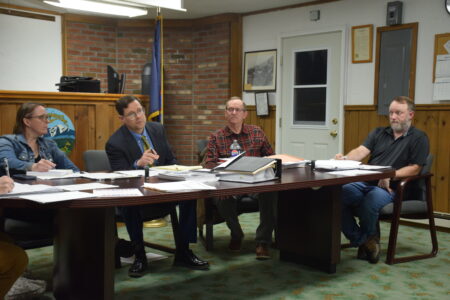
There are two school board seats up for election, with one board member planning to seek reelection and another still considering it. The district budget is also set to be discussed at the next board meeting on March 25.
The election and budget vote will be held on May 19 from 8 a.m. to 8 p.m. in the high school through door #5.
To vote on the budget and board members, one must be registered in the district in a house that is their primary residence. To register to vote, go to tinyurl.com/3zzyvk88.
–
Election
–
Both open board seats carry three-year terms.
Board Clerk Gina Pollock said application packets to run for the board are available now. To get one, email her at pollockgin@slcs.org or stop by her office in the high school through door #5. These packets are due back to the clerk by 4 p.m. on April 20.
Board member Mike Martin said he’ll be running for his seat again.
“My work is not done here,” he said.
Martin was appointed in December 2022 to fill a vacant seat. Just a few months later, he earned a full term on the board, running unopposed.
Board member Joe Henderson said he is still thinking about if he will run for a third term on the board. He was last elected alongside Martin in 2023, also unopposed.
–
Budget
–
School Business Executive Nikki Sears said she will present a budget forecast and a review of the fund balance and reserves at the board’s March 25 meeting. This meeting will take place at 5 p.m. in the high school library through door #13, and will also be streamed at tinyurl.com/2ba9csx8.
Though officials say the district is getting financially squeezed from many angles, SLCSD Superintendent Diane Fox has pledged to present a budget below the tax cap.
Right now, she said the preliminary budget is around $2.5 million short of being balanced. But she said they are working on it.
“I’m still pulling out my drawers and seeing where I can find $2.5 million hidden in one of these drawers,” Fox said with a laugh.
Her goal is to present a balanced budget to the school board. The board gets the first vote on the budget – approving it to be put up for a vote by district residents. Then, the public will get their say at the polls during the board election.
The district is currently operating on a $38.1 million budget.
The tax cap – which limits how much the town can increase its draw from taxpayers from year to year – is set at 0.75%, much lower than last year’s 4.44%. This means the district can only raise the amount it collects in taxes by $191,575 over last year’s budget without exceeding the cap. This would bring the tentative amount to be raised in taxes in the coming year to $25.7 million. Over the past year, the district has collected $25.5 million in taxes.
The budget could exceed the cap, but would need a 60% public vote to pass instead of a 50% vote. Fox said she is not considering proposing a budget that goes over the tax cap.
Sears said the district will need to dip into its reserves again to balance the budget this year.
She said rising electricity costs are already straining the current year’s budget. For one building alone, the cost of electricity jumped $8,000 over the course of one month, she said.
Districtwide, electricity is set to cost $175,000 more than what was budgeted for by the end of the year.
To cover this unexpected cost, she said the district is moving money from other pots.
Sears said Pollock is good at finding “little pockets of money” left over in other budget lines.
Electric costs are thousands of dollars a month higher than budgeted for after National Grid’s recent major rate hike; Sears said they’re looking at large fuel expense increases now, too, with the U.S. entering a war with Iran and everyone on the board has been discussing a $2 million health insurance cost increase that is looming over the district next year.
Student enrollment in the district is also at record lows for the modern era. Thirty years ago, the district had more than 2,000 students – twice as many as there are today.
Enrollment has been on a steady decline ever since. The district reported 984 students enrolled on opening day this year – 60 fewer than reported on opening day last year.
“I think we need to right-size,” Fox said.
Steve Maikowski from Santa Clara attended the board’s meeting on Wednesday to ask that as the district is budgeting, it is focused on keeping things lean and mission-critical – that mission being education. He told the board to interrogate every budget line, to see if it is absolutely necessary.
“If you keep spending up to the cap, there’s going to be huge repercussions, because we can’t afford it,” Maikowski said.
He said Santa Clara has been hit with double-digit property tax increases recently. The town of Harrietstown also recently reassessed its properties, and some are seeing their assessment going up.
“These are four to five times the level of what we’ve seen in our 12 years of living here,” Maikowski said. “We are really suffering.”
He warned that these tax increases are “not sustainable” and he’s concerned people will lose their homes due to rising taxes.
Maikowski also said, with the constant talk about affordable housing, these do not make homeownership affordable at all.
He warned the board that Santa Clara residents are planning to turn out to vote on the budget. They’re registering people to vote and will not want to pass something hiking their taxes.
“It’s going to be a different situation in terms of what you’re going to see with people voting in May on this budget than you’ve ever seen before,” Maikowski said. “I encourage you to think deeply about it.”
If voters reject the proposed budget, the district would fall back to a contingency budget – which essentially does not raise the tax levy any higher than the current year. The contingency budget is based on a formula. Because the tax cap is so low this year, Fox said there are potential situations where the contingency budget could actually be equal or higher than the proposed budget, due to the formula. There are many things the school is mandated to pay for that it cannot cut. There are state regulations, union contracts and legal requirements.
A contingency budget would essentially “unbalance” the budget, and lead to the district to start to make more cuts to “unessential” programming.
Board Chair Mark Farmer said some portion of school operations will suffer because with rising costs, shrinking enrollment and a strained tax base, something has to give.
Last month, the board unanimously voted to close Bloomingdale Elementary School – partially because of declining enrollment and partially as a way to save money.
The district estimated it could save up to $600,000 annually by closing Bloomingdale. This will not lead to a reduction in taxes, but is expected to stave off larger tax increases or budget cuts.
The high school will become a junior-senior high school to accommodate this change, and Petrova Elementary will become a Pre-K-6 school.
–
State and federal funding
–
Board Member Tori Thurston said state foundation aid for school districts is fully funded for the first time ever in both the governor’s proposed executive budget and the Senate and Assembly’s proposed budgets. She added that there are no changes to the formula for how districts get state aid, something which she and many other rural districts have been calling for.
Thurston said Gov. Kathy Hochul’s budget proposal includes a 1% minimum increase in state aid for all districts. This would give SLCSD $77,227 more than it got last year.
Thurston was “disappointed,” because the Senate and Assembly had been talking about a 4% increase to help schools weather inflation, but the state houses settled on only proposing a 2% increase.
One of the pots the district is pulling money from to cover rising electric costs is the personnel budget. There’s still money left over in personnel this year because the district budgeted for every single employee last spring.
At the time, the future of $700,000 in federal grants which paid the salaries of eight staff members was uncertain because the Education Department was being dismantled. The district ended up getting these grants, so the money budgeted for those staff did not need to be spent.
Farmer said that federal money is more in doubt this year than last year.