ROOST releases tourism sentiment survey
Results similar to past years, 83% of respondents say tourism is a positive benefit to community
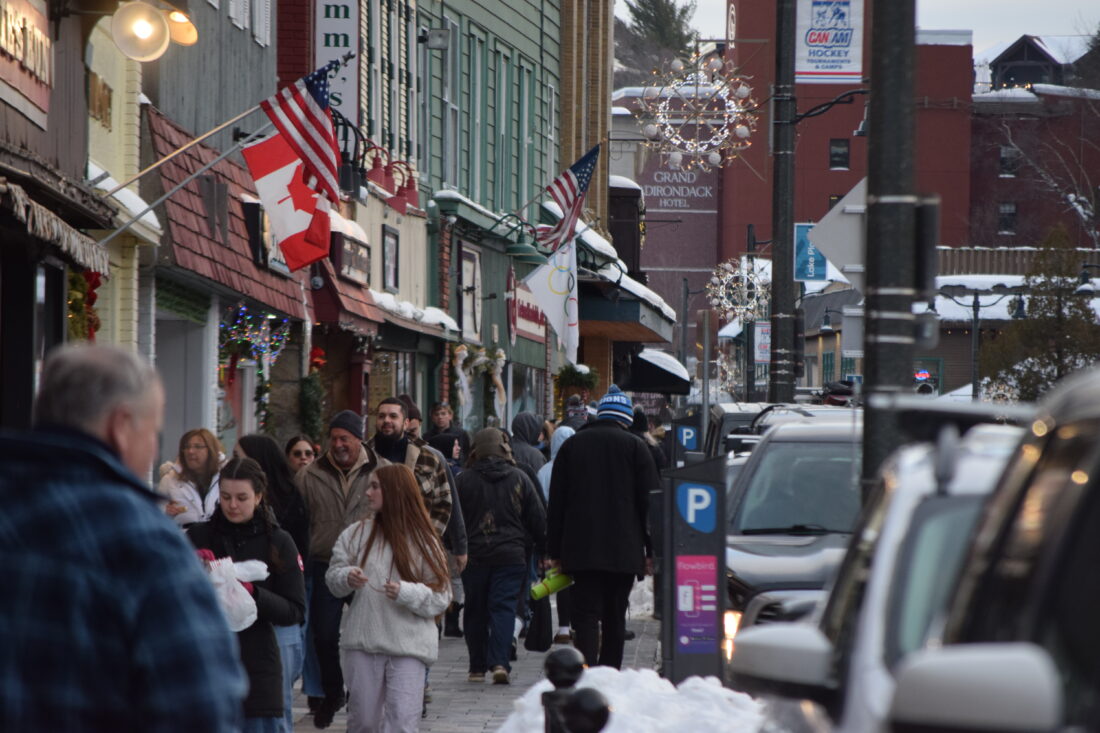
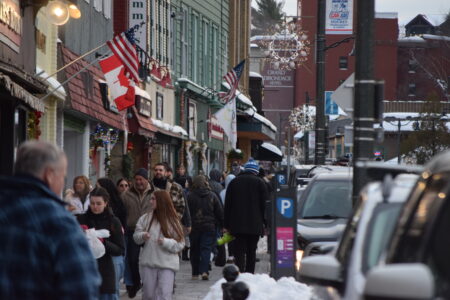
A busy Main Street sidewalk is seen in Lake Placid on Sunday, Feb. 15. (Enterprise photo — Aaron Marbone)
LAKE PLACID — While living in a tourism-driven region may come with headaches from time to time, one recent survey was clear: that the overwhelming majority of Tri-Lakes, Essex County and Hamilton County respondents said tourism makes a positive impact to their Adirondack community.
The Regional Office of Sustainable Tourism recently released the results of its fourth annual resident and business sentiment survey, which sought to capture the region’s perceptions about tourism and its socioeconomic impacts.
About 83% of respondents said that tourism has a positive impact on their community, with 5% saying it has no impact and 12% saying it has a negative impact. These figures are nearly identical to last year, where 84% of respondents said it’s positive, 5% said it has no impact and 11% said it had a negative impact.
The survey’s goal is to help ROOST better understand locals’ feelings toward such a large pillar of the economy, and how they evolve over the years. It’s also a tool for ROOST to gauge what types of events and activities could use a boost in promotion, and which don’t or no longer need as much of a spotlight. It was conducted from Oct. 6 through Nov. 17, 2025.
ROOST Chief Operating Officer Mary Jane Lawrence said that generally speaking, the topline and more nuanced questions in the survey have held steady over the past four years. President and CEO Dan Kelleher said in a Jan. 28 statement announcing the results that these numbers were gratifying.
“We appreciate that the vast majority of respondents affirm the overall benefits of tourism in our region, ” he said. “We also recognize the important and ongoing work to assist our communities with housing, large-event mitigation and other destination management initiatives.”
One of the other questions asked respondents whether they thought tourism had a positive impact on business. An overwhelming majority, 85%, said yes.
What stood out to Lawrence, though, was the alignment between business owners, who made up 26.6% of the responders, and non-business owners, who made up 73.4%. When the impact on business question was broken down between the two groups, 87% of business owners said it had a positive impact compared to 85% overall, which would equate to about 84% of non-business owners saying “yes.”
Lawrence said that the organization strives to balance tourism’s economic benefits with the community’s needs. ROOST is a non-profit destination marketing agency that is largely funded through occupancy taxes collected from visitors when they stay at hotels, motels, short-term rentals and other lodging and local governments.
It serves Essex and Hamilton counties, as well as Saranac Lake and Tupper Lake in Franklin County. This year’s survey included 852 total responses, of which 734 were from residents in these areas. Only the latter was used for the results. The participation numbers were similar to 2024, which received 825 total responses, with 734 meeting the geographic criteria.
As was the case for previous years, the survey fetched a region-wide response base, and was slightly more geographically distributed this year than last. The combined Lake Placid and High Peaks region of Essex County comprised 33% of the response pool, down from 38% last year. Saranac Lake’s share fell to 20% this year from 25% in 2024.
The Lake Champlain region’s response share rose to 14% from 11% last year. The Whiteface Region of Essex County and Hamlton each rose to 11% from 9% and 5%, respectively. Tupper Lake remained at 6% both years and the Adirondack Hub region, or southern Essex County, was 5% of the response pool, down from 7% in 2024.
–
Seasonal swings
–
One of the questions asked business owners which months they would benefit from increased customer traffic. Multiple selections were allowed, so data’s total is more than 100%. Seven of the 12 months were relatively close together, with September through March all between 50% and 53%.
April, May and June received the greatest yearnings for more business at 59%, 64% and 62%, respectively. Perhaps unsurprisingly, the peak summer months of July and August had the lowest percentages of business owners indicating they would benefit from increased business, at 42% and 44%, respectively.
Comparing each month to the survey’s four year average, the summer months, May through October, trended upwards, and the winter months were down. Kelleher attributed this to favorable winter conditions bringing more tourists to the region, keeping businesses busier than usual. Simultaneously, natural and human-induced factors made for less business in the spring.
“Our data shows that both January 2025 and January 2026 have seen significantly higher increases in visitation over the past five years,” he said. “This is largely due to the incredible snow we’ve had these past two winters. Last spring showed lower visitation due to prolonged periods of rain on the weekends coupled with an average 30% decrease in Canadian border crossings.”
Lawrence said it’s helpful to have both this year’s and the four-year running average. A major focus for ROOST has been to try to round out the ebbs and flows, and bring more visitation to the region during the traditional off-seasons.”
“May and June are situated between the busier summer and winter months,” she said. “Our businesses are staffed, trained and ready for peak season — most school calendars keep families closer to home until late June, once summer break begins. An important aspect of our program of work is encouraging year-round visitation through marketing campaigns and messaging to target markets, along with a focus on group travel and conferences.”
Lawrence thought the surveys pointed to increased fall visitation — which she said ROOST has pursued through conference marketing and leisure travel, or slower paced extended vacations — as being one of the office’s biggest successes.
For three years in a row, the arts have ranked as the top activity/experience that would benefit from increased marketing. The podium stayed consistent over the three years, with biking/cycling coming in second and food/restaurants in third. She said ROOST will continue incorporating this into its marketing strategies.
“The survey revealed that local arts and culture would benefit from increased exposure,” Lawrence said. “This aligns with current travel trends regarding experiential, immersive and slow travel. ROOST has placed more focus on events, museums, music, area festivals, local food and holiday-focused activities throughout the year.”
Lawrence said the annual survey is one piece of the puzzle when it comes to guiding ROOST’s strategy, and continued community participation in future years’ surveys is important.
“Understanding the impact of tourism on our local communities is vital,” she said. “ROOST is committed to helping ensure that the region is a great place to live and a great place to visit. The local tourism economy directly impacts our community vitality; so it’s important to strive for a healthy balance.”
The full survey results can be viewed at tinyurl.com/vwwph4x3.