
No shock: Electricity prices dominate Cashman town hall
State Assemblyman meets with constituents in Wilmington
-
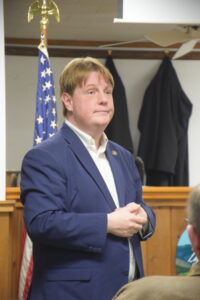
- State Assemblyman Michael Cashman, D-Plattsburgh, listens at a town hall held at the Wilmington Community Center on Friday. (Enterprise – Chris Gaige)
-
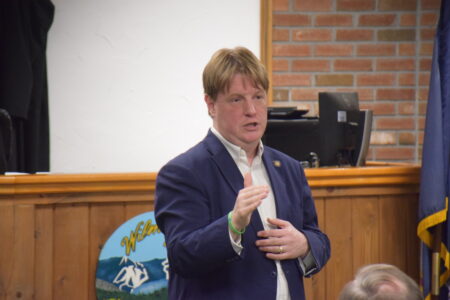
- State Assemblyman Michael Cashman, D-Plattsburgh, speaks at a town hall held at the Wilmington Community Center on Friday. (Enterprise – Chris Gaige)
-
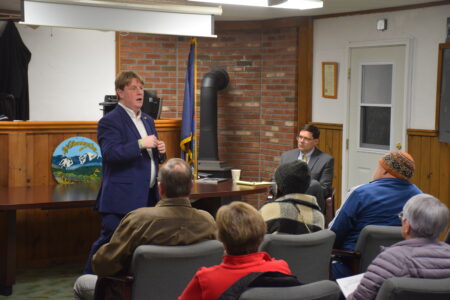
- State Assemblyman Michael Cashman, D-Plattsburgh, speaks at a town hall held at the Wilmington Community Center on Friday. (Enterprise – Chris Gaige)
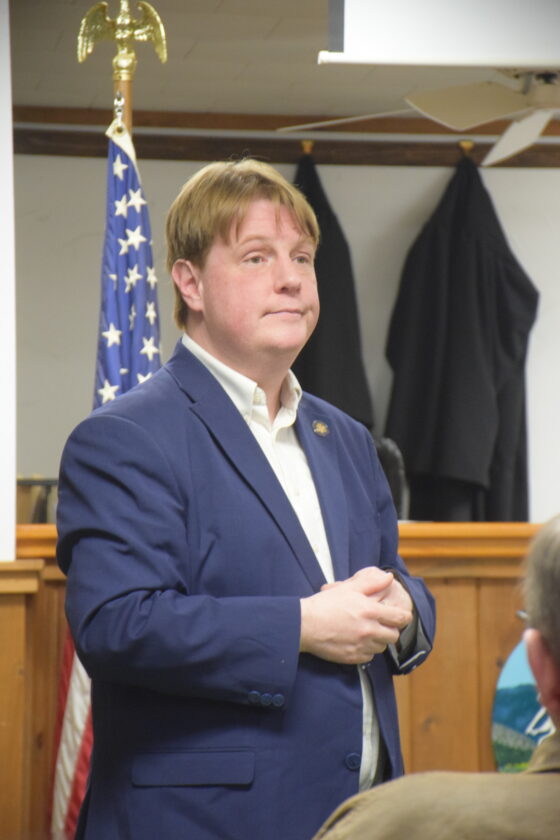
State Assemblyman Michael Cashman, D-Plattsburgh, listens at a town hall held at the Wilmington Community Center on Friday. (Enterprise - Chris Gaige)
WILMINGTON — Michael Cashman had a hunch that one issue would rise above the rest in his Friday town hall at the Wilmington Community Center: electric bills.
It comprised the first seven constituent questions.
Since taking office last fall, the North Country state assemblyman said it’s the biggest issue, by far, that he hears crisscrossing the 115th district — a legislative territory more than twice the size of Rhode Island.
“I’ve had phone calls from senior citizens who are calling me saying that they are putting double blankets on the bed to stay warm at night because they’re too afraid to put the heat too high,” Cashman, D-Plattsburgh, said. “We have farmers that are being crushed by this, and small businesses, I mean this is a universal crisis that we are at right now.”
Bob Peters, a retired shop teacher who said he accrued a foundational knowledge of electronics through his career, questioned why in recent months the delivery rate on his bill is exceeding the usage rate, and why the delivery cost is being billed in terms of kilowatt hours.
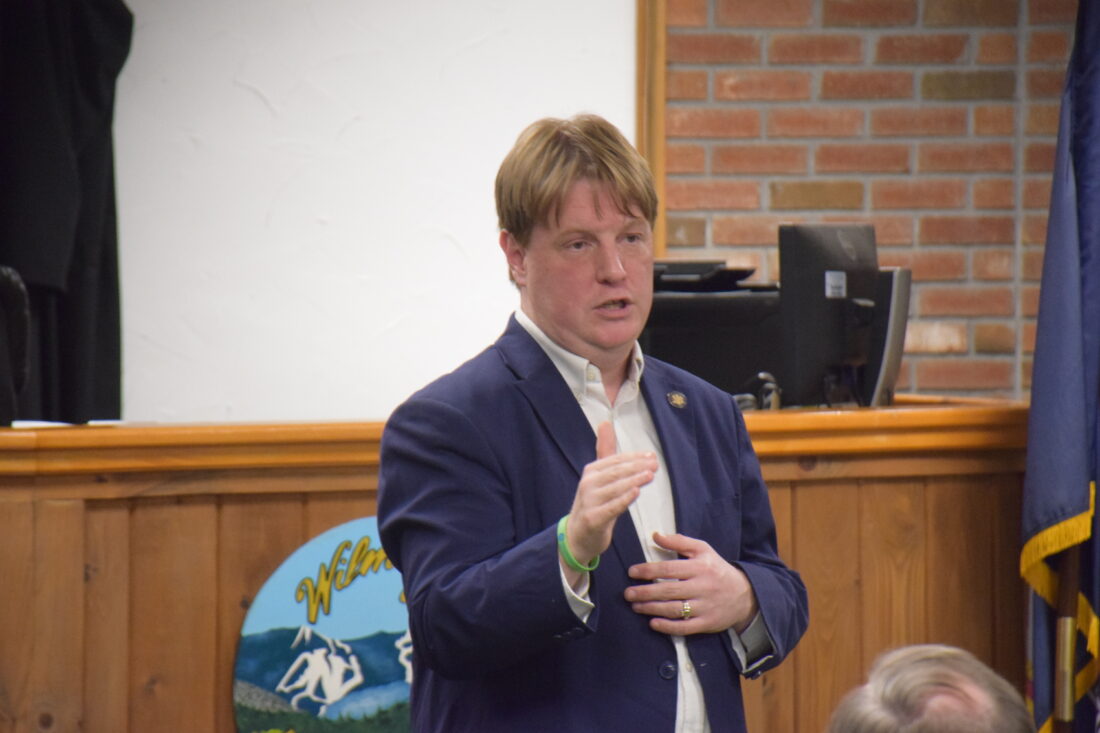
State Assemblyman Michael Cashman, D-Plattsburgh, speaks at a town hall held at the Wilmington Community Center on Friday. (Enterprise - Chris Gaige)
“I don’t care whether you’re putting one watt, 100 watts, 1,000 watts — whatever it is going through that line,” he said. “(It) doesn’t mean squat! It’s the same thing. It should not cost more.”
He said it amounts to a penalty on homes that have electric-powered heating elements that other homes may have serviced by propane or other heating elements. Peters said it’s not as bad for him, personally, as it is for others. That’s because he has home solar panels and is somewhat less reliant on the grid — but he said that didn’t make the practice just.
“So someone that uses — because they have an electric hot water heater or baseboard electric heat — 2,000 kilowatt hours, all of a sudden they’re paying a larger amount of money for delivery than what I would pay because I’m using less?,” he asked.
Peters added that he felt taxing electricity didn’t make any sense.
“Why is there a tax on electricity?” he asked. “Heating oil’s not taxed. Propane’s not taxed. Why is electricity taxed? It’s a commodity also.”
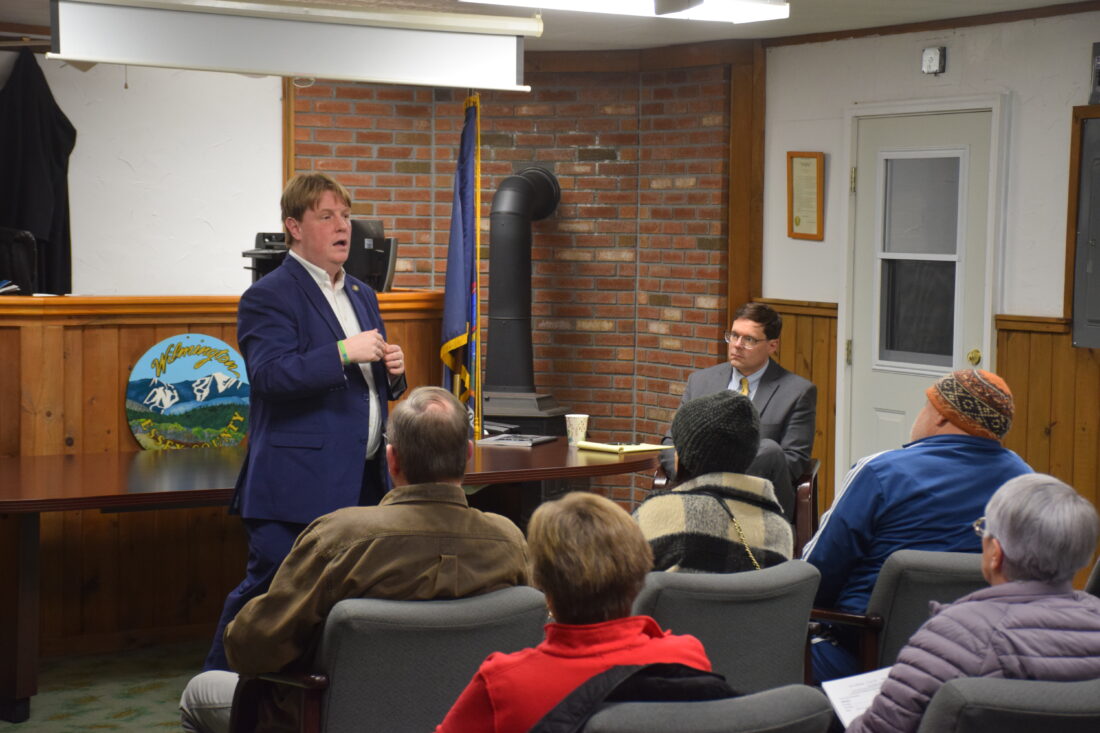
State Assemblyman Michael Cashman, D-Plattsburgh, speaks at a town hall held at the Wilmington Community Center on Friday. (Enterprise - Chris Gaige)
Cashman agreed.
“We need reform,” he said. “You don’t get to shop around for your electricity.”
A9426, a bill Cashman introduced in December, would require for more itemized and uniform billing practices from utility companies. It’s currently in committee and the bill’s full text is available at tinyurl.com/y9amfdz3.
He said this policy push was motivated from speaking to constituents who showed him bill increases that were not just exorbitant, but highly variable in ways beyond what could be explained in different usage amounts or providers. Cashman said there seemed to be no rhyme or reason, and suggested it could be sloppy or even errant accounting in some cases.
“There are huge discrepancies across the board,” he said. “We need a system that is fair and transparent. Transparency comes from accountability and auditing, first and foremost.”
Cashman said utility executives often tell him they need to raise more revenue to build out and improve grid capacity as electricity increasingly replaces fossil fuels as a source of power. The assemblyman added that he recognizes the increased usage, and that there’s a kernel of truth in the explanation, but feels it’s woefully inadequate excuse for two reasons.
The first, he said, is that if the money was significantly being invested back into infrastructure, the utility companies wouldn’t be making “all-time record profits,” as their expenses would be rising in accordance with revenue. NYSEG, National Grid and ConEd, are either directly or through their parent companies publicly traded, and as such, their financials are publicly available.
Cashman’s second reason was that if infrastructure upkeep was truly as pressing of a concern as executives in recent months have made it out to be, the companies would have been more proactive rather than deferring grid maintenance, some of which he said is between 20 and 30 years out of date.
Wilmington town Supervisor Tim Follos asked if downstate New York was experiencing the electric rate increases to the same degree upstate is, and if residents will be getting rebate checks, and if so, when those might be disbursed and how much they could amount to.
Cashman said it’s a statewide crisis, but didn’t know if it was as significant to the south.
“We have other stressors,” he said of upstate. “Gas is naturally higher up here.”
The assemblyman said the rebate checks can only become “a reality” if they make it through the state budget process. While the budget is statutorily due by April 1, Cashman was doubtful that the budget will be on time this year, but even if it was, more work would have to be done to figure out cost responsibilities before any checks are sent out.
He estimated that if rebates go out, they likely wouldn’t do so until June, if not later.
–
Other town hall questions
–
About 12 minutes into the question-and-answer session, the first non-electricity query came from Cliff Holzer, the 2025 Wilmington Citizen of the Year who recently announced his candidacy for Wilmington town supervisor. It pertained to the AuSable River, and a longstanding issue for Wilmington.
“That river is in desperate need of help,” he said. “We’ve had a lot of sediment buildup and it needs to be dredged. Is that something you can help with at the state level?”
Cashman said it was something he’d look into, and said the Adirondack Park Agency and Army Corps of Engineers could be helpful partners. He added that having a well-thought-out implementation plan in place as part of a study identifying the problem generally makes it easier to obtain state financial assistance.
Another constituent asked about road paving, and expressed concern that Essex County seems to lag behind other counties for its state funding allocation.
“There are no Democratic roads, there are no Republican waterlines,” Cashman said. “Infrastructure is universal. It is the thing that local government, and I would say government in general, has the most responsibility to do because it’s universal to all of us. We have to do better, without a doubt.”
Another constituent asked if the region was in danger of losing any more of its rural hospitals or healthcare infrastructure.
Cashman said rural healthcare is in trouble, and solutions need to be systemic. For instance he said even if a well-paying position at a hospital was open, if there’s not enough housing stock, child care or public transportation, it becomes much harder to attract people to the area.
“We have to open the aperture and work on things together,” he said. “Just because we solve one problem doesn’t mean we’re solving the collection of problems to meet the standard of what we really need to do to fix the ‘beginning problem.'”
Wilmington resident David Lally asked if there was anything Cashman was doing to try to rein in excessive or unnecessary state spending. The assemblyman said one idea he’s floated is allowing local municipalities and school districts to collaborate with healthcare insurance pools, which he said they currently cannot do.
Cashman said that insurance costs eat up such high percentages of school and local government budgets, and that having larger employee pools tends to reduce insurance costs. He was under no illusion that this would be doable in the short term, noting that it would involve a “complex” restructuring of education and municipal laws, and may require referendums, but remains an ongoing goal for him — becoming even more important as approximately 25% of New York’s state, county and municipal government workforce is projected to retire in the next five years.
Town Councilman Randy Winch asked if anything was being done to convert shuttered prisons or the land they sit on into housing stock.
“They just leave them standing there, rotting away,” he said. “It does not make any sense to me, whatsoever, why they can’t come up with a solution to use some places for housing.”
Cashman said he supports looking into housing projects there, citing Camp Gabriels specifically, and reiterated that the North Country can’t afford to not invest in housing solutions. He said it’s the linchpin and the entire economy of scale, and the region is currently in a housing deficit.
Winch followed up, questioning how the state prioritizes spending money while wading into one of the more controversial Tri-Lakes topics.
“How could the state possibly think of spending $40 million for a new APA building in Saranac Lake when they could probably fix up what they’re in right now in Ray Brook for $1 million or whatever,” he said. “I mean why would you spend $40 million for a building up there for that?”
Cashman answered that many projects “have a storied history” to them, and that the big price tag is partially attributable to the years of planning and consultation that went into it. He didn’t know exactly whether or not the APA’s cost benefit analysis justifies that price tag, but said Winch was asking a good question.
“I wasn’t at the starting line for (the APA building project),” Cashman said. “But I think we need to be looking at how are we spending our resources in an equitable fashion?”
Cashman thanked everyone for attending, noting that the more than two dozen people in attendance was impressive for such a small town. Wilmington’s strong attendance wasn’t a total surprise. After all, in the 2025 general election, Wilmington had the highest voter turnout rate, 65.6%, of any of the 38 towns and one city in the 115th assembly district.
Local News
112 mph wind gust clocked at Whiteface Monday
St. Armand battery facility debate charges up

With bronze in hand, Farquharson reflects on 2026 Olympics
No shock: Electricity prices dominate Cashman town hall

Saranac Lake village election today
Crown Plaza becomes Grandview Lake Placid
LAKE PLACID — After nearly six decades as a franchised hotel with IHG, the Crowne Plaza Lake Placid is being ...