Mercantile makeover proposed
Locals to pitch business ideas Sunday, shareholders to vote on new board next month
-
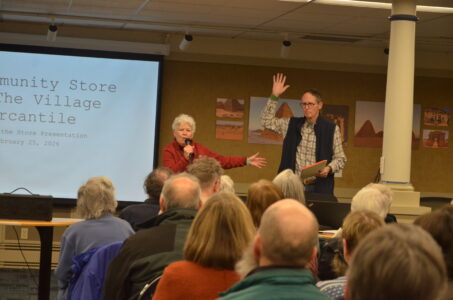
- Village Mercantile board members Melinda Little and Peter Wilson speak to a crowd of supporters of the store last month. On Sunday, some of these people will pitch a new business plan for the community-owned department store. (Enterprise photo — Aaron Marbone)
-
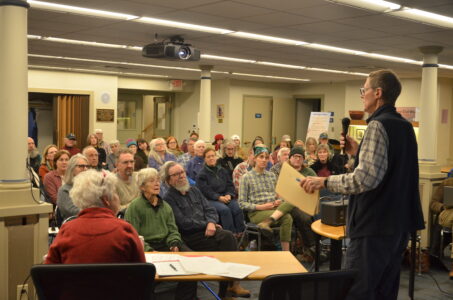
- Village Mercantile board members Melinda Little and Peter Wilson speak to a crowd of supporters of the store last month. On Sunday, some of these people will pitch a new business plan for the community-owned department store. (Enterprise photo — Aaron Marbone)
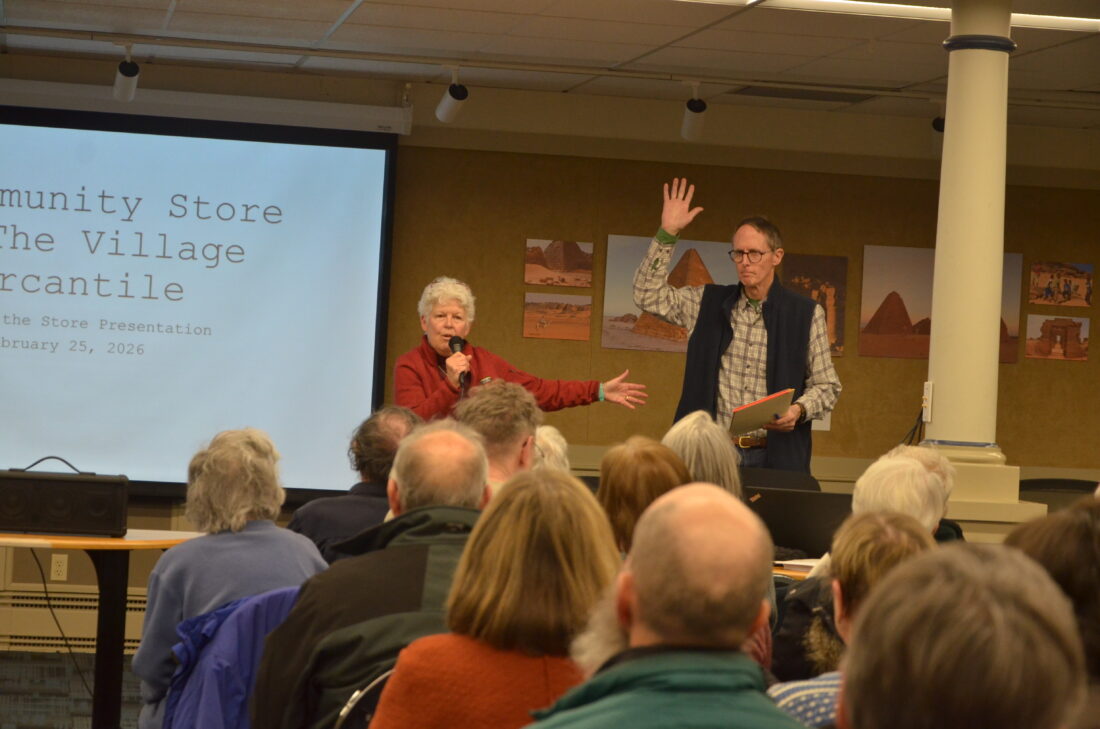
Village Mercantile board members Melinda Little and Peter Wilson speak to a crowd of supporters of the store last month. On Sunday, some of these people will pitch a new business plan for the community-owned department store. (Enterprise photo — Aaron Marbone)
SARANAC LAKE – A group of Saranac Lakers are preparing to pitch a new future for The Village Mercantile on Sunday.
Two months ago, the board of the only community-owned department store in New York publicly stated that it’s been struggling financially since it opened in 2011 and revealed that they were considering dissolving the corporation.
The community reaction was immediate, energetic and sizeable. Locals lamented the pending loss of the beloved and vital “Merc.”
The board was “heartened” by this feedback and decided to take dissolution off the table – for now – to see if the energy could translate to action.
“Our future can’t continue the way our past has gone,” Mercantile board member Peter Wilson said.
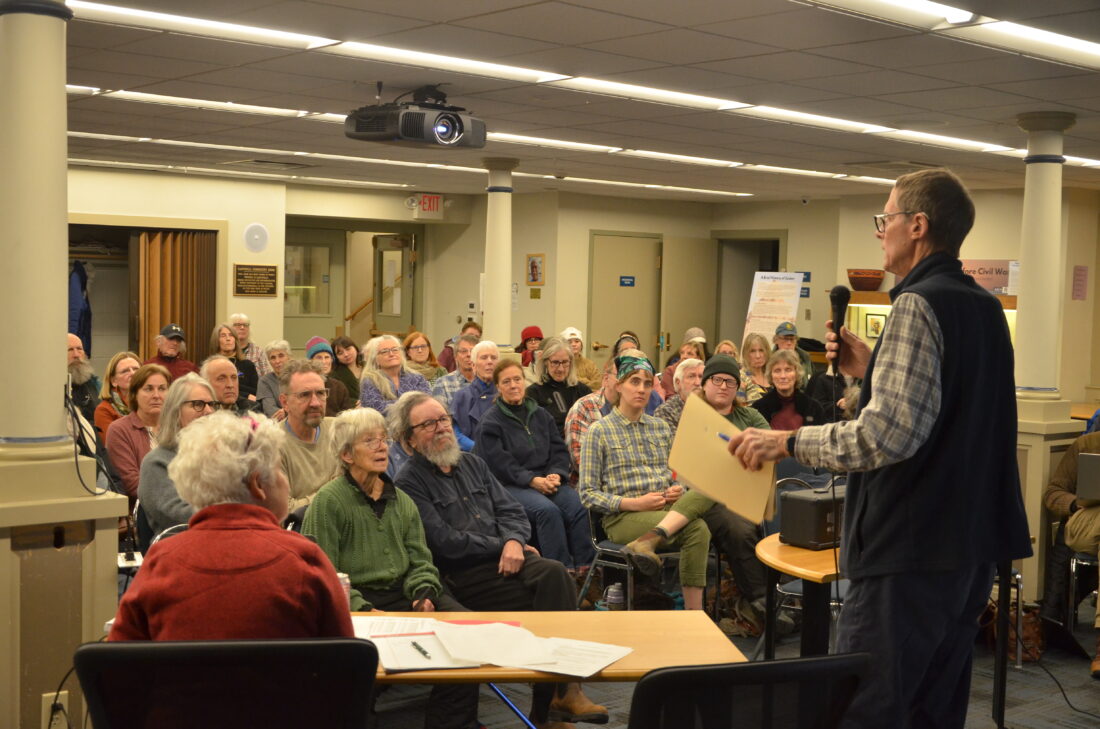
Village Mercantile board members Melinda Little and Peter Wilson speak to a crowd of supporters of the store last month. On Sunday, some of these people will pitch a new business plan for the community-owned department store. (Enterprise photo — Aaron Marbone)
Mercantile board member Leslie Karasin said they want to put the future of the store in new hands. Mercantile founding board member and President Melinda Little said the current four-member board is “burned out.”
Last month, a standing-room-only crowd packed the Cantwell Room of the Saranac Lake Free Library to hear about the state of the store, learn the challenges it faces, brainstorm ideas to improve the business model and form a group to pitch itself as a new board.
Little said there was lots of desire in that room, and she heard several good ideas a future board could pursue.
On Sunday, Mercantile shareholders Lindy Ellis, Valerie Trudeau and Regina Derzon will be back at the Cantwell Room holding a pitch session from 2 to 4 p.m. It will be open to the public to attend.
The Saranac Lake Village Mercantile is a corporation with several hundred shareholders, run by a volunteer board of directors.
In mid- to late-April, the current board plans to schedule an in-person shareholder meeting where the several hundred shareholders can vote on a formal proposal and a new set of board members. If they do not see a proposal or slate of board applicants they believe would work, they could still take a vote to dissolve.
This will essentially be a confidence vote – gauging if the shareholders feel this new group has a path forward that can work.
“This will at least give the community a change to not only weigh in, but help find a business model that can actually be sustained,” Little said.
The Mercantile sells daily essentials that are needed, but not sold elsewhere for miles around. It has clothing, bedding, kitchen supplies, craft supplies, children’s shoes, women’s boots and home decorations. The store also does consignment and sells syrup, jewelry, art, books and candles made by local creators. In recent months, hats, gloves, snowpants and boots have been hot items.
It’s been struggling since it opened in 2011. Some years have gotten close, but Little said they’ve never turned a profit and the current model is not sustainable.
Depending on the year, the store is usually around $18,000 to $50,000 away from being profitable. During the coronavirus pandemic, with increased shopping and two $25,000 pandemic-era grants, they got $2,000 and $3,000 away from profit.
But Little said the store fell behind on bills during the pandemic and it’s been a “slog” ever since.
The Merc does around $350,000 in sales each year – up to $400,000 in several recent years.
Most of the store’s assets are tied up in inventory – around $150,000 in inventory. Inventory has come down “significantly” in the past three months.
“We do have a lot of debt,” Little said.
She said she wants people to know the challenges of the store, so they can start thinking of alternative ideas.
The store owes around $246,000 on a variety of loans from banks, government agencies and from board members themselves.
At times, board members have given the Merc short-term loans.
“What are you going to say when you’ve got a $6,000 bill that’s due and there’s not enough money on the credit line?” Little said.
The store – originally called The Community Store – rebranded and launched an online retail site in 2018. Little said their goal was $50,000 in online sales per year, but it’s been closer to $15,000, instead.
The Merc became the on-site managers of the building at 97 Main St., which lowered their rent by $1,000. Currently, they pay $3,300 in rent per month for the storefront.
The Bear Essentials custom apparel store below the Merc has closed and is empty. The building has one apartment, too.
A community-owned department store is incredibly rare. Little said it might be the only one in the country still functioning. Retail has changed a lot since the store opened almost 15 years ago, Little said, adding that it’s a hard business to be in today.
Kay Ingulli, a newcomer to town who attended the meeting last month, said that the store also runs “like a nonprofit,” in that it has a community mission that guides its decisions, rather than pure profit.
Little said the Merc has been a place for nonprofits to sell their merchandise, but it does not result in great deals for the store. She said they have kept overhead down, but have not been able to compensate staff as much as they would like to. The store has refrained from expanding its offerings into certain markets, to not compete with other local stores.
–
Ideas
–
Most attendees at last month’s meeting were in agreement that the Merc needs a new mechanism to bring revenue into the store.
Jim Sonneborn said the Merc is important to the community fabric and an essential resource for people moving into town. He said the store should focus on its core services that meet these needs. Karasin called this “Team Underwear” – people with a focus on the essentials.
Other people pointed out that, with online shopping being easier, quicker and more widespread than ever, Saranac Lakers can now buy underwear on Amazon. They suggested the store focus on more than just retail.
Valerie Trudeau suggested a focus on “Made in Saranac Lake” – creating more opportunity for local entrepreneurs and craftspeople to sell what they make at the Mercantile. She said this might lead to more people getting into trades creating household basics.
Wendy Foley, who runs the Wendy’s Place Christian Bookstore on Broadway, suggested focusing on what sells the fastest.
“We cannot be everything to everybody,” she said.
She recalled something she heard at a business conference years ago: “Your puppy is ugly – get over it.”
If product sits on the shelf, Foley recommended marking it down and getting rid of it to make room for what is selling.
She also said she owns her building, which has helped her to survive through the changing retail market.
Attendees suggested the store take stock of what product moves fast and what moves slow, and compare that to a community survey of what people say they want.
Rich Shapiro suggested a tip option at checkout where shoppers can donate to the store if they want.
–
History
–
Megan Gorss said that many people in town don’t know what the Merc is fundamentally. Many were not here when it started. But when they learn its history and mission, they are always interested and excited, she said.
Ingulli, who moved into town two weeks prior and had learned about the Merc after reading about it in the Enterprise, said she was “blown away” by its history.
Several people said the Merc’s history is essential to its success. Someone pitched the idea of an annual block party celebrating it.
The store took a huge effort to start, and did a crowdfunding effort in 2018 to raise debt capital.
When the Ames department store closed due to bankruptcy in 2002, it left a major hole in the local retail scene. People had to travel to Plattsburgh, Malone or Potsdam to buy everyday essentials like underwear, children’s shoes, cooking utensils or craft supplies.
For a number of years, Walmart was in talks to open up a supercenter here, at the end of town where McDonald’s, Aldi and the village sand pit are.
This was controversial, with fierce support and fierce opposition to the large company coming into town. The plan was eventually scrapped.
As consolation, a group of locals started up The Community Store, inspired by and modeled after the community-owned Powell Mercantile in Wyoming.
The Community Store started selling shares in 2007, holding events like trivia nights where hundreds of shares were sold. A person involved with the Merc in Wyoming came and talked to organizers. The Powell Mercantile opened in 2001 and closed in 2016. It took several years, but the Saranac Lakers raised the $541,700 needed to start the store.
The store was the first community-owned department store in the state.
The New York Times wrote about the opening and called it “the retail equivalent of the Green Bay Packers.” Ironically, the last time the Green and Gold won the Super Bowl was in February 2011, eight months before The Community Store opened.