Forest ranger recalls saving hiker lost for two days in Dix Range
Heralds hiker’s ‘pure determination to keep moving’ was key to getting out of woods alive
-
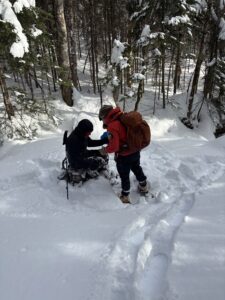
- A DEC forest ranger, right, tends to a hiker around 3 p.m. on Feb. 26 shortly after he was found alive after spending two nights in the Dix Range. The hiker got lost off of the Lillian Brook trail. (Provided photo – New York state Department of Environmental Conservation)
-
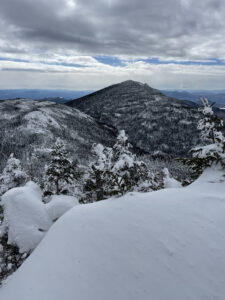
- Rob Thomas South Dix Mountain, left, and Macomb Mountain are seen are seen from Hough Peak in the town of North Hudson on Friday. The Lillian Brook trail runs through the pass between Hough and South Dix. (Provided photo – Rob Thomas)
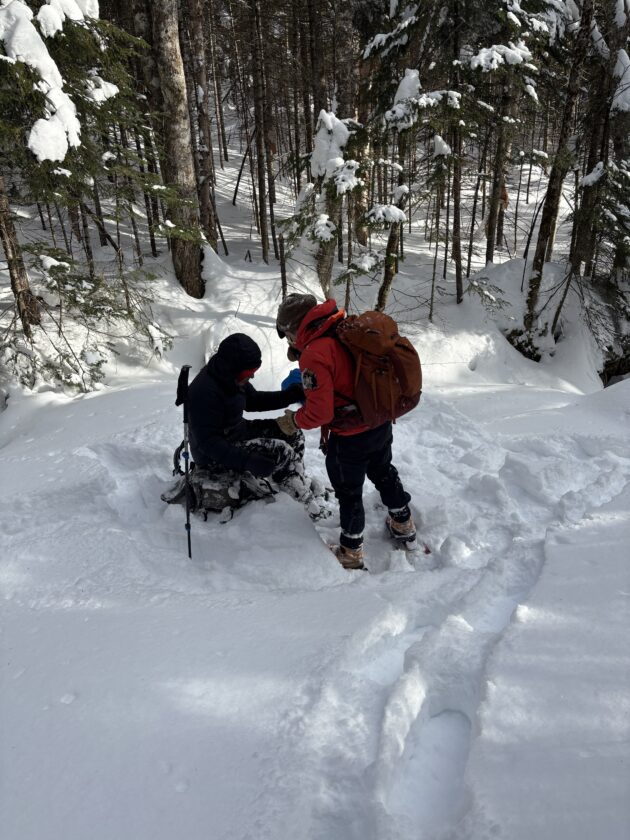
A DEC forest ranger, right, tends to a hiker around 3 p.m. on Feb. 26 shortly after he was found alive after spending two nights in the Dix Range. The hiker got lost off of the Lillian Brook trail. (Provided photo - New York state Department of Environmental Conservation)
NORTH HUDSON — When Forest Ranger Matthew Adams got the 5:30 a.m. call to join the search for a missing hiker in the Dix Range, it didn’t take him long to realize that the straits were dire.
A 58-year-old male from Mechanicville had been in the wilderness for two nights in a row. It had snowed seven inches in the mountains the day before — and the day before that, low temperatures were below zero.
“We had to find him as soon as possible,” Adams said in an interview on the incident released by the state Department of Environmental Conservation.
For Adams — one of more than 20 DEC forest rangers assigned to the search — time wasn’t on his side. Seven rangers had been searching through the night after the spouse called the DEC’s Ray Brook dispatch center at 8:45 p.m. on Feb. 25 to report that the hiker was overdue.
Adams was tasked with towing some snowmobiles to Elk Lake, the trailhead where the hiker and subsequent rescue operation began. When he arrived around 8:30 a.m., the nighttime rangers debriefed with the reinforcement crew. Adams said that they were sapped of energy, given the intensive searching over steep and rugged terrain – but they got out safely, and the next shift moved in.
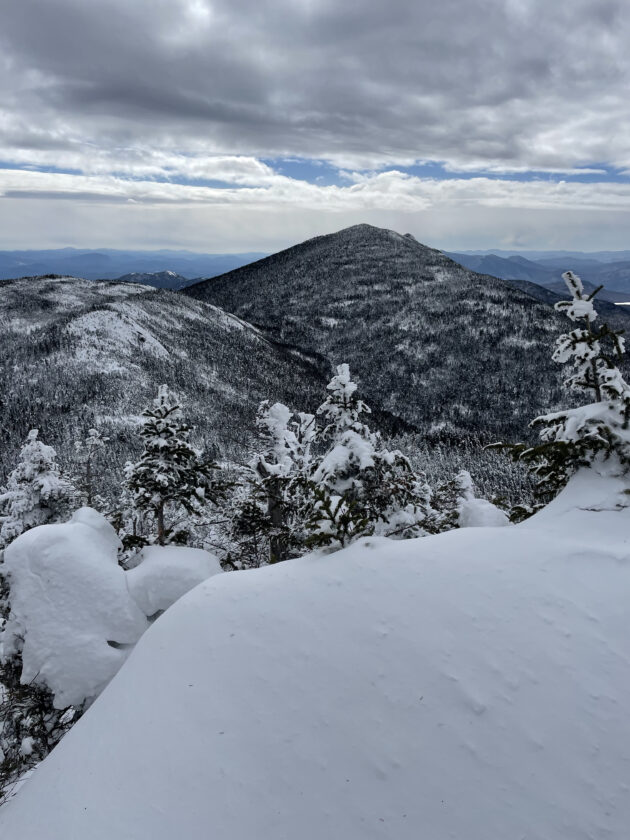
Rob Thomas South Dix Mountain, left, and Macomb Mountain are seen are seen from Hough Peak in the town of North Hudson on Friday. The Lillian Brook trail runs through the pass between Hough and South Dix. (Provided photo - Rob Thomas)
Alongside the ground searchers, four forest rangers took off in a New York State Police Aviation unit helicopter from the Adirondack Regional Airport in Lake Clear. The snowstorm had pushed out of the area, and clearing skies opened the opportunity for a helicopter to join the rescue effort.
In addition to searching from the air, the State Police helicopter was able to insert forest rangers at high elevations unreachable by any other sort of motorized transportation, saving precious time and energy.
The Dix Range is rough — even by High Peaks, let alone Adirondack, standards. Its five 4,000-foot-plus peaks, Dix, Hough, South Dix, Grace and Macomb, require several miles of hiking in from the trailhead just to get to the true base of the mountain. Some of the paths are unmarked, and even the official trails are seldom traveled, especially in winter.
Many choose to hike the range in one go, either looping to and from Elk Lake to the south or, less commonly, state Route 73 to the north. On paper, there’s a shortcut, the Lillian Brook trail, offering direct access from the trail to Elk Lake to the three mountains — Hough, South Dix and Grace — in the middle of the range, saving hikers from either having to climb or re-climb over either Dix or Macomb mountains on the edges of the range.
In reality, though, the Lillian Brook trail is rarely used — especially in the winter — a product of most traffic tending to loop the range, avoiding that trail entirely.
Before the hiker’s spouse had called to initiate the rescue, the hiker had called them, expressing that he was tired and moving slowly. The DEC was able to use that earlier call to determine the hiker’s last known location. It was near the Lillian Brook trail, leaving lots of opportunity for the hiker to go off-trail.
The initial set of forest rangers had already covered the actual trail around the last known location, with negative results. After consulting with the incident commander, Adams said rangers made the determination to begin searching off-trail. It wasn’t a decision that was made lightly.
With a snowpack of more than 6 feet in the mountains, wading through such deep snow would be a massive energy expenditure — even moving downhill and with snowshoes — and the going would be slow.
But with no signs of the hiker, forest rangers knew it was almost a certainty that the hiker had gone off-trail. So it began.
After some time searching through the woods, Adams said rangers came across a faint set of snowshoe tracks. Given the fresh snowfall the day before, Adams was pretty confident he was on the right track.
“We were off-trail, and eventually our path crossed some faint snowshoe paths,” he said. “We’re like, ‘That’s the only person, (no one) else is going to be out in the woods way off trail.'”
Adams said they began calling the man’s name, moving downhill and following the tracks. Although they were on the tracks, a callback was still far from a given. At 2:55 p.m. on Feb. 26, the moment any rescuer relishes came.
“We were like, ‘Wait, did we actually hear what we just heard?'” he said. “He responded back to us that we were really close now, and moments later, we saw him.”
Adams said it was his first rescue where he made initial contact with a subject in the woods. It’s a feeling he couldn’t quite describe in words.
“It was the best feeling ever, I can’t explain it,” he said. “It’s a feeling I’ve never experienced before, and it makes you feel incredible. It makes it all worthwhile.”
The hiker, while in rough shape, was extremely relieved. Adams said the hiker mentioned that he had heard the helicopter up high. He knew rangers were searching for him, and it was a motivating factor to not give up the fight. Adams said that it was incredible that the person had survived that long in weather that cold.
“I think he just kept moving, and it was pure determination to keep moving and staying alive is what kept him going,” Adams said.
Though the overdue hiker was able to talk, he was suffering from frostbite and hypothermia and was depleted of energy. Forest rangers provided first aid and determined that a helicopter evacuation to expedite the hiker’s time to more serious medical care was necessary.
Adams said it was about 40 minutes from first contact to when the subject was hoisted up to the helicopter. Between aiding the hiker and coordinating with the helicopter, Adams said those 40 minutes went by in a blur.
Lining up the chopper was far from an easy task, Adams said. Even with their GPS coordinates provided, the trees were so dense that it took some time for the aircraft to hover over the correct location. Fortunately for the lift, the lost hiker had been following a drainage, and the frozen river provided just enough aperture for the harness to be lowered without tree branches getting in the way.
Forest rangers talked the hiker through what to expect in a helicopter hoist. They advised that he might spin near the top of the lift, but if it happens, not to panic. Once the subject was flown off, the day wasn’t over for Adams and the other rescuers on the ground.
“The drainage out from where we found him, back to the hiking trail, was pretty rough, and that took us a while,” he said. “We hiked out, met another ranger and we were able to snowmobile a good chunk of the way out.”
The DEC said the hiker was flown to the Lake Placid airport, where he was treated by the Lake Placid Volunteer Ambulance Service. The DEC did not provide an update on the hiker’s post-rescue medical status by press time Sunday.
Asked if he had any leftover adrenaline by the time he got home, Adams said he was out of energy and fell asleep almost immediately.
Reflecting on the rescue, Adams had some advice for those who venture into the backcountry in winter.
“You need a lot more gear in wintertime than you think you do,” he said. “Another thing is, don’t hike alone if you can avoid it. When you’re in a group, you have more people to have more gear — one person can bring a stove instead of you each having a stove. And then just tell someone where you’re going and when you expect to be back.”
Adams’ interview, which was conducted by DEC spokesman Jeff Wernick, is available in its entirety at tinyurl.com/4rpzshvk.
Local News
Forest ranger recalls saving hiker lost for two days in Dix Range

Back-to-back champions

LPHS to host concussion seminar Wednesday
Weekend roller coaster as mid-March warm-up looms
SARANAC LAKE — You might want to keep a few different coat options handy this weekend. A hallmark of the ...

Saranac Lake halts controversial police cam installation