Flock blocked
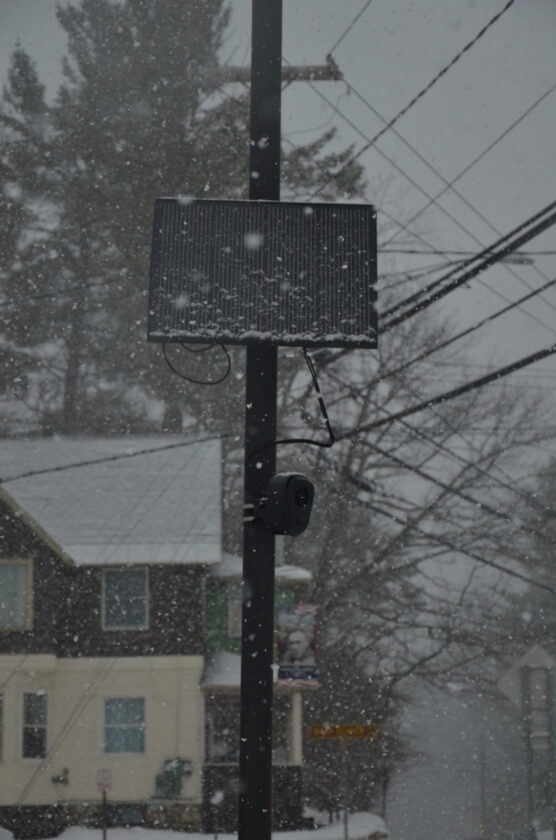
A Flock camera on Broadway in Saranac Lake. (Enterprise photo - Aaron Marbone)
SARANAC LAKE – The Saranac Lake village board chose to cancel its contract with the controversial license plate reader and surveillance camera company Flock, and never enter into an agreement with the company again, in a 4-1 vote Monday night.
When the Saranac Lake Police Department announced the installation of the cameras last month, the negative response from the public was swift.
Residents said that they didn’t want the village to contract with the company building a national network of data-collecting cameras. They had concerns about the company’s contracts with the federal government, known risk of hackers accessing its databases and an error rate of at least 10% in the license plate readers. They were also upset that the public did not know about the cameras until they were being installed.
The village was set to get six “Falcon” ALPRs and six “Condor” security cameras, known as “pan-tilt-zoom” cameras. Three had been installed so far.
Late last month, Mayor Jimmy Williams said the program was being paused until the village could discuss the cameras and the contract with the police chief.
Trustee Kelly Brunette brought a resolution to Monday’s meeting which would pause the Flock installation until the board could review the policies governing its use.
The resolution stated that the cameras raised “important considerations related to privacy, data governance, records retention, cybersecurity and public transparency.”
It mandated that any such ALPR or networked public safety camera system contracts shall need to be authorized by the board first.
At the start of the meeting, Williams pledged that this would be a unanimous vote to pass.
“That bill is going to be unanimously supported,” he said.
But that was before amendments were made to the resolution. After they were added, the resolution passed 4-1, with Williams as the only vote against.
Trustee Sean Ryan said he doesn’t agree with every part of the resolution, but voted for it for “the greater good.”
Trustee Matt Scollin had already publicly said the cameras should “be boxed up and sent back.”
Trustee Aurora White proposed three amendments which included stronger language. All three passed.
One amendment directed the village manager to immediately terminate the contract with Flock.
Brunette, Scollin, White and Ryan voted for this. Williams voted against it.
The second amendment said that “the village shall not enter into any future agreements with Flock.”
Brunette, Scollin and White voted for this. Ryan and Williams voted against it.
“We don’t have the expertise to be proper stewards of this data,” White said.
Williams said he does not know enough about Flock at this point to say “yes” or “no” about never contracting with them again and was not ready to throw it out the window yet without talking to the chief first.
The third amendment directed village staff to provide a full report detailing the procurement process used, the timeline of decisions and the individuals who authorized the execution of the agreement.
White said this amendment is meant to “plug the holes” and find weaknesses in the system that allowed the cameras to be installed without public discussion.
Brunette, Scollin and White voted for this. Ryan and Williams voted against it.
It was a packed meeting in the village boardroom on Monday, with numerous people sitting on the floor and standing in a line out the door into the hallway.
The board’s bickering began even before the pledge of allegiance.
After the vote, several people thanked the board for acting quickly on their concerns.
Village resident Joy Cranker said she felt the public’s wishes had been heard, and that they hadn’t been feeling that before.
“You did done good,” Village resident Kelly Metzgar said, adding that this should have happened earlier.
Village resident Margot Gold said the resolution exceeded her expectations.
SLPD Chief Darin Perrotte was not at the meeting on Monday.
Williams said Perrotte has been in a big training course with papers and physical exams on top of him answering questions about Flock for all the board members texting and calling him. He was only available on Monday evening until an obligation at 6:30 p.m., Williams said.
Williams added that Perrotte would be at the next village meeting in two weeks. With the installation paused, he felt there was no rush to cancel the contract before talking with him.
White said that Perrotte was left out of the meeting.
“He was asked to join us tonight, he was planning on joining us tonight and he mentioned to me that if it was a direction from the board to cancel these contracts that he would happily do it. He was told not to attend tonight,” White said.
Gasps swept through the audience.
Williams said the Monday meeting was busy with the volunteer fire department as a special guest, and executive session and discussion of the Adirondack Park Agency lease before the Flock discussion. He didn’t think they’d be able to have a full conversation with Perrotte before his 6:30 p.m. obligation.
A member of the public said they should have rearranged the meeting. White also said Perrotte told her he could cancel his obligation.
–
Taking stock of Flock
–
Automatic license plate readers, referred to as ALPRs, and police-operated surveillance cameras are not new technology, but Flock pairs them with artificial intelligence image recognition, a cloud database, an option to join statewide or nationwide database networks and an officer-facing dashboard to form profiles of vehicles, flag suspected stolen vehicles or vehicles used in a crime on a “hot list” and allows officers to add license plates to the hot list.
The website deflock.org, which crowdsources the locations of ALPRs into an interactive map, shows these Flock-branded cameras may be the first in the Adirondacks.
Williams said Perrotte asked about cameras several years ago and the response was “lukewarm.”
The SLPD uses other ALPRs locally – from private and commercial entities and other law enforcement agencies.
In 2023, after a string of vandalism, Village Manager Bachana Tsiklauri brought up the idea again in an email to the board and Perrotte mentioned the grant. At the time, Scollin, Brunette and Williams supported the idea. Williams pointed out that, also, at the time, AI and ICE were not in the conversation. Tsiklauri also said this was “way before the Flock cameras were broadly criticized online.”
The village was awarded a $241,500 state law enforcement technology grant in 2024. The village board accepted the grant in June of that year. It provided funds for a range of potential tech upgrades and did not specify which of the technologies on the list of options the money could be used for. The money has been used for several technologies. One of those is the cameras.
Williams said he let Perrotte choose the camera company to contract with. He said he does not like to micromanage the purchases of department heads.
The village board, through the vouchers it approves at the start of every meeting, approved the SLPD to spend $72,000 of the grant for the Flock cameras. Both Williams and Tsiklauri signed the check for the cameras.
This $72,000 paid for the installation of the cameras and a two year subscription to the Flock hardware and software. The annual subscription costs $36,000, according to the contract.
White felt there was failure on multiple levels due to flawed processes in the village. She said the board should have more oversight of the chief.
White said the village guidelines say it should not be pre-paying for services. She also said the contract was not attached as documentation to the voucher.
White had previously brought up concerns about how the vouchers are signed, and said this could have been avoided if the village had been auditing the vouchers every meeting as she had called for.
–
Flock talk
–
Several people drew a distinction between a closed circuit camera system operated by the SLPD and Flock’s nationwide network of cameras with vehicle profiling and data sharing agreements.
“I have nothing to hide, but I don’t need to have my car tracked around the village,” Metzgar said.
Metzgar said she likes the SLPD and they’ve been helpful to her before. But she was “disappointed,” saying the cameras were “hidden from the public.”
Village resident Schuyler Cranker said the cameras were installed with no regard for the privacy of citizens. He called Flock “snake oil” being sold to police as a “wonder tool.”
Flock’s contracts include a passage saying “Flock may access, use, preserve and/or disclose the footage to law enforcement authorities, government officials and/or third parties, if legally required to do so or if Flock has a good faith belief that such access, use, preservation or disclosure is reasonably necessary to comply with a legal process, enforce this agreement or detect, prevent or otherwise address security, privacy, fraud or technical issues or emergency situations.”
Schuyler said the terms in that passage are not well-defined. “Good faith belief” is broad enough to allow many uses of the footage, he said.
He also said living in a “panopticon” has been shown to be bad for people’s psyches.
Forrest Law asked the board to expand the resolution to include regulation on all police surveillance cameras, to require public participation on surveillance technology the village installs and to let surveillance technology allowances to “sunset.” Technology changes fast, and he said the board should regularly update its policies and use of it.
“Where is Lexipol?” Harrietstown Councilman David Lynch asked.
Saranac Lake contracts with the company Lexipol for its policy manual. Flock directly partners with Lexipol.
Lynch said the policy manual has not been updated since January 2025. He also said the village’s policy on ALPRs is not specific to Flock characteristics like the “vehicle fingerprint” feature. He questioned why Lexipol could not have updated the policy since the contract was signed two years ago.
In December, 404 Media and YouTuber Benn Jordan found that livestreams and administrator control panels on some of Flock’s Condor cameras were “exposed to the open internet, where anyone could watch them.” Journalists were able to gain access to the cameras without a login and watch them live, download a month of video archive, change settings, see log files and run diagnostics.
Sandra Kalinowski from Saranac Inn said these cameras being unsecured is scary. She worried about predators gaining access, seeing unattended children and acting on it.
“These cameras are not going to keep us safe,” Kalinowski said.
Virginia Slater said the cameras create more opportunity for crime.
She said surveillance technology involves an exchange of privacy for safety. But in this case, she felt the exchange was uneven.
Slater said ICE uses Flock in states banned from cooperating with the agency.
Last month, Perrotte had said the department would not use the cameras for immigration enforcement. He said if an immigration agency requested photos or footage, the department would only provide it if it was paired with a criminal matter.
But Flock has made secret agreements with U.S. Border Patrol to give its agents backdoor access to ALPR data from its cameras around the country — including cities like Syracuse, which had not agreed to share data with the federal agency. When Syracuse police “inadvertently” opted into sharing data on Flock’s nationwide network, Border Patrol — which had a contract to search the nationwide network, despite its CEO Garrett Langley falsely claiming it did not — was able to search its database. Syracuse news outlet Central Current found that there were 2,097 immigration-related searches made.
A similar situation was exposed by 9NEWS in Denver, Colorado.
–
Flock information
–
Flock cameras are installed in public areas and photograph every car that passes. They store information about the vehicles in a database — license plate numbers, make, model, color and characteristics like bumper stickers or after-market additions.
Law enforcement officers can search on a dashboard for these points of information, bring up a profile of the vehicle and see everywhere that car has been within the network, how long it stays places and how frequently it visits those places. This data is stored for 30 days and can be shared with other law enforcement agencies.
The goal of these cameras is to find missing people and suspects, recover stolen vehicles and solve crimes faster.
“It’s not going to be used for traffic enforcement. These cameras don’t mail out tickets,” Perrotte said last month. “They’re not going to be used for following or harassing any citizen.”
But, this fast-growing company and its extensive nationwide camera network have been under scrutiny for a 10% error rate in license plate readings, claims of invasion of privacy by a private company, concerns about data it collects on civilians being vulnerable to leaks and belief that the product violates the Fourth Amendment due to its collecting data on citizens without a warrant.
Flock contracts with more than 5,000 agencies in the country. But around 30 cities have ended contracts with Flock after public outcry over concerns of mass surveillance, misuse of data or federal immigration enforcement agencies having access to the data. Some state and federal legislators around the country have also attempted to pass bills regulating the technology.
Perrotte said the cameras are not speed detection devices, they don’t record audio, they do not have facial recognition or detect people by race or gender and they will not be monitored 24/7. He said they will only be used retroactively to investigate crimes.
Kalinowski said that the cameras can get software updates and that facial recognition could be added at some point.
Flock deletes all footage on a rolling 30-day basis, except as otherwise stated, according to the contract.
“Flock does not own and shall not sell customer data … customer-generated data … anonymized data,” the contract states.
This anonymized data remains Flock’s property after a contract is terminated. Flock uses this data to train its machine learning algorithms.
The ALPR photos are encrypted, but numerous data security risks have been exposed by technology experts. The potential for the data to be hacked, stolen and leaked to bad actors, data brokers, criminals, corporations or other agencies is a concern of privacy advocates.
A 2021 study of Flock’s “Falcon” camera by surveillance research firm IPVM found a 10% error rate in the camera output. After this study, Flock stopped selling its products to IPVM for testing and claimed the firm’s results were not accurate.
There are several cases in other states where these errors resulted in wrongful detentions, children being held at gunpoint and dogs being released on people erroneously targeted by the AI system.
Flock is selling a new product called Nova to connect its data collection on vehicles to data collected on people. This could tie drivers to vehicles. 404 Media found that some of this personal data comes from illegal breaches and hacks
Local News
Flock blocked
Treachery in the backcountry
Safety risks led Army branch to drop support for howitzer testing in 2023
The risk of projectiles ricocheting into state Route 9 and I-87 led the U.S. Army branch contracting with a private ...
Slush and smiles at 3P
Fishin’ tradition