Despite weather mayhem, maple season marches on
Several ‘Maple Weekend’ events planned across Tri-Lakes
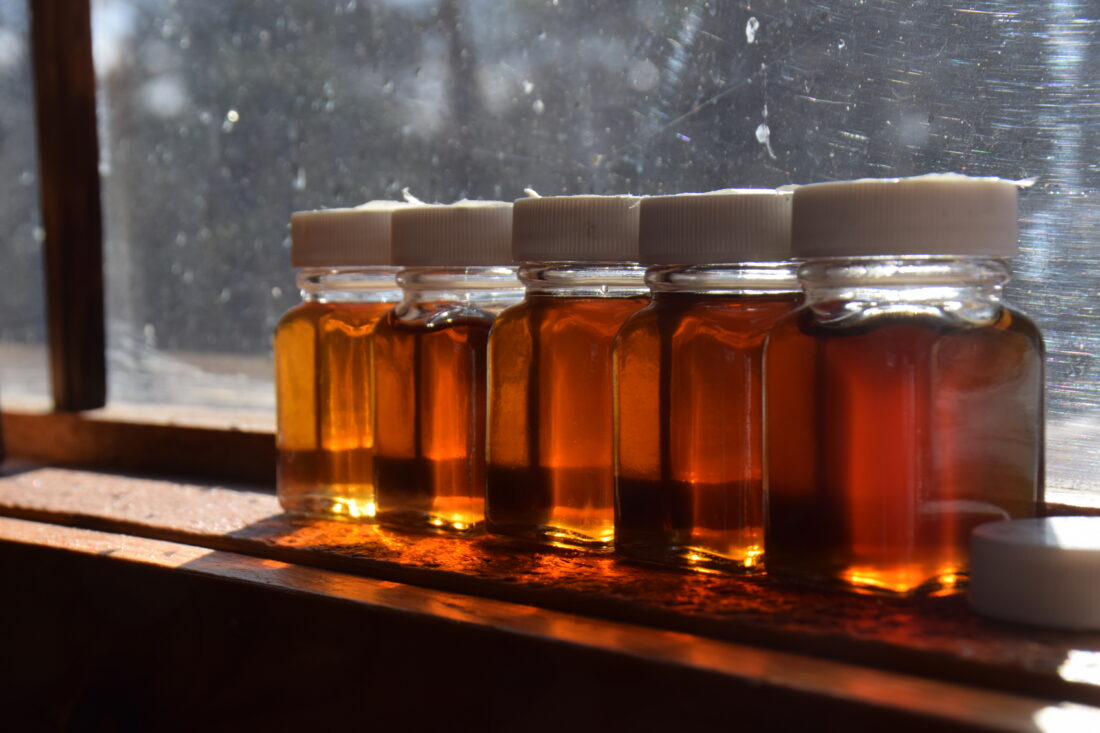
Maple syrup samples are seen at the Wild Center’s sugar shack on March 23, 2025. (Enterprise - Chris Gaige)
When it comes to maple syrup production, sugarmakers know they’ll more likely than not have an uphill battle — and this season is no exception.
The overarching reason is simple: ideal sap flow rests on such a delicate array of weather factors all falling perfectly into place. And they usually don’t, at least not for as long nor as consistently as sugarmakers would like. Daytime high temperatures in the upper-30s to mid-40s and nighttime lows below freezing, ideally in the 20s.
Clear skies, while not an outright necessity, generally help to accentuate this — warming the tree faster than the surrounding air through radiational heating during the day, and allowing temperatures to fall quicker once the sun sets, as clouds tend to serve as an atmospheric blanket, trapping the daytime’s warmer air.
If it’s achieved, this ideal temperature cycle allows the sap to flow amply during the daytime and the tree to recharge at nighttime as the cooling creates a negative pressure, more readily allowing the tree’s roots to draw in water, replenishing sap production within the tree.
If it stays below freezing for an extended duration, though, the sap will not flow. And if it stays warm for too long, the sap will run out as trees stop replenishing themselves.
Maple syrup season comes to an end when the trees start budding — triggered by a combination of prolonged warmer temperatures, increased humidity and longer days — as the sap’s chemistry shifts. This changes the flavor from sweet to sour, bitter and earthy.
Simply enough, higher maple syrup productions are achieved by longer windows of these conditions — and that can come under attack from either direction. Climatologically, the trend has been for earlier thaws, shortening the season’s back end. But it could just as well come from a prolonged cold spring that holds the sap flow back closer to budding time.
And this season, at least in the Adirondacks, has seen a bit of it all. The hearty winter was followed by an early-March surge in the mercury, with multiple nights staying above freezing, and a six-day streak of high temperatures north of 50 degrees. And then came the crash. Temperatures this week, notwithstanding Sunday and Monday, are staying below freezing.
Then again, it’s early in the Adirondack maple season, and sugarmakers say that while the start has been “less than ideal,” there’s still a lot of game left to be played. Adam Wild, the director of Cornell University’s Uihlein Maple Research Forest on Bear Cub in Lake Placid, said the strong winds earlier last week also knocked some of the maple syrup production infrastructure down, but it’s back up and running now.
Wild oversees one of the larger production operations in the Adirondacks. The research forest taps 6,500 of its own trees, along with producing syrup for a few thousand other trees between clients who bring their sap to be boiled there.
In all, Wild said he’s producing syrup from around 9,000 trees this year. And Wild’s goal, at least for his trees, is to get at least a third of a gallon of sap from each tree. It takes about 40 gallons of sap to produce one gallon of maple syrup.
Wild said he’s about a quarter of the way to his goal, or about one twelfth of a gallon of sap per tree collected so far. Asked if he’s confident this season will get him across the finish line, Wild said it’s always hard to know until the end, and there’s a lot of variability in when that will be.
“We don’t really know until the sap stops flowing or the flavor of it changes once the buds start opening on the trees,” he said. “We never really know what it’s going to be until the season’s over. But we have a goal that we try to hit every year.”
He said the warmer temperatures earlier this month could spur the trees to bud sooner, but again, this remains to be seen.
Wild Center museum Education Programs Manager Shannon Surdyk echoed Wild, saying that while the weather hasn’t exactly been helpful thus far, there’s still a good stretch for the “sap to start flowing like normal again.”
Maple weekends return
Looking at the extended forecast, Surdyk said it’ll probably be too cold for much sap to flow this weekend, but the Wild Center saved some sap from the earlier warm stretch to boil for visitors to watch. Even though it’s the first of two statewide maple weekends, she said it’s par for the course for the Adirondacks to lag on the temperature front.
“That’s always the case for Adirondack sugarmakers,” she said. “We’re always a little bit colder during Maple Weekend whereas the rest of the state may be well underway with their production.”
It’s something the Wild Center and the other local participants always plan for, though. In addition to the sap reserve, she said the Wild Center’s pancake breakfast promises its usual fun and excitement, regardless of what’s going on outdoors.
Despite the nomenclature, the annual event is stretched out over not one, but two weekends, with participating maple syrup producers showcasing their processes and offering tours to the public. This year’s dates are March 21, 22, 28 and 29 from 10 a.m. to 4 p.m. each day, although not all activities or locations will be open or occurring during all of these times.
In Lake Placid, there are two venues for folks to visit — and they just so happen to be on the same road — the Cornell University Uihlein Maple Research Forest, at 157 Bear Cub Lane, and the Uihlein Foundation’s Heaven Hill Farm, at 302 Bear Cub Lane. Both offer free admission and plan to participate all four days.
In Tupper Lake, The Wild Center, located at 45 Museum Drive, is participating, with admission included with a museum ticket or membership. While the museum’s sugar shack is anticipated to have programming all four days, there will be a special pancake breakfast on March 21 specifically.
The museum will host a Maple Pancake Brunch from 10 a.m. to noon. It will feature live pancake art demonstrations, as artists shape batter into an array of artistic renderings. One flapjack per person is included with admission, time and supplies pending, according to the Wild Center. Admission to just the breakfast, and not the rest of the museum, is free, though food purchases are separate without a ticket.
At Paul Smith’s College between 9 a.m. and 1 p.m. on March 21 and March 28, there will be horse drawn wagon rides from the parking area into the sugarbush. The address is 322 White Pine Road, Paul Smiths. Smitties will lead tours of the sugarbush and sugarhouse. There will be a sugar on snow party for kids and adults, and a tapping demonstration.
For more information on Maple Weekend, including a comprehensive map of participating locations across the state, visit mapleweekend.com.
Local News
Grants awarded to local trail projects
Despite weather mayhem, maple season marches on
Brush-burn ban in effect for 2 months
A brush burn ban is now in effect for New York state for the next two months due to fire risks. New York State ...
Why did the spruce cross the road?
SARANAC LAKE – On Tuesday, high wind gusts knocked a massive spruce tree over on Grove Street – crossing the ...

ACT sweep