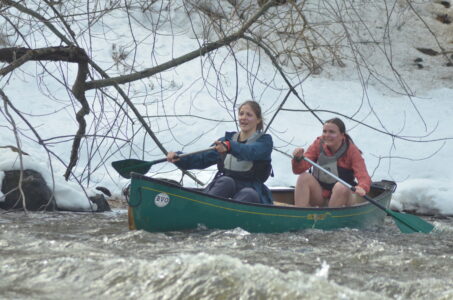
Snowstorm could snarl Friday evening commute
4 to 7 inches predicted by Saturday
SARANAC LAKE — A burst of heavy snow could make for a tricky Friday evening commute across the Tri-Lakes.
An area of low pressure is forecast to track eastward from the upper Midwest on Friday and linger into Saturday. The flakes are predicted to begin falling midday Friday and ramp up in intensity as the afternoon goes on.
While the snowstorm’s overall 4 to 7 inches of expected accumulation isn’t an especially impressive storm, by Adirondack standards, it’s the timing that has meteorologists at the National Weather Service’s Burlington, Vermont office, which serves the Tri-Lakes region, paying close attention.
“That’s the period of our most concern, that 1 to 7 p.m. timeframe when everyone’s trying to get off work and go home,” NWS Burlington Meteorologist Marvin Boyd said. “Blowing snow won’t be too much of an issue, but just the snowfall rates look to be enough to cause an issue.”
Those could peak at between 1 and 2 inches per hour somewhere within that timeframe, Boyd said, which he expected should become more certain as meteorologists fine-tune the forecast today. With temperatures hovering in the upper 20s or low 30s, it will likely be a dense, wet snow that could make for some slick spots, especially on secondary roads and untreated surfaces.
While the heaviest snowfall rates will likely be in the rearview mirror by 7 p.m. Friday, light to moderate snow is predicted to persist into early Saturday, tapering off throughout the morning hours.
–
Snow science
–
Even though temperatures will be around freezing at the event’s onset, Boyd was confident that the precipitation type would remain all snow because of the atmospheric conditions with this storm. The preceding air mass overhead today and early Friday is quite dry. Much of the initial precipitation will evaporate as it falls from the clouds before the atmosphere becomes saturated enough for precipitation to fall from the clouds to the ground.
As water evaporates, changing from a liquid to a gas, it requires heat. It takes that from the surrounding air. This means as the air becomes more saturated, it’s also getting cooled off from the top down. Boyd said this phenomenon will mean that the first precipitation making it all the way down to the ground will come as snow, even if the temperature is a bit above freezing near the surface at the beginning of the storm, midday Friday.
Local News

Having the time of their lives
Saranac Lake trustee candidates speak at forum
SARANAC LAKE – Three of the candidates running for two open village trustee seats on the March 18 ballot – ...
Flock blocked
Treachery in the backcountry
Safety risks led Army branch to drop support for howitzer testing in 2023
The risk of projectiles ricocheting into state Route 9 and I-87 led the U.S. Army branch contracting with a private ...