
Saranac Lake’s rabblerouser
Steve Schnibbe remembered for humor, generosity and support of local music
-
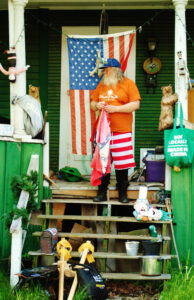
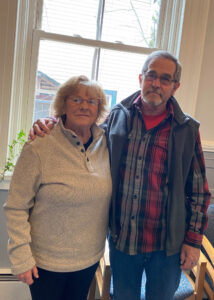
- Steve Schnibbe at his home on Park Avenue. (Provided photo)
-
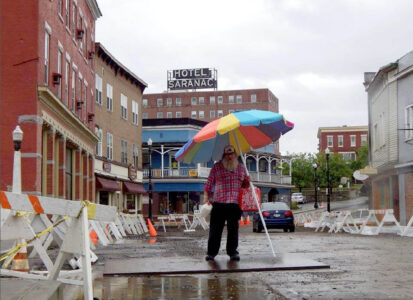
- Steve Schnibbe on Broadway. (Provided photo)
-
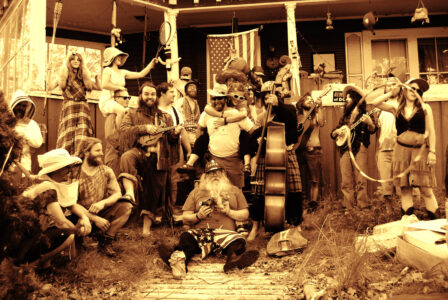
- Steve Schnibbe, seated, with Blind Owl Band and company at his home on Park Avenue. (Provided photo)
-
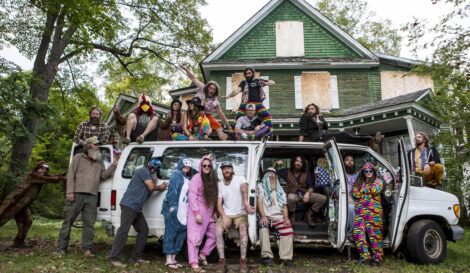
- Steve Schnibbe, seated in the back door — wearing American flag shorts — with Blind Owl Band and company at his home on Park Avenue. (Provided photo)
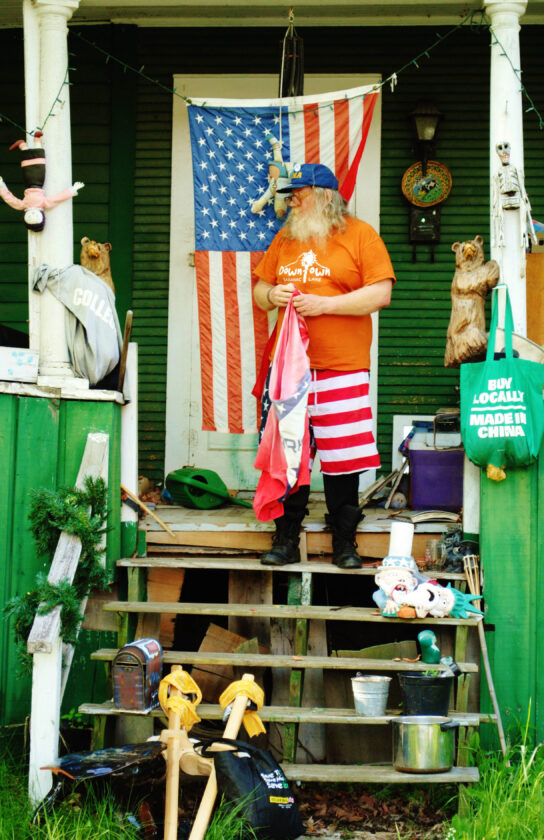
Steve Schnibbe at his home on Park Avenue. (Provided photo)
SARANAC LAKE — Saranac Lake is missing a rabblerousing performance artist, a generous gift-giver, a merry prankster and a brilliant anti-authority writer.
Steve Schnibbe died at home on Dec. 14, 2025. He was 75.
Schnibbe was a regular of downtown Saranac Lake — riding around in his 1999 Chevy Venture and later his scooter, wearing wildly colorful outfits, handing out trinkets at Partio and making people laugh.
He was a carrier of the Saranac Lake ethos and embodied the town’s motto of “decidedly different.”
He was a mascot for the Saranac Lake band Blind Owl Band.
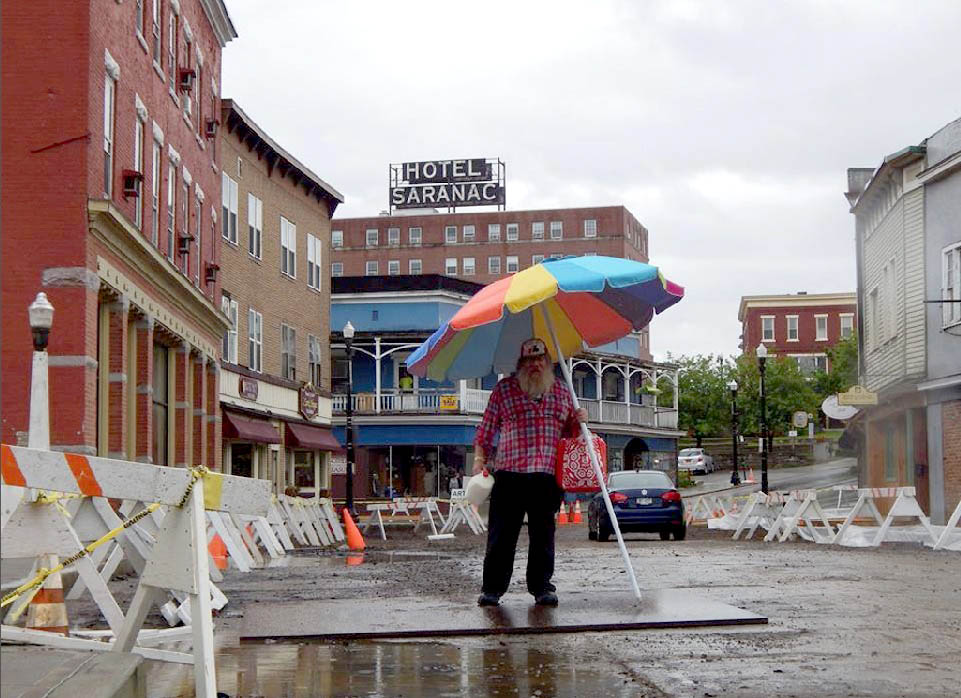
Steve Schnibbe on Broadway. (Provided photo)
He was a prankster who registered his own son as an emotional support dog and never missed a chance to bring someone powerful down to our level.
He defied authority and carried his tickets and arrests as badges of honor.
He was generous — with his time, money and possessions.
“He was constantly donating money, supporting under served populations, and finding and giving things to others,” his son Bobby wrote in a Facebook post. “My dad was brilliant. I loved him very much, and I’m very sad.”
Jessica Brothers met Schnibbe at a Blind Owl Band show years ago. As she traveled to see the band around the Northeast, Steve would “magically appear.” He was always front row and dancing, decked out in layers of fabric and handing out cheap smokes. She said he’d take “photos” of concertgoers with a wooden camera. He always brought a fun energy, she said.
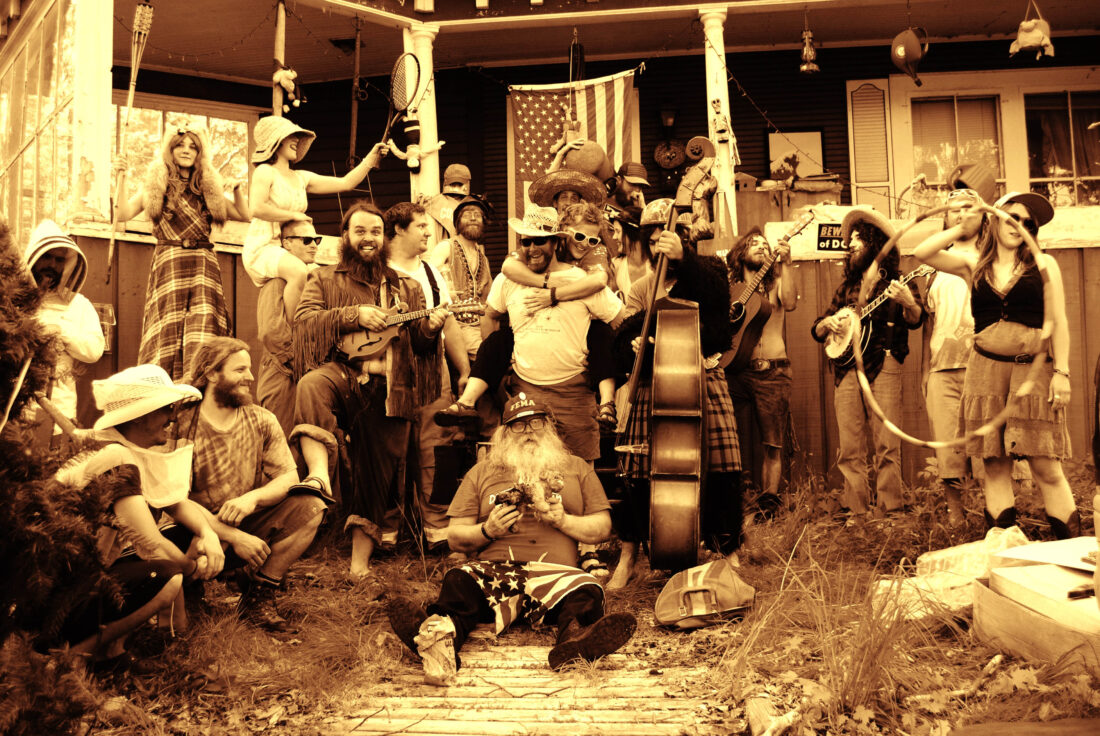
Steve Schnibbe, seated, with Blind Owl Band and company at his home on Park Avenue. (Provided photo)
Brothers remembers, one night after a Waterhole show, when the temperature was well below zero, Schnibbe gave her a ride home so she didn’t have to walk. He was kind and helpful that way, she said.
Bobby said in his father’s obituary that Schnibbe deliberately chose to make his home in Saranac Lake. He proposed to his wife, Ginny, at a bar in Keene Valley with a cigar ring.
“She knew what she was getting into,” Bobby wrote.
Together, they had two children — Bobby and Juliane.
Bobby had fond memories of his childhood. His father was an expert entertainer. He would toss kids up through the false styrofoam ceiling near the living room, Bobby said, and permanently embedded a whoopee cushion under the padding of one of the chairs in the dining room.
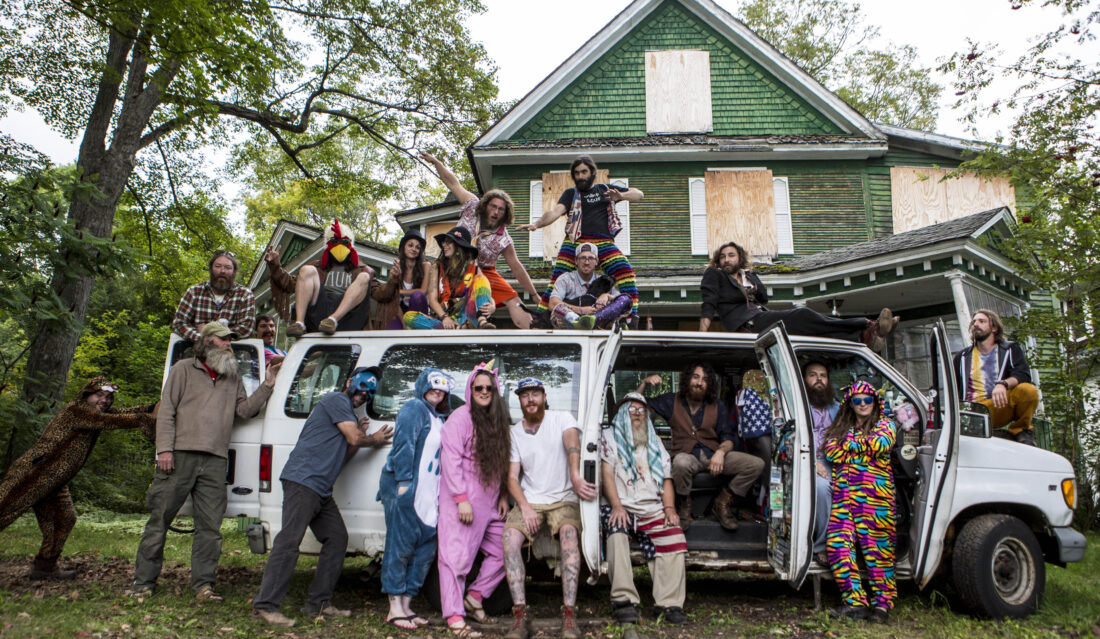
Steve Schnibbe, seated in the back door — wearing American flag shorts — with Blind Owl Band and company at his home on Park Avenue. (Provided photo)
“The treehouse was, of course, epic,” Bobby wrote.
He said his father would make up rules for board games.
“I learned how to cheat at Candyland by stacking the deck, which he figured out, and stacked the deck deeper to undermine it,” Bobby wrote.
“He would disable the color on the TV whenever we watched the Wizard of Oz. (Because that’s how he had to watch it when he was a kid.) So it was not until we were at someone else’s house that we discovered most of the movie is in color,” Bobby wrote.
He would trick his children into repeating misinformation — what Bobby refers to as “time-delayed pranks” — teaching them words far beyond their vocabulary, or giving incorrect definitions for words that would make future conversations awkward.
He purchased memorial bricks at the Adirondack Carousel for his — still living — children and had them engraved with doctorates the siblings had not earned.
–
A couple of stories
–
Schnibbe’s penchant for embellishment extended to his obituary.
“There were a few minor liberties,” Bobby said on Facebook.
Separating fact from fable is difficult when writing about Schnibbe. Even Bobby said that the truth about whether or not his father graduated from SUNY Albany is an “unanswered mystery.”
But, even when details are enhanced, there’s usually a spot of truth in the tales. Brothers compared it to the movie “Big Fish.”
Schnibbe didn’t directly turn down the CIA’s attempt to recruit him, but a brain like his likely would have been sought by the U.S. intelligence agency, Bobby said.
His obituary says he was once the president of the skydiving airport, which produced the parachuting scandal of the 1986 World Series.
Bobby said his father was invested in the skydiving airport Michael Sergio took off from when he crashed the 1986 World Series, landing on the field flying a banner reading “Go Mets.” Billy Richards, who was also part of that airport, parachuted into Steve and Ginny’s outdoor wedding.
Yes, he was deported from the Bahamas.
“After his brother’s wedding, there was a party on a cruise boat. My dad fell asleep drunk somewhere and got left behind, which then had left by the time he woke up, where he got caught as a stowaway,” Bobby wrote. “So he got deported from the Bahamas, and had to be met coming back by a surly FBI agent who wasn’t entertained.”
Schnibbe was very well-traveled — for both work and pleasure. Bobby said the only continents his father did not visit were Antarctica and South America.
His career as a stage manager and set designer for trade shows brought him all around the world. These included presentations for investors or sales representatives for pharmaceutical giants like Pfizer, investment banks like Dean Witter or major companies like Mattel or Microsoft.
Bobby recalls hearing about his father arguing with Bill Gates over a PowerPoint presentation. He remembers his father talking about bribing officials in Russia and Brazil to get equipment through the borders unpilfered.
His constant travel also gave him the chance to play his particular brand of pranks on powerful and famous people, who also travel a lot. Bobby said he bumped into country artist Willy Nelson quite often.
He’d wave and call out “Hey Willie!” to get his attention, but then, gesture at his wrist, in a motion saying, “No time, got to run.”
Bobby said the two never actually met outside of these occasional — and certainly confusing — interactions.
Schnibbe’s home at 139 Park Ave. was a former tuberculosis cure cottage. Over the years, the yard accumulated decorations and fixtures and turned into a sort of collage piece. Residents made complaints to the village, code enforcement came in and declared the home a “public nuisance.” He was ticketed and the house was condemned. For a little while, he camped in a tent on the front lawn, protesting the property being called “abandoned.”
Bobby described this as “civil disobedience.”
He said they lost a lot of belongings in the fight with the village.
Linda Hilerio remembers her first Halloween trick-or-treating on Park Avenue with her daughter, 4, who was dressed as Spiderman. They came up on Schnibbe’s house — with a front yard filled with jetsam, appliances, political signs and flags.
He was handing out ramen noodles.
Hilerio’s daughter was thrilled.
“We don’t usually buy ramen noodles, so it was a huge treat for her,” she said. “After that, every single year, his was the first house that they wanted to hit.”
Some years, he gave out pretzels. Other years, it was those big rectangular NAPA Auto Parts stickers. He always made them laugh, Hilerio said.
After his house was condemned, they missed him on Halloween night.
The Enterprise’s coverage of the condemnation of the home brought Schnibbe’s ire to the paper.
When he was banned from commenting on the Enterprise Facebook page, he took to copy-pasting entire articles — sometimes several from a single day’s paper — on his own Facebook page, with his commentary interspersed.
He referred to the paper sarcastically as “the bastion of journalistic integrity” and its parent company derisively as “coal and data miners” due to its being headquartered in West Virginia.
He maintained numerous fake, parody and fictional Facebook pages and organizations and used them to comment on White House posts and interact with each other. He made good use of Facebook’s tagging feature.
His wall-of-text posts were near-indecipherable for the uninitiated. But once learning his creative use of allusion, syntax, nicknames, sarcasm, hyperbole, linkage and idiom, they hold gems of humor, truth and intrigue.
Bobby has taken over Schnibbe’s iconic Facebook page. He said he may turn it into a memory page.
“I’m halfway tempted to make a SteveBot, reposting his stuff and tagging everyone, until Facebook goes out of business,” Bobby wrote.
–
‘Guardian angel’
–
Schnibbe and the Blind Owl Band met because at the time they were both “permanent fixtures downtown,” according to band member Eric Munley.
Munley said Schnibbe was a huge supporter of bands and music — with Mallett Brothers Band, Folkfaces, Jatoba and Hot Day at the Zoo being among his favorites.
Initially, Blind Owl Band members knew him as “Poster Man.” He had a van that he would write concert dates for his favorite bands on the side of. He invented rivalries between the bands, having them insulting each other in paint on his ride.
Blind Owl Band sings about Schnibbe on the song “Scorpion” off their first album.
“Oh Poster Man / Oh Poster Man / The gifts that you give are strange / but it doesn’t seem to matter in the end.”
When Blind Owl Band reunited for two Winter Carnival concerts last week, they dedicated “Scorpion” to honor their friend.
Schnibbe’s gifts spread joy, Munley said. He carried a Stewart’s bag of random items — cheap cigarettes, dolls, pins.
Once, he gave them uniforms from the office supply store Staples to wear at a show.
Munley said they gravitated to Schnibbe because he was the “best representation of counterculture in Saranac Lake you could have.” They were part of the same scene and really connected with him.
He was an inspiration for the band and a huge supporter.
Munley still has the $25 check Schnibbe tipped them with at their second-ever show. The memo line reads “Jatoba has Jatobettes. Blind Owl Band has the Blind Owl F***ers. Groupies unite.”
“I was like, there’s no way in hell I’m cashing this,” Munley said.
Schnibbe became part of the Blind Owl Band culture when they started incorporating him in their artwork. Inside their first album is a photo where they filled a room with all the chairs in a house and brought everyone from that night’s show.
After Schnibbe was kicked out of his home, they decided to do a photoshoot there — as a sort of way to stick it to the man, a celebration of his home.
This became the cover of the second album, “This Train We Ride Is Made of Wood and Steel,” and the house became a part of Blind Owl Band lore.
Their third album, “Skeezy Patty,” is dedicated to their van, which Munley said they designed to be like Schnibbe’s house. As they toured, they glued everything from toothpaste to advertisements to cigs to overdrive pedals to the dashboard.
Munley said Schnibbe was a “guardian angel” to him. He supported every crazy, bad idea the band had.
Munley said the band was not good at first. It took years to get people’s support and to win people over. But Schnibbe was always there.
When Blind Owl Band released their second album, Schnibbe dropped $500 on 50 copies.
“He walked down Main Street and gave every business on Main Street a copy of the album,” Munley said.
Schnibbe followed the band around as they played hundreds of shows around the East Coast. He’d come hours early, hang out, buy 25 tickets and hand them out to the first 25 people for free.
Munley went on to buy the Waterhole with his wife, Kiki.
A post on the Waterhole Facebook page says Schnibbe was one of their biggest supporters from “day one.”
“(He) built real relationships with the bands. If he liked your band, he never missed a show or the opportunity to tell someone about it,” the post says. “Steve put his money, his time, and his heart where it mattered. Buying merch straight from the artists. Promoting events on his car — and later his scooter. Handing out Stewart’s gas cards so bands could keep making music and keep grinding down the road. He supported artists and underdogs without hesitation.”
Munley said the Blind Owl Band’s fans loved Schnibbe for his energy and humor.
He recalls that one night, Schnibbe brought a giant bag of oversized marshmallows to a Lucid show, which started a food fight. The drummer lit them on fire on the cymbals. By the end of the show, the marshmallows were stuck to everyone’s shoes.
He attended a Saranac Lake village board meeting during the coronavirus pandemic in a WWII-era gas mask, producing some grins in a tense time.
Munley said Schnibbe worked through the struggles of life with humor. Sometimes when he was pulling pranks and telling jokes, Munley said, deep down, he was in a hard place.
“There’s a slight sadness to really knowing Steve,” he said.
The unexpected death of his wife, Ginny, hurt him a lot. The bandmates met Schnibbe shortly after she died and started hanging around downtown more often. Munley said she kept him in check, and he was unleashed on the town.
Though he was hurting, Munley said Schnibbe didn’t give in to anger. He used humor to temper it.
“There will never be anybody like Steve again,” Munley said.
He feels a “gaping hole” in the world where his friend was.
Munley said people can remember Schnibbe by being nice to a stranger, making someone laugh or helping someone in need.
“Steve didn’t have much, but he gave away and helped people much more than people with a lot,” he said.
To read more truths and tales about Schnibbe’s life, go to his obituary at tinyurl.com/ym8p4ssh or Bobby’s message on his Facebook page at tinyurl.com/bde2jz2y.
Local News
Sk8 to Elimin8 Cancer returns to Oval
Writing center seeks writing pieces by North Country teens
SARANAC LAKE — The Adirondack Center for Writing is seeking submissions for its fourth annual print publication ...
Enterprise, Lake Placid News sold to Gazette
Songwriter’s Night at the Hootenanny
SARANAC LAKE — On Feb. 16 at 6:30 p.m. in The Garagery, a concert celebrating original music in the North ...
Here comes the punchline