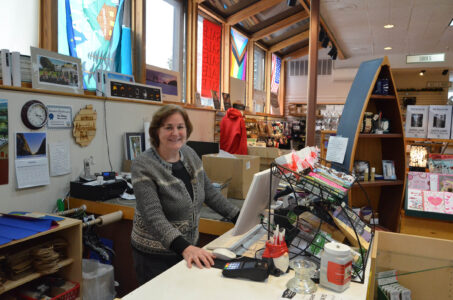
Saranac Lake school restructuring vote coming Wednesday
Residents make last pleas to save Bloomingdale School
-
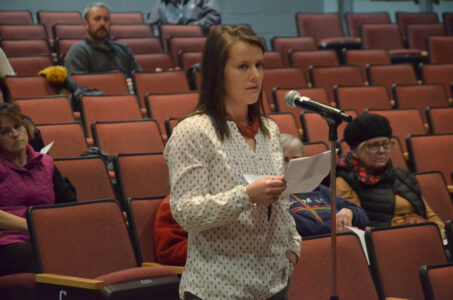
- Colleen Wimsatt speaks to the Saranac Lake Central School District Board of Education on Wednesday. (Enterprise photo — Aaron Marbone)
-
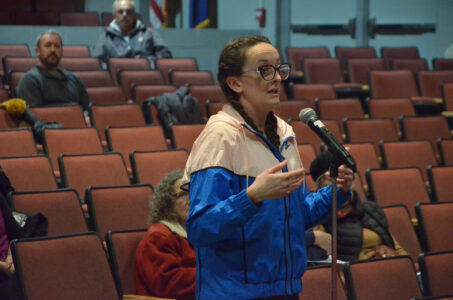
- Shauna Manning speaks to the Saranac Lake Central School District Board of Education on Wednesday. (Enterprise photo — Aaron Marbone)
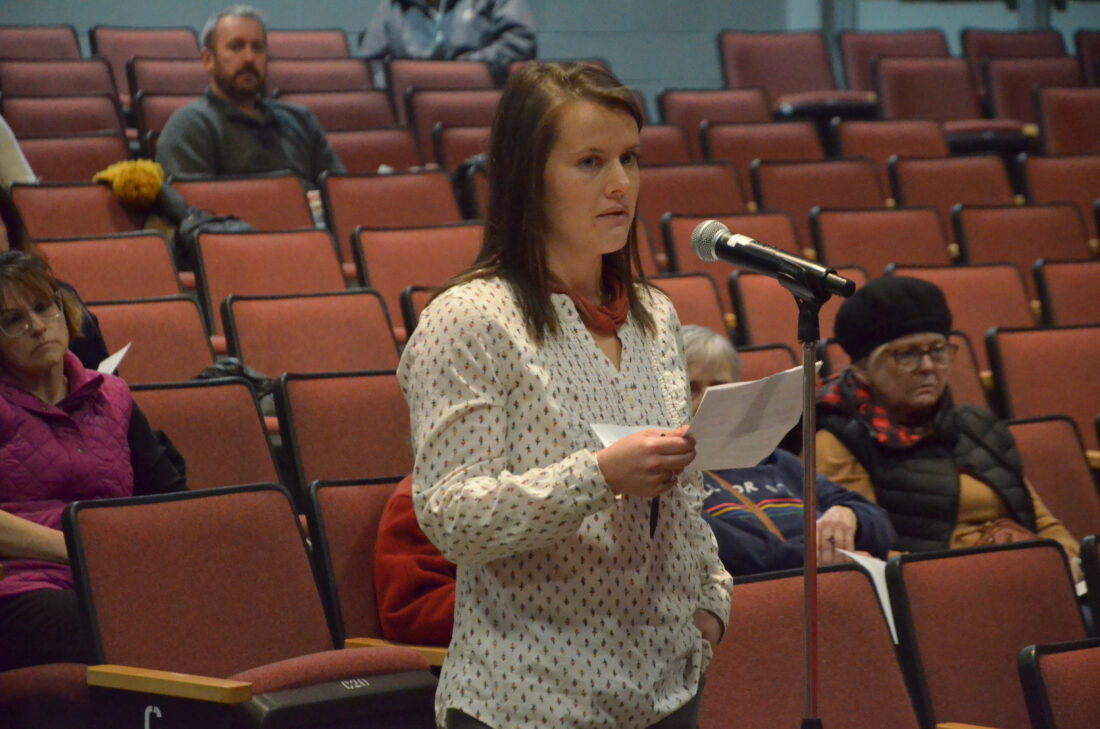
Colleen Wimsatt speaks to the Saranac Lake Central School District Board of Education on Wednesday. (Enterprise photo — Aaron Marbone)
SARANAC LAKE — On Wednesday, the Saranac Lake Central School District Board of Education will be making what members have called the biggest decision they’ve faced in a decade.
The controversial votes on whether to close Bloomingdale Elementary School, move seventh and eighth graders to the high school building and have students of all grade levels ride together in a single bus run to and from school will be taken.
Last Wednesday, the final public hearing on the decision drew a much larger crowd than previous hearings as Bloomingdale school supporters urged the board to delay or reconsider their vote, parents and teachers voiced concerns about the accelerated timeline of the changes, community members voiced concerns about putting middle schoolers in the high school and parents made their last pleas to keep the school they love open.
A majority of board members and building facilities committee members said, though it’s a hard decision, and one they don’t want to make, they believe closing the school will be most beneficial for the district as a whole. But there is dissent on the building facilities subcommittee, which has been studying the reconfiguration that the resolutions are proposing.
The district is facing a tough situation. Student enrollment dipped below 1,000 this year for the first time in decades. Meanwhile, the cost of running schools continues to rise each year as things get more expensive and schools need to do more to meet modern education requirements.
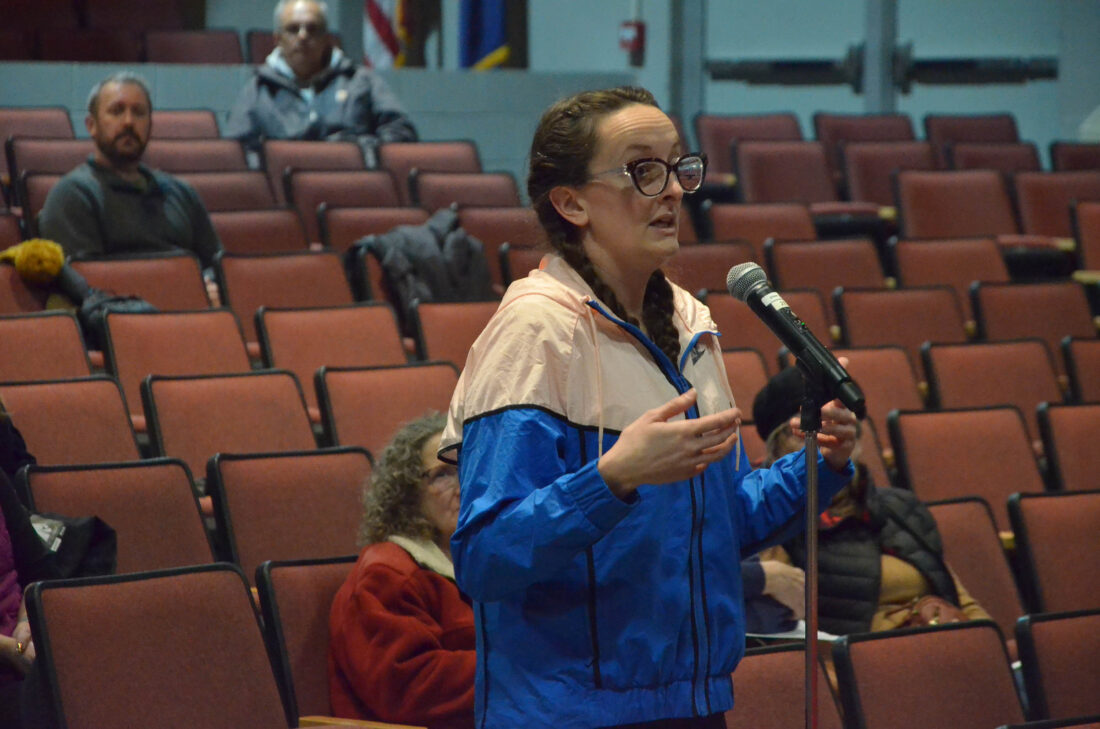
Shauna Manning speaks to the Saranac Lake Central School District Board of Education on Wednesday. (Enterprise photo — Aaron Marbone)
This year, SLCSD Superintendent Diane Fox shifted Bloomingdale students in grades three, four and five to Petrova Elementary, making the Bloomingdale school a K-2 building. Bloomingdale Elementary has 67 students currently. The school opened in 1967.
At this meeting, and at previous ones, a contingent of residents who want to keep the Bloomingdale school open offered creative solutions. The board mostly said the ideas, though appreciated, would not work, would not be legal with education regulations or would not stop the root cause of declining enrollment.
On Wednesday, several people expressed concern about how much will change so fast if these resolutions pass.
But several parents of students who have transferred to Petrova spoke highly of the school.
The votes on Wednesday will take place at a meeting at 5:30 p.m. in the High School library through door #13. The meeting will also be livestreamed at tinyurl.com/2ba9csx8.
–
The decision
–
Elizabeth Amell-Farmer asked if these decisions could be put to a public vote.
School Board Member Tori Thurston said state education law says such decisions are at the “sole discretion” of the board of education.
The board will vote on three resolutions about the future of the district’s three school buildings.
One resolution would close Bloomingdale Elementary School and the Middle School, one resolution would shift the Middle School grades to the high school building and make Petrova Elementary a Pre-K-6 school and one resolution would consolidate the two morning and two afternoon bus runs into one morning and one afternoon bus run with students of all grade levels riding together.
The resolutions can be read in full at tinyurl.com/yc38vh9e.
The public can continue to submit written comments about the potential closure and other district configuration issues until a decision is made. Comments should be emailed to the board clerk at pollockgin@slcs.org.
The state Education Department must approve whatever reconfiguration decision the board makes.
Last Thursday, the St. Armand town council unanimously passed a resolution urging the district to “fully explore alternative solutions” — including renting space to a day care, restructuring the budget or programming or seeking community partnerships.
The resolution said the school’s closure “would significantly disrupt students’ learning, increase travel times and lead to overcrowded classrooms at Petrova” and that the school “plays a vital role in sustaining the local economy, attracting families to the area and preserving the community’s identity.”
The district estimated it could save up to $600,000 annually by closing Bloomingdale. This would not lead to a reduction in taxes, but would stave off larger tax increases or budget cuts.
Jill Henck said she is saddened that Bloomingdale Elementary will likely be closed, but added that Petrova is a great school, too.
She said the $600,000 in estimated annual savings by closing the school is small in comparison with the district’s $38.1 million budget and incoming expense increases, but she challenged anyone to find somewhere else the district could cut that amount of money.
She said she also doesn’t love the timeline.
“I also feel like this is rushed, but I understand the urgency behind the budget,” Henck said.
St. Armand town Supervisor and building facilities subcommittee member Davina Thurston said she doesn’t believe the urgency is related to the budget.
“Diane has stated several times … that she’s willing to be the ‘bad guy’ and close Bloomingdale School, then retire so that the next superintendent doesn’t have to do that,” Davina said. “We understand that you are willing to die on the sword, Diane, but we’re asking you not to.”
Karen Miemis, a subcommittee member, sixth-grade teacher and co-president of the Saranac Lake Teachers Association, said the administrators sought the feedback of faculty. There were mixed results.
“Many elementary teachers, including some of those at Bloomingdale, welcome the potential of a dedicated pre-K to six building at Petrova,” Miemis said. “Others have voiced valid concerns regarding scheduling and shared spaces at the high school. Many are also feeling the weight of the proposed timeline.”
–
Bloomingdale family
–
Vermontville resident Colleen Wimsatt said her kids have been excited to start attending Bloomingdale Elementary, but that excitement has turned to uncertainty as the “beloved” school may be closed before they can attend it.
She said the school is a “hub” for families and in a world that feels disconnected, a place for connection in neighborhoods.
“Requiring families to commute to Saranac Lake would mean we no longer know our neighbors’ children. Our social circles are more spread out and parents are forced to make additional trips into town,” Wimsatt said. “This decision feels as though it steals from our children, robbing them of a warm, close-knit school environment that nurtures meaningful connections with neighborhood friends.”
She said some people do not have reliable transportation for their kids to attend all the school events that there is no busing for. She said closing the school would be a “misplaced bandage.”
Bloomingdale resident Dale Gonyea said the Bloomingdale school is “like a family.”
Tori said she likes the idea of having all district students being together from kindergarten to graduation — as a district family.
Still, she said her heart breaks for Bloomingdale parents, but the board is “running out of options.”
She had hoped for an outside-of-the-box idea from the subcommittee, but she said the group failed to find one.
“In recent years, the elementary school situation in the district has not been equitable,” Tori said.
Because of budget, regulation and state aid constraints, they cannot afford a complete contingent of special educators in each building.
Saranac Laker Anne Cantwell-Telfer asked why special education services can’t be shared between schools. Fox said students’ needs are higher now than they were before.
Tori said even if someone lives right next to Bloomingdale school, if their student needs some special education instruction, they would have to go to Petrova. This leads to Bloomingdale having lower special ed needs and Petrova having higher ones.
She then gave her own opinion on the situation, which she said would be “brutally honest.”
“Is a child that attends Bloomingdale more deserving than a child at Petrova? Is a child that attends Bloomingdale more important than a child at Petrova?” Tori said. “Is the child that attends Bloomingdale, the ‘gem of a school,’ and receives a private school education at a public school price more worthy than a child that attends Petrova?”
An audible response of people bristling to this statement rippled throughout the auditorium at the meeting.
Davina voiced the Bloomingdale residents’ offense to this in a letter to the editor to the Enterprise.
She said the subcommittee didn’t fail, alleging that the board stopped them from succeeding.
These decisions were initially supposed to be made in June 2026. Late last year, the board learned they had to tell the state of reconfiguration plans for next year by March 1. They did not know about this deadline previously, and it is sooner than expected. Davina questioned why it was not known sooner. The board called for public hearings to start in January. The committee had five more meetings scheduled before the public hearings were supposed to start.
“I’m not saying 100% that we would have come up with a solution, but to tell us that we failed is absolutely, unequivocally unfair,” Davina said.
She also felt Tori blamed the Bloomingdale community for special education services not being offered at the school. She said the district removed those services and that residents have asked for the district to bring those services back for years.
Davina, who has been a member of the building facilities subcommittee, asked board and subcommittee Chair Mark Farmer if he felt the process was transparent.
“I do,” he said.
Fox previously said the longest bus routes students take would not get longer with a single bus run. Davina questioned how this could be true. Farmer said Transportation Supervisor David Whitson did the numbers on that.
Board members have said they have “zero intentions” of selling the building if the school closes. They have not discussed ideas of what it would be used for much, outside of naming a couple of potentials.
“It’s just disenheartening to know that we don’t have a plan for the school,” Davina said.
Davina was one of several people to correct a population statistic Tori gave at the last meeting. Tori had said there are 12,879 potential voters in the district. That is the district population. Davina said there are around 7,500 registered voters in the district.
Davina said this showed that people can make mistakes and asked the board to let the committee finish its job.
The facilities report the board commissioned, which was completed in 2024, advised the district to take no action before the 2027-28 school year, saying that would be the year that Petrova’s enrollment is projected to be small enough to accommodate the additional students.
Fox said the report recommended closing Bloomingdale Elementary next year and shifting the middle school to the high school two or three years later.
But, she said, district enrollment has decreased faster than expected, and at the time of the report, the district was living high on coronavirus-era funding. Now, without that aid, they’re looking at staffing reductions. Fox said they’re trying not to do layoffs while keeping education the same. They plan to reduce by attrition — not hiring for replacements after teachers retire. She said a portion of the high school staff is aging out and is expected to retire in the near future.
–
Middle school, high school shift
–
Gail Meyer, who taught science in the district for more than 20 years, felt that the middle school and high school realignment might be coming too quickly.
The facilities report recommended a two-to-three year phase-in for that shift, she said. Meyer said there’s not much time before September to figure all the logistics out.
She had a slew of in-depth questions about how everything would fit at the high school building — art classes, the library media center, teachers and guidance counselors, lunch periods and special education classrooms.
Meyer believes the seventh and eighth grade cohorts are larger than the ones that come after them. She said if the district delays this one year, it might be fiscally challenging, but it would be easier logistically.
Megan Ellsworth previously taught at the Lake Colby Elementary School before it was closed in 2011. She said her position as a sixth-grade teacher is likely changing with the reconfiguration and her sixth-grade daughter will likely be impacted. She said Petrova is a “well-functioning environment” and a good school.
But she questioned if there is enough time for the district to develop a good plan for the seventh and eighth-grade students who would move to the high school building before classes start in September.
She said middle school students are in transition. They are forming who they are and are still very rooted in childhood. Some are more mature, but most are developmentally young, she said.
Ellsworth recommended the district keep daily recess for these students, for their movement, for focus and for physical health.
“Let them be kids,” she said.
She also said the proposed idea of pairing these middle school students with juniors and seniors as mentors has pros and cons. She urged that this program have safeguards if it happens.
Shauna Manning asked if they could move grades seven and eight to Bloomingdale, to give them a break before entering the high school building. Farmer said those grades would get their own section at the high school building, separate from the older grades. Manning said the building is small, and it wouldn’t be much of a division.
Bloomingdale resident Jacquelyn Niederbuhl said she was bullied when she attended school in AuSable Valley. She asked the board to take time and study the impact this change would have on kids. She said they missed a lot of development milestones during the coronavirus pandemic and questioned if the middle schoolers are ready to be in the same building as high school students.
Gonyea said his grandson told him he saw a pre-schooler being bullied on the bus by an older kid and that he intervened. Gonyea said he worries about the stories he’d hear if all grade levels rode the bus together.
St. Armand Councilman Ray Tempestilli said 4-year-olds are impressionable and that older kids could be a bad influence on them. If they’re on a bus with a 16-year-old who has a nose piercing, he said they might go home and try to give themself a piercing. If they see a high schooler vaping, he said, they might go home and try smoking.
“Don’t throw them together and make a mixed soup and expect it to taste good,” Tempestilli said.
Henck said she doesn’t love the idea of her 4-year-old riding the bus with an 18-year-old, but added that she trusts the district staff to do well by their children.
Cantwell-Telfer created an online petition asking the board to slow down. This petition can be found at c.org/tYVT4FqdjY. As of press time on Sunday, the petition had 387 digital signatures.
Cantwell-Telfer asked if Petrova could fit a pre-K class, since it was not in the original calculation. Fox said there is room and that pre-K has been there before.
Amell-Farmer mentioned comments board members made in 2024 about Petrova “bursting at the seams” with students, and that Bloomingdale had space.
Fox said the proposed moves would not increase class sizes, as long as the district also moves its middle school classes to the high school building. This would group teacher certification by building — grades 1 to 6 at Petrova and 7 to 12 at the high school building.
The board has said they have an anticipated $2 million increase in insurance costs coming next year. Cantwell-Telfer asked if that responsibility would be split between employees and the district.
Cantwell-Telfer said that, currently, kids in Lake Clear go to Petrova instead of Bloomingdale.
She recommended a single-bus run while keeping Bloomingdale open with an opt-in for Bloomingdale residents who want to transport their children.
“Students should be bused to the school closest to home, not to the school that the district wants to protect,” Cantwell-Telfer said.
Nick Darrah said he was frustrated seeing the district saving up for expensive electric buses while closing Bloomingdale Elementary, partially for financial reasons. Farmer said the state’s electric bus mandate is coming and the district has no choice in the matter. He said they’re just as frustrated over the mandate.
Earlier this month, Fox made a recommendation to the board to close the Bloomingdale school.
Enrollment is at record lows for the modern era, the cost of running a school building is higher than ever and she said it doesn’t make sense to keep Bloomingdale open if it cannot provide equal access to resources for its students as Petrova can.
The district had its highest population in 1995, with twice as many students as there are today — more than 2,000. Enrollment has been on a steady decline ever since, she said. A majority of this drop has happened in the past quarter-century. At the turn of the millennium, the district had 1,743 students. In the 2014-15 school year, the district had 1,266 students. The district reported 984 students enrolled on opening day this year — 60 fewer than reported on opening day last year.
To read more about recent discussions about this issue, go to tinyurl.com/ytxcntw2.
The district held public hearings on the facilities reconfiguration last month. To read about these hearings, go to tinyurl.com/27etaf6t.
The subcommittee released its official thoughts on the best path forward — including a full history, findings and opinions of the committee on what to do. The report it generated shows division among the members. The district administrators also released a letter addressing the resolutions. To read more about this report, the administrator’s letter and a history of the discussion, go to tinyurl.com/3n5kr8df.
The subcommittee has eight members — five from the school, one retired teacher and two members from the community who were selected by the school board from a pool of around a dozen applicants. This is an advisory committee for the board. The board makes the final decision on whether or not to accept the group’s proposal.
Local News
Saranac Lake school restructuring vote coming Wednesday

Saranac Lake hoopers return to title game
Hunter education course planned
SARANAC LAKE — The Saranac Lake Fish & Game is sponsoring a New York State Hunter Education Course from 8 ...
Gendebien leads with donations in NY-21 campaign
Blake Gendebien, one of four men seeking to represent Northern New York in Congress, is bringing in the most in ...
A call to arms