Saranac Lake halts controversial police cam installation
Village to take down cameras, discuss Flock contract after public opposition
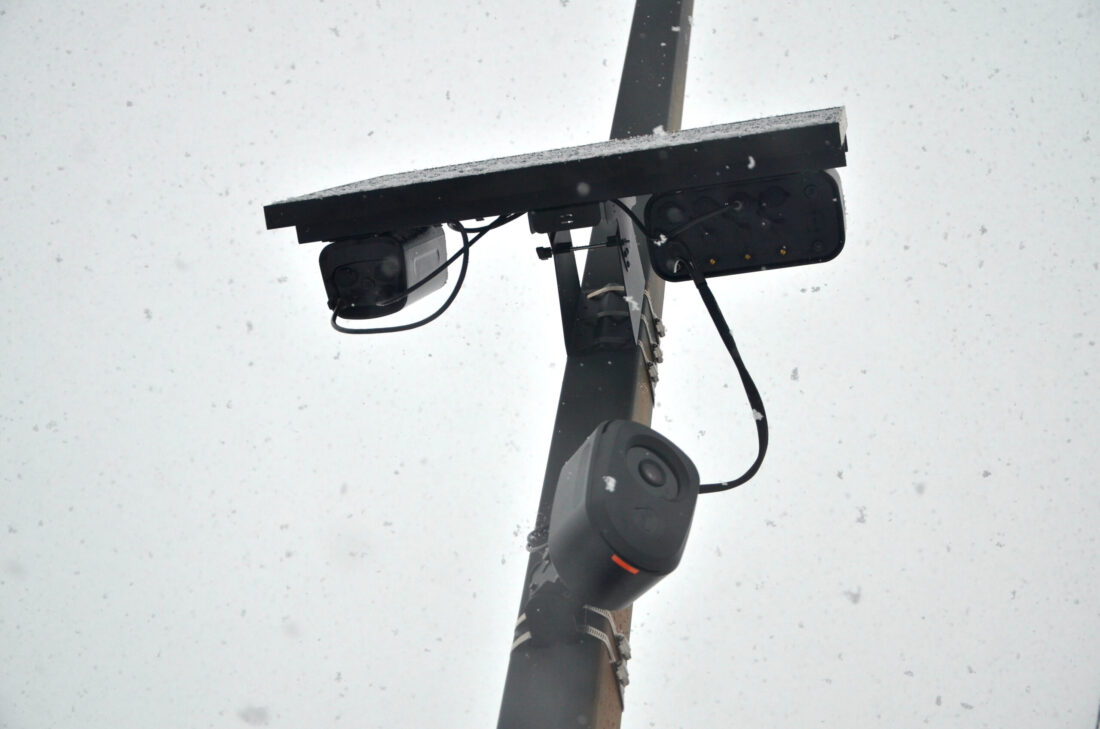
A Flock license plate reader camera is seen outside Kinney Drugs on Broadway in Saranac Lake. (Enterprise photo — Aaron Marbone)
SARANAC LAKE — Saranac Lake is hitting pause on the controversial installation of Flock license plate reader cameras and surveillance cameras for the police department, after more than 20 locals turned out to a village board meeting on Monday to protest the surprise addition.
On Thursday, Mayor Jimmy Williams released a video saying the installation would be halted and the three cameras already installed would be taken down until public work sessions can be held to “come up with a good way forward.”
“You’ve been heard, we appreciate it,” Williams said.
The village board is planning to discuss the cameras at its next meeting on March 9, with the company contract on hand and the police chief in attendance. Williams said on Friday he does not believe the cameras installed are currently on, and said the police department is coordinating with the contractor to confirm the timeline of the cameras being taken down.
“The public response to Chief Perrotte’s post quickly made it clear that more discussion and research is needed,” Williams said.
Residents at the meeting said that they didn’t want the village to contract with the company building a national network of data-collecting cameras. They had concerns about the federal government or hackers accessing these databases due to the company being untrustworthy to them. They were upset the public did not know about this until the cameras were already being installed.
Numerous speakers asked the village to take them down. At the end of the meeting, Trustee Aurora White suggested that the trustees — who just learned about this themselves — bring the Flock contract to the next meeting, to discuss it along with SLPD Chief Darin Perrotte.
Several trustees have already voiced their opinions on the cameras.
“I do feel that they should come down, be boxed up and sent back to Flock,” Trustee Matt Scollin said on Tuesday.
“We do not have the technical expertise on staff currently to be proper stewards of this data,” White said on Wednesday, adding that she does not believe Flock is responsible for its data.
Automatic license plate readers, referred to as ALPRs, and police-operated surveillance cameras are not new technology, but Flock pairs them with artificial intelligence image recognition, a cloud database, an option to join statewide or nationwide database networks and an officer-facing dashboard to form profiles of vehicles, flag suspected stolen vehicles or vehicles used in a crime on a “hot list” and allows officers to add license plates to the hot list.
The village is set to get six “Falcon” ALPRs and six “Condor” security cameras, known as “pan-tilt-zoom” cameras. Three have been installed so far.
Perrotte said the cameras are not speed detection devices, they don’t record audio, they do not have facial recognition or detect people by race or gender and they will not be monitored 24/7. He said they will only be used retroactively to investigate crimes.
“We’re not going to be using it for immigration enforcement. It’s not going to be used for traffic enforcement. These cameras don’t mail out tickets,” Perrotte said last week. “They’re not going to be used for following or harassing any citizen.”
The website deflock.org, which crowdsources the locations of ALPRs into an interactive map, shows these Flock-branded cameras may be the first in the Adirondacks.
The goal of these cameras is to find missing people and suspects, recover stolen vehicles and solve crimes faster.
But, this fast-growing company and its extensive nationwide camera network have been under scrutiny for a 10% error rate in license plate readings, claims of invasion of privacy by a private company, concerns about data it collects on civilians being vulnerable to leaks and belief that the product violates the Fourth Amendment due to its collecting data on citizens without a warrant.
The installation is being funded through a $241,500 state law enforcement technology grant and includes support for the program for two years. The grant was accepted by a village board vote in June 2024. It provided funds for a range of potential tech upgrades.
Village Manager Bachana Tsiklauri said the grant award letter did not specify which of the technologies on the list of options the money could be used for.
He said conversations about the police installing cameras around town date back to 2023, when the village saw a number of vandalism cases. At the time, he said the board showed support for cameras, regardless of the brand. Tsiklauri said this was “way before the Flock cameras were broadly criticized online.”
On Monday, Harrietstown Councilman Doug Haney said he was “bummed” that the public found out through a Facebook post. He said how these grant funds were used should have been discussed publicly, and that the surprise installation made the community uncomfortable.
Schuyler Cranker said even if the cameras are removed, the village will still have betrayed their trust.
Village resident Andrew Kelly submitted a records request for the documents about the Flock contract and the village responded promptly.
In an email in 2023, included in Kelly’s FOIL request, Perrotte said, though “some may feel that this is ‘Big Brother Watching,'” he felt that “cameras have been instrumental in solving crimes.”
“Someone will not be sitting and watching these cameras day in and day out monitoring residents activity, these are for investigative purposes after the fact,” he said in the email.
Williams and Brunette both said they supported this decision at the time.
The village signed the agreement in September 2024.
Charlotte Lomino said when cameras were talked about three years ago, she thought they would be a decentralized, local system with feeds directly to the department. She’s not sure if she’s comfortable with that, but this is worse, she said, referencing George Orwell’s novel “1984.”
“Does this move bring us closer to that dystopia?” Lomino asked. “Even if you agree with what the federal government is doing right now, you might not in the future.”
Lomino mentioned that Flock has contracts with the federal government and is building a national network of these cameras, asking if the board was OK with that.
“We don’t need them,” Saranac Laker Jason Brill said. “We don’t want to become part of the surveillance state. … This is a solution looking for a problem. … Just because it’s there doesn’t mean you need to use it.”
“Joining a national dragnet surveillance network is not in our interests,” village resident Andrew Kelly said.
Perrotte had noted that almost anywhere people go in public today, they are on camera. Stores, ATMs, gas stations, doorbells, vehicles and building exteriors all have cameras that are maintained by private companies.
“When you’re in public, you have a different expectation of privacy,” he said. “Anyone at any point in time can take a picture of me, of you, as I’m walking down the street.”
Flock cameras are installed in public areas and photograph every car that passes. They store information about the vehicles in a database — license plate numbers, make, model, color and characteristics like bumper stickers or after-market additions.
Law enforcement officers can search on a dashboard for these points of information, bring up a profile of the vehicle and see everywhere that car has been within the network, how long it stays places and how frequently it visits those places. This data is stored for 30 days and can be shared with other law enforcement agencies.
The village does not own the Flock cameras. It leases them and the software from Flock through a subscription.
After the two years of subscription run out, Perrotte said if the cameras were to continue, they’d need to get grant money, find room in the budget or decide if they want to go a different route.
The annual subscription costs $36,000, according to the contract.
Flock deletes all footage on a rolling 30-day basis, except as otherwise stated, according to the contract.
“Flock does not own and shall not sell customer data … customer-generated data … anonymized data,” the contract states.
This anonymized data remains Flock’s property after a contract is terminated. Flock uses this data to train its machine learning algorithms.
–
More concerns
–
Harrietstown Councilman David Lynch said the cameras may currently violate the village police department’s policy on surveillance. The full policy can be found at tinyurl.com/46s3vts4 starting on page 199. It states that all cameras should be marked with signs to inform the public that the area is under surveillance. The two cameras, which have been identified on deflock, are both ALPRs and the ALPR policy does not require signs. The ALPR policy can be found at tinyurl.com/5745v4t7 starting on page 4.
Lynch also said the public has been misled about Flock’s access to data.
It’s contracts include a passage saying “Flock may access, use, preserve and/or disclose the footage to law enforcement authorities, government officials and/or third parties, if legally required to do so or if Flock has a good faith belief that such access, use, preservation or disclosure is reasonably necessary to comply with a legal process, enforce this agreement or detect, prevent or otherwise address security, privacy, fraud or technical issues or emergency situations.”
White felt that this passage is broad enough to allow misuse of the data.
Saranac Laker Margot Gold said Perrotte told her the department controls footage. But she said the “devil is in the details.”
“We don’t have control of (Flock’s) potential use of it,” Gold said.
She said the time to amend or withdraw the contract is now, before the system is fully implemented.
The ALPR photos are encrypted, but numerous data security risks have been exposed by technology experts. The potential for the data to be hacked, stolen and leaked to bad actors, data brokers, criminals, corporations or other agencies is a concern of privacy advocates.
Flock’s “pan-tilt-zoom” cameras have recorded potential security vulnerabilities.
In December, 404 Media and YouTuber Benn Jordan found that livestreams and administrator control panels on some of Flock’s Condor cameras were “exposed to the open internet, where anyone could watch them.” Journalists were able to gain access to the cameras without a login and watch them live, download a month of video archive, change settings, see log files and run diagnostics.
Virginia Slater said the ALPRs collect data on all vehicles, whether or not the driver is suspected of a crime. She called this “mass surveillance.”
“ALPRs collect location data on all of us, and they are searched without any warrants or oversight,” Slater said.
Opponents of Flock have accused the network of acting like a tracking device without a warrant.
A 2012 U.S. Supreme Court decision found that the Fourth Amendment bars law enforcement from long-term tracking of a citizen’s physical location without a warrant.
The Fourth Amendment gives the right to be secure against “unreasonable searches and seizures” without a warrant.
In 2024, a Virginia Circuit Court judge ruled that collecting location data from ALPRs there counted as a “search” without a warrant and could not be used as evidence due to the Fourth Amendment. This ruling was overturned in October 2025.
Slater felt that the cameras were not necessary. The police have other ways to find suspects. These methods require warrants, which provide oversight and accountability, she said. Departments have policies on the use of Flock cameras. She felt these policies were often weak and poorly-enforced. With new technology, she said, oversight often lags behind deployment.
She’s heard people ask why they should care if they’re not doing anything illegal.
“You don’t get to decide what looks suspicious tomorrow,” Slater said. “As history has shown, when governments or third parties gain unchecked surveillance powers, they are eventually used against people who weren’t doing anything wrong until someone decided that they were.”
She said, once the infrastructure is set up, it only grows and becomes more invasive.
“History has shown that surveillance systems expand beyond their original scope,” she said.
Perrotte said if an immigration agency requested photos or footage, the department would only provide it if it was paired with a criminal matter.
“Strictly for immigration enforcement? No, absolutely not,” he said.
On Monday, the village board narrowly passed a resolution which limits the cooperation village police can have with federal immigration enforcement agencies. This includes language saying police shall not share data to assist federal immigration agents with civil immigration enforcement — as opposed to criminal immigration enforcement — unless required by a valid judicial process or federal or state law.
Sandra Kalinowski from Saranac Inn said other communities are done with Flock, including nearby Syracuse.
Flock contracts with more than 5,000 agencies in the country. But around 30 cities have ended contracts with Flock after public outcry over concerns of mass surveillance, misuse of data or federal immigration enforcement agencies having access to the data. Some state and federal legislators around the country have also attempted to pass bills regulating the technology.
Flock has made secret agreements with U.S. Border Patrol to give its agents backdoor access to ALPR data from its cameras around the country — including cities like Syracuse, which had not agreed to share data with the federal agency. When Syracuse police “inadvertently” opted into sharing data on Flock’s nationwide network, Border Patrol — which had a contract to search the nationwide network, despite its CEO Garrett Langley falsely claiming it did not — was able to search its database. Syracuse news outlet Central Current found that there were 2,097 immigration-related searches made.
A similar situation was exposed by 9NEWS in Denver, Colorado.
Schuyler said, given Flock’s history of lying to officials and journalists, the village cannot trust them to keep their word that they delete data in the time frame that they claim, or that the data is safe from security breaches.
“We can’t expect any large corporation not to take every action available to them to increase their profit margins,” Schuyler said. “Right now, large quantities of public data fetch a very high price tag.”
Joy Cranker felt that, if Flock wants to, it would break the terms of the contract. Rules are being broken all over the U.S. nowadays.
Zach Scribner said when he attended Paul Smith’s College, he had a friend who got a ride back to campus from a police officer after a night out. This officer harassed her for her phone number and would continue to pursue her on- and off-duty when he saw her for years afterward. Scribner said this was unprofessional and he doesn’t feel safe for her if the police have access to ALPRs that track her location.
The concerns about the Flock cameras can be as big as the federal level, all the way down to the individual level, he said, even in departments this village controls.
There have been several cases of police chiefs or lieutenants misusing the technology to stalk exes, their new partners, wives or private citizens. Some were arrested, but most lost their police certification or were put on probation.
A female SLPD officer sued the department last year over claims of alleged sexual harassment and retaliation. The lawsuit claims a sergeant stalked her at her home and at the hospital in retaliation. This lawsuit is in the process of being dismissed by the judge after the attorneys representing the department filed a motion to dismiss the case.
Perrotte said the department has policies and prohibited uses about video surveillance use, which says that the equipment “shall not be used to harass, intimidate or discriminate against any individual or group,” and includes guidelines about logging who is accessing footage, as well as when and why they are accessing that footage.
Perrotte said when they run a query on a license plate, they need to include a case number and a reason for the search.
The policy requires an annual audit of the system to address administrative issues, including discipline.
Perrotte said he’ll be reviewing the existing policy, comparing it to other policies from departments with Flock cameras and adjusting it if needed.
Schuyler Cranker called Flock’s AI algorithm “unreliable” and mentioned that it can produce false positives. Slater said mistakes happen, and when they do, the village pays for them.
A 2021 study of Flock’s “Falcon” camera by surveillance research firm IPVM found a 10% error rate in the camera output. After this study, Flock stopped selling its products to IPVM for testing and claimed the firm’s results were not accurate.
There are several cases in other states where these errors resulted in wrongful detentions, children being held at gunpoint and dogs being released on people erroneously targeted by the AI system.
In Aurora, Colorado, in 2020, a family of five with children as young as 6 were wrongfully detained and held at gunpoint after an ALPR erroneously flagged their vehicle as stolen.
In Toledo, Ohio, in 2024, a police dog was released on a man who was then wrongfully detained. A Flock camera had flagged his license plate as stolen, which was not true.
In Espanola, New Mexico, in 2023, a woman and her 12-year-old sister were handcuffed and held at gunpoint when Flock flagged their license plate as stolen. It was not.
In Memphis, Tennessee, in 2024, a nurse was wrongfully detained when her car ended up on a “hot list” because a license plate from Pennsylvania with the same characters was reported stolen.
Perrotte said the cameras would just be used as a “tool” for the department.
“We don’t base any arrest solely on a tool,” he said. “Someone’s going to be verifying the (output).”
Perrotte said officers will always verify if a plate reading is correct — if a “O” is a “0” or if a “3” is an “8” — as well as if the state on the plate is correct or if the color of a vehicle is correct.
There have also been wrongful detainment cases resulting from human error, such as an officer entering the wrong plate number.
Flock is selling a new product called Nova to connect its data collection on vehicles to data collected on people. This could tie drivers to vehicles. 404 Media found that some of this personal data comes from illegal breaches and hacks.
In 2024, the House passed the “Fourth Amendment is Not For Sale Act” 219-199. This act would block government agencies from purchasing personal data from data brokers. North Country Rep. Elise Stefanik voted against it. The bill died in the Senate.
Village meetings are held at 5 p.m. on the top floor of the Harrietstown Town Hall. They are also streamed on Zoom. Links to the Zoom meetings are included in meeting agendas. The March 9 agenda will not be posted until a few days before the meeting. Agendas can be found at tinyurl.com/bdhzus6k.
Local News

LPHS to host concussion seminar Wednesday
Weekend roller coaster as mid-March warm-up looms
SARANAC LAKE — You might want to keep a few different coat options handy this weekend. A hallmark of the ...
Saranac Lake halts controversial police cam installation
How a state grant derailed plans for Cascade Welcome Center
Snowshoer found dead in lean-to in Pharaoh Lakes Wilderness
SCHROON — A Florida man died from a self-inflicted gunshot wound to the head in a lean-to in the 44,400-acre ...