New Flock police cameras take roost in Saranac Lake
New AI license plate readers, security cameras draw mixed reaction from community
-
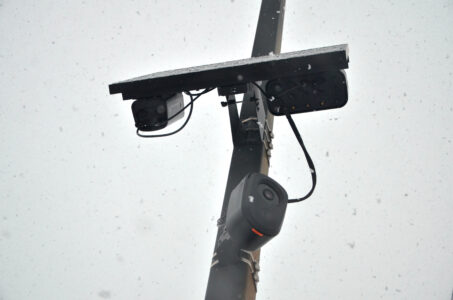
- A Flock license plate reader camera outside Kinney Drugs on Broadway is one of three recently installed by the Saranac Lake Police Department. There will be six LPRs and six security cameras installed around the village in total. (Enterprise photo — Aaron Marbone)
-
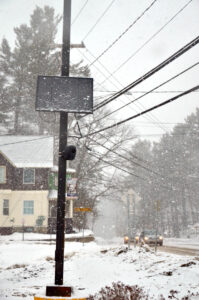
- A Flock license plate reader camera outside Kinney Drugs on Broadway is one of three recently installed by the Saranac Lake Police Department. There will be six LPRs and six security cameras installed around the village in total. (Enterprise photo — Aaron Marbone)
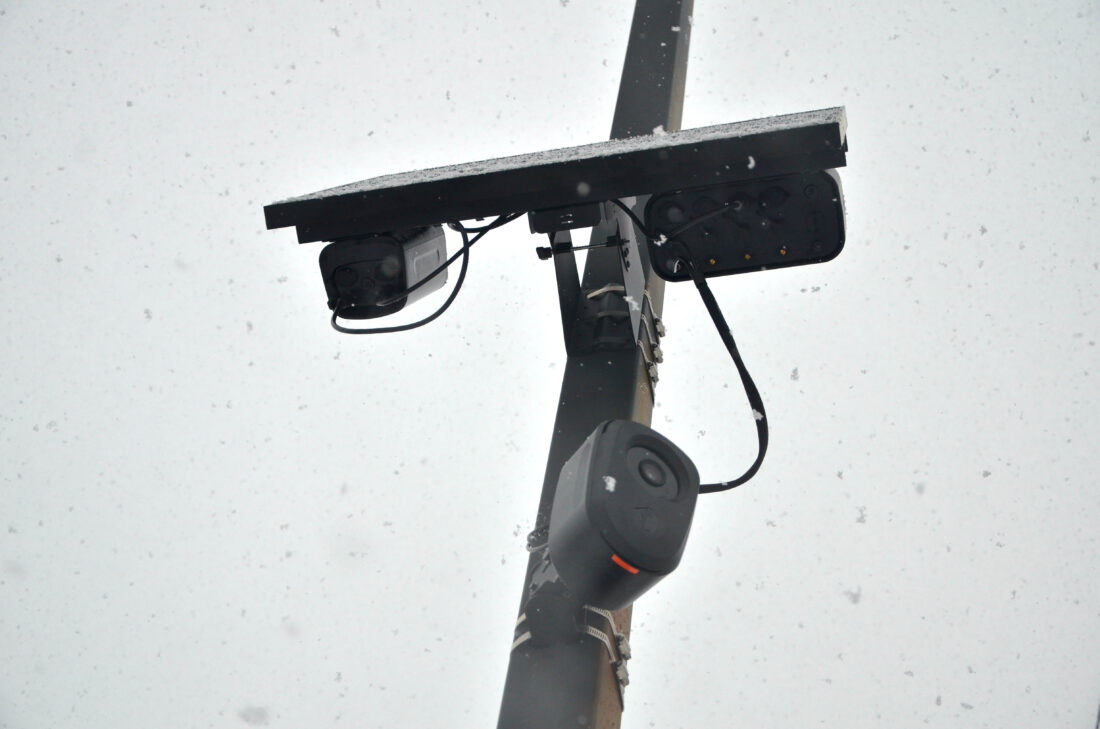
A Flock license plate reader camera outside Kinney Drugs on Broadway is one of three recently installed by the Saranac Lake Police Department. There will be six LPRs and six security cameras installed around the village in total. (Enterprise photo — Aaron Marbone)
SARANAC LAKE — The Saranac Lake Police Department is installing a dozen Flock license plate reader cameras and security cameras around the village with a state grant.
These automatic license plate readers, referred to as ALPRs, are not new technology, but Flock pairs them with artificial intelligence image recognition, a cloud database and an officer-facing dashboard to form profiles of vehicles, flag suspected stolen vehicles or vehicles used in a crime on a “hot list” and allows officers to add license plates to the hot list.
Three of the 12 cameras have been installed so far, in and around the village. The village is getting six ALPRs and six security cameras, known as “pan-tilt-zoom” cameras.
The goal of these cameras are to find missing people, find suspects, recover stolen vehicles and solve crimes faster.
But, this fast-growing company and its extensive nationwide camera network have been under scrutiny for a 10% error rate in license plate readings, claims of invasion of privacy by a private company, concerns about data it collects on civilians being vulnerable to leaks and belief that the product violates the Fourth Amendment due to its collecting data on citizens without a warrant.
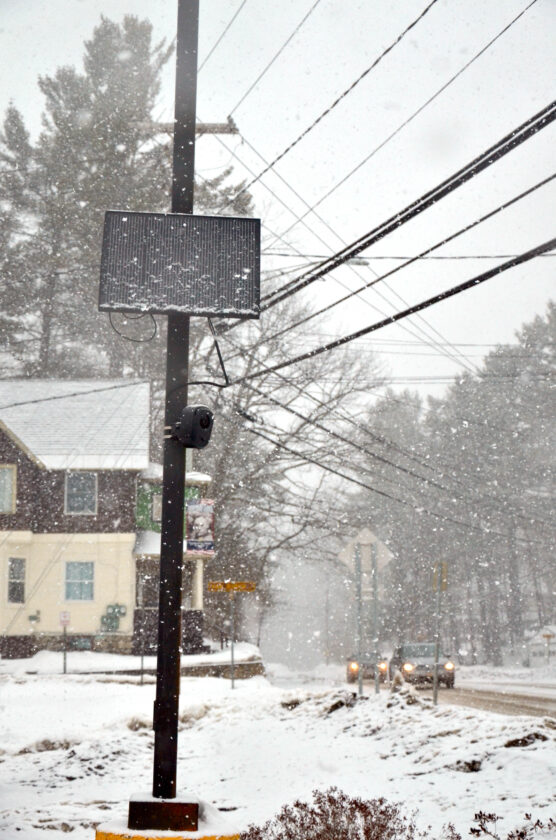
A Flock license plate reader camera outside Kinney Drugs on Broadway is one of three recently installed by the Saranac Lake Police Department. There will be six LPRs and six security cameras installed around the village in total. (Enterprise photo — Aaron Marbone)
SLPD made the announcement on Thursday. It was met with mixed reviews on social media. Among comments of people saying these cameras will help with solving crimes or finding missing people, there were plenty of comments about “Big Brother” and “panopticons” — a reference to George Orwell’s dystopian novel “1984” and a word derived from the Greek word for “all seeing,” respectively.
“These advanced camera systems are designed to assist law enforcement in real time by identifying vehicles connected to criminal activity, locating missing persons and strengthening investigations — while respecting privacy and civil liberties,” the post says.
SLPD Chief Darin Perrotte said the cameras are not speed detection devices, they don’t record audio, they do not have facial recognition or detect people by race or gender and they will not be monitored 24/7.
“It’s not tracking anyone. There seems to be a misconception that it’s tracking individuals or it’s following you,” Perrotte said. “They’re going to be used retroactively when a crime has been committed. We can look back and see if we can determine if that vehicle was here in the community.”
Perrotte noted that almost anywhere people go in public today, they are on camera. Stores, ATMs, gas stations, doorbells and building exteriors all have cameras.
“Those cameras are maintained by private companies,” he said. “So what happens with those images or that data, we have no control over. These images and photographs are controlled by the police department. We control them. We’re not sharing them with anyone outside of official law enforcement purposes.”
He hopes they can be used to save lives.
“Recent regional incidents, including the fugitive from Cohoes wanted in connection with a homicide and the missing vulnerable adult from Malone, highlight the critical role technology plays in protecting our communities,” the post says. “These cases demonstrate how timely information and modern tools can make a life-saving difference.”
Anthony Bechand, who has been charged with killing his ex-girlfriend in Cohoes in September, fled to the Brighton-Paul Smiths area and was hiding out in the woods for nearly two weeks before eyewitnesses saw him and called the police. Police said they tracked his truck to the North Country via license plate readers.
In October, a 90-year-old man from Malone went missing and was found deceased in Brighton. Perrotte said this technology could have helped find him.
“When a loved one is missing, I want to have every tool available to us to make sure that we’re doing everything possible to find them,” he said. “If we have a tool like this that could help get a loved one back to you safe, wouldn’t you want us to use it?”
He laid out a couple of the uses the cameras will not have.
“We’re not going to be using it for immigration enforcement. It’s not going to be used for traffic enforcement. These cameras don’t mail out tickets,” Perrotte said. “They’re not going to be used for following or harassing any citizen.”
Local police departments in certain states use Flock to provide data to the federal government, including ICE.
Perrotte said if an immigration agency requested photos or footage, the department would only provide it if it was paired with a criminal matter.
“Strictly for immigration enforcement? No, absolutely not,” he said.
The website deflock.org, which crowdsources the locations of Flock ALPRs into an interactive map, shows these Flock-branded cameras may be the first in the Adirondacks. Currently, the map has catalogued a couple cameras in Plattsburgh, a couple in Gouverneur and a couple in Lowville — all just outside the Blue Line.
The installation is being funded through a $241,500 state law enforcement technology grant and includes support for the program for two years. The grant was accepted by a village board vote in June 2024. It provided funds for a range of potential tech upgrades. Village resident Shaun Kittle questioned why the board did not vote on the specific use of the grant. He and some other residents said they were surprised that the cameras were installed without being discussed publicly or specifically voted on by the board of trustees.
Village Manager Bachana Tsiklauri said the grant award letter did not specify what technology the money could be used for.
He said conversations about the police installing cameras around town date back to 2023, when the village saw a number of vandalism cases. At the time, he said the board showed support for cameras, regardless of the brand. Tsiklauri said this was “way before the Flock cameras were broadly criticized online.”
He and Perrotte gathered quotes and then the village got the grant. He said Flock was decided on as the best offer.
–
How Flock works
–
Flock cameras are installed in public areas and photograph every car that passes. They store information about the vehicles in a database — license plate numbers, make, model, color and characteristics like bumper stickers or after-market additions.
Law enforcement officers can search on a dashboard for these points of information, bring up a profile of the vehicle and see everywhere that car has been within the network, how long it stays places and how frequently it visits those places. This data is stored for 30 days and can be shared with other law enforcement agencies.
The village does not own the cameras. It leases them and the software from Flock through a subscription.
After the two years of subscription run out, Perrotte said if the cameras were to continue, they’d need to get grant money, find room in the budget or decide if they want to go a different route.
Flock contracts with more than 5,000 agencies in the country. Around 30 cities have ended contracts with Flock after public outcry over concerns of mass surveillance, misuse of data or federal immigration enforcement agencies having access to the data. Some state and federal legislators around the country have also attempted to pass bills regulating the technology.
–
Concerns
–
The ALPR photos are encrypted, but numerous data security risks have been exposed by technology experts. The potential for the data to be hacked, stolen and leaked to bad actors, data brokers, criminals, corporations or other agencies is a concern of privacy advocates.
Flock’s “pan-tilt-zoom” cameras have recorded potential security vulnerabilities.
In December, 404 Media and YouTuber Benn Jordan found that livestreams and administrator control panels on some of Flock’s Condor cameras were “exposed to the open internet, where anyone could watch them.” Journalists were able to gain access to the cameras without a login and watch them live, download a month of video archive, change settings, see log files and run diagnostics.
A 2021 study of Flock’s “Falcon” camera by surveillance research firm IPVM found a 10% error rate in the camera output. After this study, Flock stopped selling its products to IPVM for testing and claimed the firm’s results were not accurate.
There are several cases in other states where these errors resulted in wrongful detentions, children being held at gunpoint and dogs being released on people erroneously targeted by the AI system.
In Aurora, Colorado in 2020, a family of five with children as young as 6 were wrongfully detained and held at gunpoint after an ALPR erroneously flagged their vehicle as stolen.
In Toledo, Ohio in 2024, a police dog was released on a man who was then wrongfully detained. A Flock camera had flagged his license plate as stolen, which was not true.
In Espanola, New Mexico in 2023, a woman and her 12-year-old sister were handcuffed and held at gunpoint when Flock flagged their license plate as stolen. It was not.
In Memphis, Tennessee in 2024, a nurse was wrongfully detained when her car ended up on a “hot list” because a license plate from Pennsylvania with the same characters was reported stolen.
Flock does not take accountability for these errors. The millions of dollars of payouts to some of the victims of these errors come from local municipalities.
Perrotte said the cameras would just be used as a “tool” for the department.
“We don’t base any arrest solely on a tool,” he said. “Someone’s going to be verifying the (output).”
Perrotte said officers will always verify if a plate reading is correct — if a “O” is a “0” or if a “3” is an “8” — as well as if the state on the plate is correct or if the color of a vehicle is correct.
There have also been wrongful detainment cases resulting from human error, such as an officer entering the wrong plate number.
Opponents of Flock have accused the network of acting like a tracking device without a warrant.
A 2012 U.S. Supreme Court found that the Fourth Amendment bars law enforcement from long-term tracking of a citizens’ physical location without a warrant.
The Fourth Amendment gives the right to be secure against “unreasonable searches and seizures” without a warrant.
In 2024, a Virginia Circuit Court judge ruled collecting location data from ALPRs there counted as a “search” without a warrant and could not be used as evidence due to the Fourth Amendment. This ruling was overturned in October 2025.
“When you’re in public, you have a different expectation of privacy,” Perrotte said. “Anyone at any point in time can take a picture of me, of you, as I’m walking down the street.”
He said the data from the cameras does not give an indication of where the car is going or what the driver is doing.
Flock is selling a new product called Nova to connect its data collection on vehicles to data collected on people. This could tie drivers to vehicles. 404 Media found that some of this personal data comes from illegal breaches and hacks.
In 2024, the House passed the “Fourth Amendment is Not For Sale Act” 219-199. This act would block government agencies from purchasing personal data from data brokers. North Country Rep. Elise Stefanik voted against it. This bill died in the Senate.
There has also been concern of police misuse of the cameras. There have been several cases of police chiefs or lieutenants using the technology to stalk exes, their new partners, wives or private citizens. Some were arrested, but most lost their police certification or were put on probation.
A female SLPD officer sued the department last year over claims of alleged sexual harassment and retaliation. The lawsuit claims a sergeant stalked her at her home and at the hospital in retaliation. This lawsuit is in the process of being dismissed by the judge after the attorneys representing the department filed a motion to dismiss the case.
Perrotte said the department has policies and prohibited uses about video surveillance use, which says that the equipment “shall not be used to harass, intimidate or discriminate against any individual or group,” and includes guidelines about logging who is accessing footage, as well as when and why they are accessing that footage.
Perrotte said when they run a query on a license plate, they need to include a case number and a reason for the search.
The policy requires an annual audit of the system to address administrative issues, including discipline.
Perrotte said he’ll be reviewing the existing policy, comparing it to other policies from departments with Flock cameras and adjusting it if needed.
The full policy can be found at tinyurl.com/46s3vts4 starting on page 199.
Local News
Hunter education course planned
SARANAC LAKE — The Saranac Lake Fish & Game is sponsoring a New York State Hunter Education Course from 8 ...
Gendebien leads with donations in NY-21 campaign
Blake Gendebien, one of four men seeking to represent Northern New York in Congress, is bringing in the most in ...
A call to arms
Village Mercantile takes closure off the table
New Flock police cameras take roost in Saranac Lake