
Lewis residents sound off at howitzer info session
Many express outrage, fear and concern over proposal
-

- Lewis residents and stakeholders listen as Protect the Adirondacks! Executive Director Claudia Braymer shares information about the upcoming Adirondack Park Agency adjudicatory hearing for a proposed howitzer testing range in the town. (Enterprise photo — Chris Gaige)
-
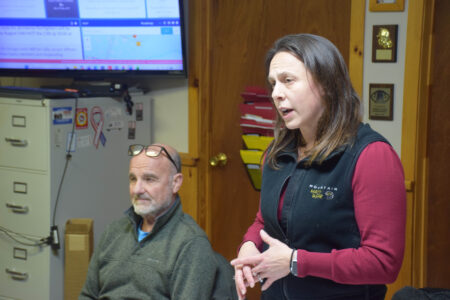
- Protect the Adirondacks! Executive Director Claudia Brayer fields questions from Lewis residents and stakeholders over an upcoming Adirondack Park Agency adjudicatory hearing for a proposed howitzer testing range in the town. Protect! is one of the hearing parties and opposes the howitzer project. Seated behind her is Protect!’s Conservation Director and Counsel Chris Amato. (Enterprise photo — Chris Gaige)
-

- Lewis resident Barry Goldstein speaks during a public information session hosted by Protect the Adirondacks! at the Lewis firehouse on Monday evening. Protect! is one of the hearing parties to an upcoming Adirondack Park Agency adjudicatory hearing for the project, which it opposes.
-
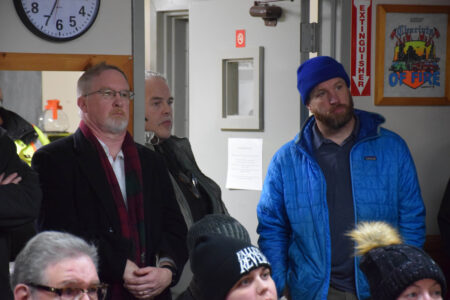
- Project sponsor Michael C. Hopmeier, standing at center, listens during a public information session on the upcoming Adirondack Park Agency’s adjudicatory hearing for the howitzer testing range he, through his company Unconventional Concepts, Inc. is seeking a permit for. (Enterprise photo — Chris Gaige)
-

- Annie Preston, a Lewis resident, speaks during a public information session hosted by Protect the Adirondacks! (Enterprise photo — Chris Gaige)

Lewis residents and stakeholders listen as Protect the Adirondacks! Executive Director Claudia Braymer shares information about the upcoming Adirondack Park Agency adjudicatory hearing for a proposed howitzer testing range in the town. (Enterprise photo — Chris Gaige)
LEWIS — Around 40 town residents and area stakeholders packed into the Lewis firehouse Monday evening for an information session on the upcoming Adirondack Park Agency adjudicatory hearing to decide the fate of a howitzer testing range proposed in the town.
The standing room only meeting was open to the public and hosted by Protect the Adirondacks!, an environmental conservation advocacy group that is opposed to the testing range, and one of the parties that will participate in the hearing.
The majority of those who spoke voiced concern with the proposal, citing environmental and noise impacts.
Protect! Executive Director Claudia Brayer and Conservation Director and Counsel Chris Amato, both attorneys, fielded questions and provided attendees with some background and legal analysis on the adjudicatory hearing process.
Project sponsor Michael Hopmeier was present at the meeting, though he did not address the room. Hopmeier’s attorney did not respond to the Enterprise’s invitation for comment by press time Tuesday evening.
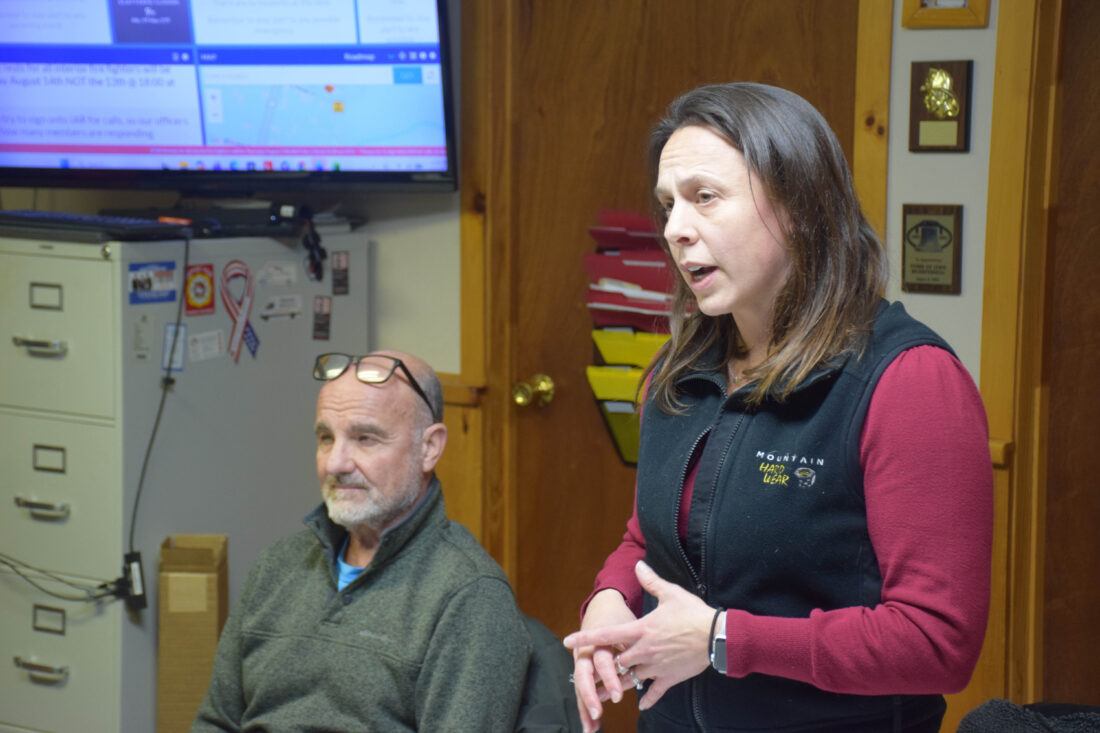
Protect the Adirondacks! Executive Director Claudia Brayer fields questions from Lewis residents and stakeholders over an upcoming Adirondack Park Agency adjudicatory hearing for a proposed howitzer testing range in the town. Protect! is one of the hearing parties and opposes the howitzer project. Seated behind her is Protect!’s Conservation Director and Counsel Chris Amato. (Enterprise photo — Chris Gaige)
–
Residents react
–
Lewis resident Lea Crowningshield-Whalen, who served in the Army National Guard from 2012 to 2016, was one of the dozen or so residents who spoke against the proposal at the meeting.
“I’m here for my family, I’m here for my community members,” she said. “This is where I was raised. This is where I want to raise my children — and it’s terrifying.”
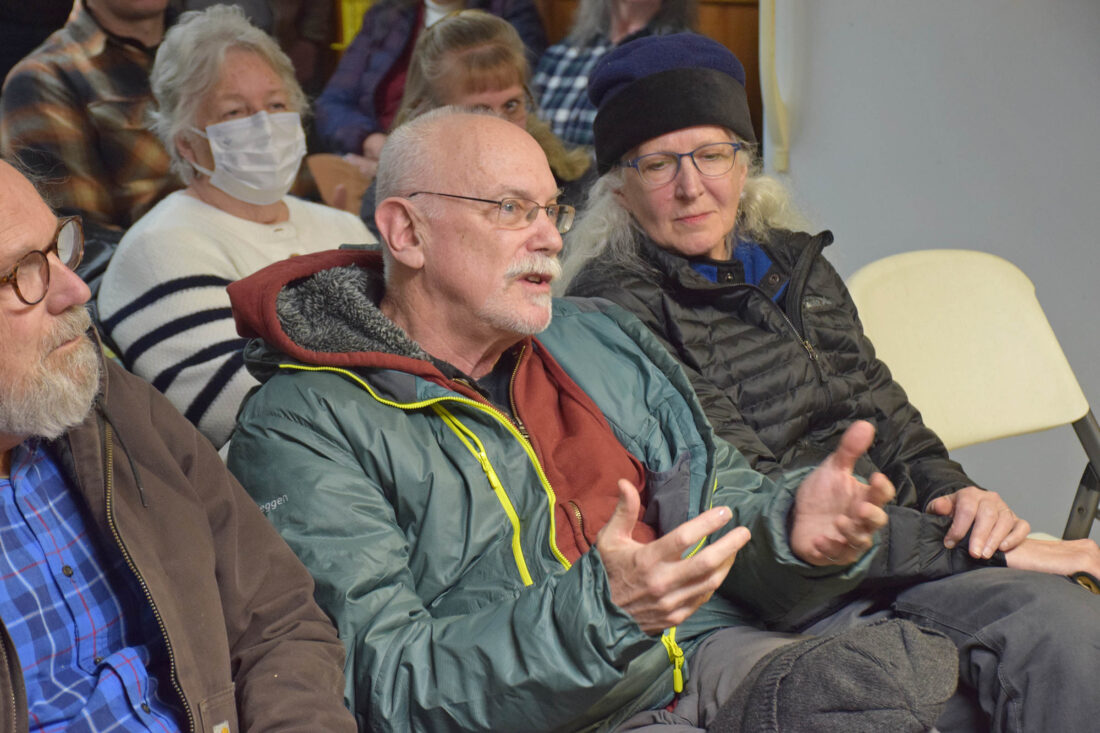
Lewis resident Barry Goldstein speaks during a public information session hosted by Protect the Adirondacks! at the Lewis firehouse on Monday evening. Protect! is one of the hearing parties to an upcoming Adirondack Park Agency adjudicatory hearing for the project, which it opposes.
Crowningshield-Whalen said she was shocked when she first found out about the howitzer testing proposal in the town.
“I was absolutely floored because I am a veteran,” she said. “I’m all for the soldiers. I’m all for the training. I’ve been through a bunch of the training. But there’s a time, there’s a place — and this is not the place. I get the forests, I get why they want to train here, but they have that in Fort Drum.”
She said the town of Lewis makes no sense for a testing venue.
“Why are we testing out in the wild?” she said. “There are plenty of ranges. I’ve been on those ranges in Fort Drum. There’s more than enough capability. Why are we bringing this to a little town in the middle of the Adirondacks?”
Her message to the APA board was straightforward.
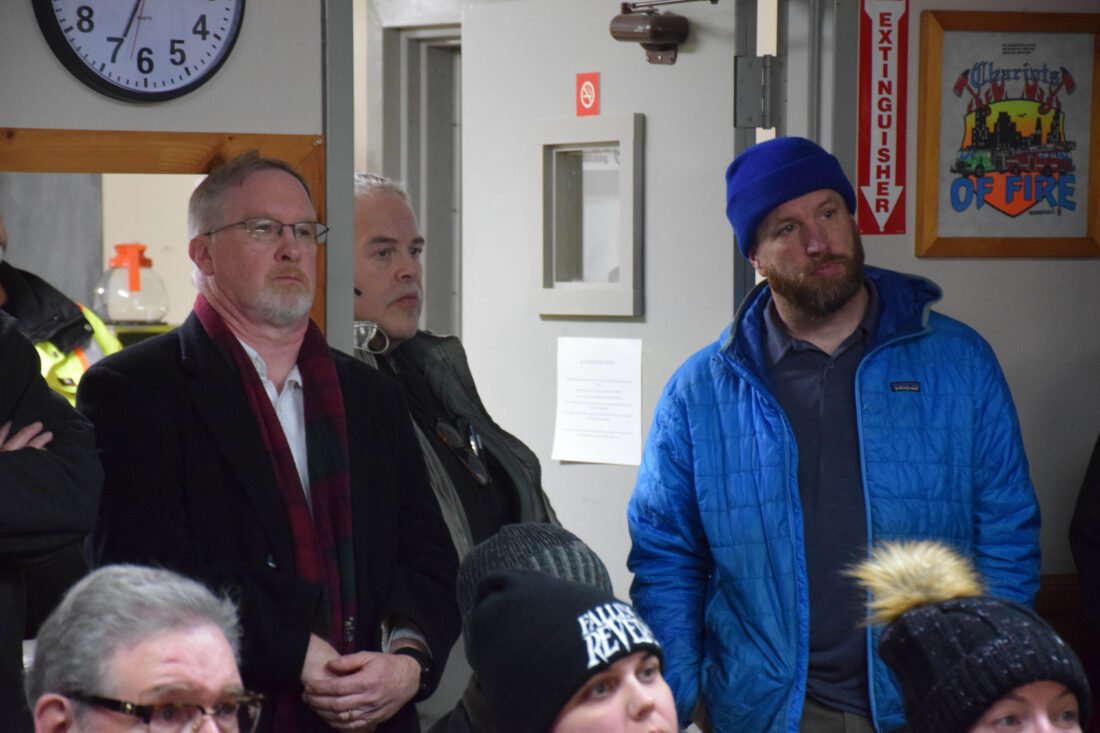
Project sponsor Michael C. Hopmeier, standing at center, listens during a public information session on the upcoming Adirondack Park Agency’s adjudicatory hearing for the howitzer testing range he, through his company Unconventional Concepts, Inc. is seeking a permit for. (Enterprise photo — Chris Gaige)
“Hear the community,” she said. “Listen to us. Listen to the people who are opposing it, and unanimously at that. We’ve written. This is our land. This is where we live. This is what we’re going to deal with every single day … just take us into consideration.”
Lewis resident Barry Goldstein expressed a similar sentiment.
“There are scores, I don’t know how many, but certainly scores of well-established artillery test sites throughout the country that the military makes active use of, that have been well designed, well vetted, well run for years and years,” he said. “Nothing about this project seems either necessary or valuable, except perhaps as an income-generator to the landowner. Private enterprise does not permit one to do anything they feel like in order to make a buck — and from what I can see, that’s pretty much what this is about.”
When Goldstein first heard about the proposal, he didn’t think it was real.
“I thought it was a joke, frankly,” he said. “It took me many months to learn that this was sort of serious.”
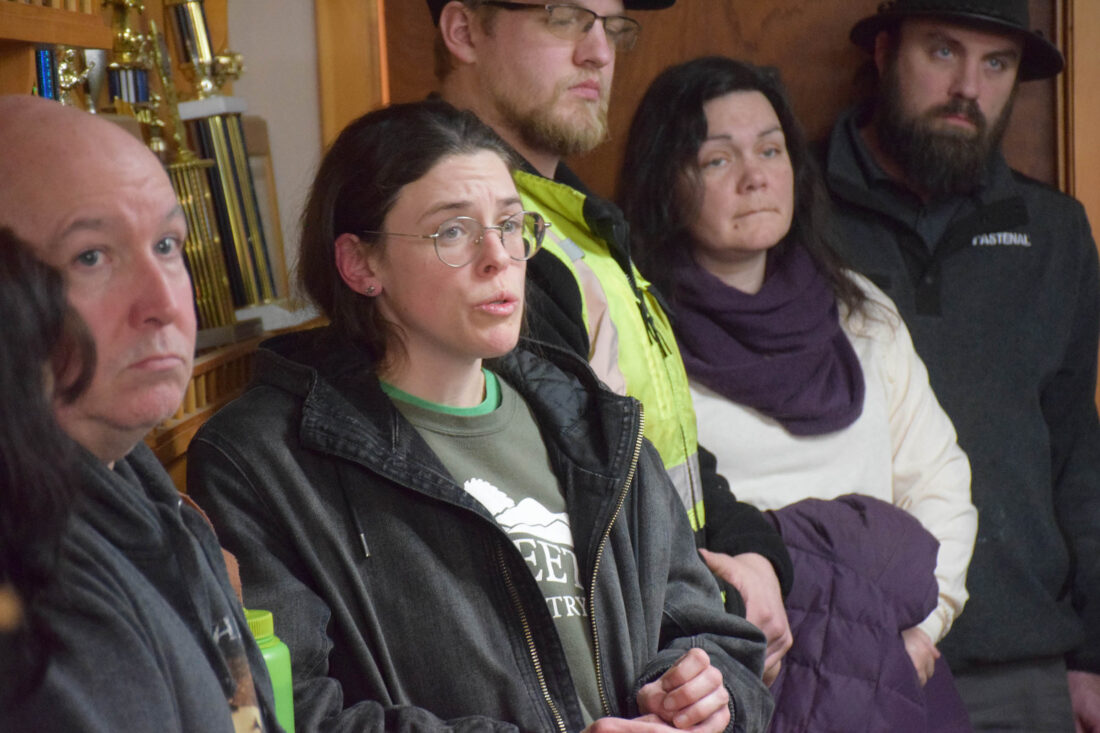
Annie Preston, a Lewis resident, speaks during a public information session hosted by Protect the Adirondacks! (Enterprise photo — Chris Gaige)
“I think if the APA approves this, then I think the function of the APA has to be seriously reevaluated,” he added.
Lewis resident Jacob Gittler said he attended the meeting both to get a better sense of where the project stands and to make his opposition known. He said the packed room illustrated how many people oppose it. Asked why he’s against the howitzer testing in Lewis, Gittler didn’t know where to start.
“I think, on principle, it’s insane,” he said. “And quite frankly, indefensible.”
Even as Protect! in its meeting acknowledged it was a separate matter from the howitzer adjudicatory hearing, Gittler also expressed dismay at the military training exercises Hopmeier had on his property this summer. These involved low-flying helicopters, sometimes at night. He said he would have liked those responsible for the exercises to have seen and dealt with the anguish it caused his family’s dogs, describing it as nightmarish and “f**king ridiculous.”
–
The meeting
–
Amato said the event was to provide information to the community, and that often times, such complex proceedings can leave those who would be most impacted in the dark about what’s going on, especially if they have a lot of other life demands. By coming to Lewis directly and in the evening, Amato said Protect! was trying to bridge that.
“We wanted to create an opportunity for us to tell the people what we know about the proceeding and to answer questions that they might have about what’s going on and what might happen going forward,” he said. “And I thought it went really well. Obviously, there was a lot of interest. It was well attended, we got a lot of really good questions and hopefully people came away with a little more understanding than what they came here with.”
The meeting lasted over an hour and began with the Protect! staff providing an overview of the hearing process, and their background as an environmental conservation advocacy group that frequently engages with projects before the APA. They explained that it’s the APA board that will make the ultimate decision on the project.
Amato added that the APA board voted unanimously to send the howitzer proposal to an adjudicatory hearing — following the recommendation of agency staff — to flesh out information that they felt was lacking in the application, which has been before the APA since 2021, previously receiving six previous notices of incompletion.
Adjudicatory hearings are the only procedural avenue through which the APA can deny or substantially modify a project once it’s deemed complete, which this one was on Sept. 26, 2025. More information about the proposal’s description and the APA board’s decision to hold an adjudicatory hearing can be found at tinyurl.com/adywcwh2.
While the hearing is currently slated to begin on Feb. 25, it’s still in the pre-trial phase. Amato said none of these dates are set in stone, and people should be prepared for them to shift. Even if that date holds, he said it’s really just a chance for the parties to give opening statements, and there will be a lot more pre-trial logistics that have to play out until the hearing substantively begins.
The current scheduling order requires that all pre-filed witness testimony and related exhibits be filed by May 20. Amato said once all the testimony is in, it would then make sense for the administrative law judge overseeing the process to set hearing dates.
“One of the things we wanted to stress to everyone here is that this is going to be a long process,” Braymer said. “Just as with any community here, there’s opposition from the people within the community. You have to sort of hang on, stay patient and stay involved.”
Braymer added that the APA’s website is meant to provide the latest scheduling updates as they arise, as well as project background. That’s available at tinyurl.com/mpdramry.
–
Audience participation
–
Several audience members asked procedural questions, such as what information is contained on the APA website, how hearing information will be presented to the APA board for its consideration and how the APA’s compliance enforcement works.
Lewis resident April Guilder asked who was sticking up for the adjoining property owners. Her family has been in the town for more than 100 years, she said, and owns multiple properties, including one camp that they operate as a short-term rental business. She was frustrated by what she feels is a lack of advocacy for nearby property owners opposed to the howitzer testing.
“Who is sticking up for all these property owners who own property that are attached to this?” she said. “Who’s speaking for us?”
She applauded the neighboring town of Jay’s board voting to formally oppose the project, and wants to see similar action from the Lewis town board. Even though town boards don’t have any decision-making powers here, she said it was important to make the community’s sentiments apparent to the APA board.
“We have a lot of concerns about our environment and the noise,” she said. “I believe our town needs to support what the people want, and that includes our town board.”
Braymer said Protect! is trying to fulfill that role in the hearing, given that no neighboring resident is a hearing party at this time.
“That’s one of the reasons that we’re here,” she said. “To let you know that we are listening and we’re trying to bring your concerns to the agency board — because you don’t have anyone talking for you.”
Amato said they would follow up with interested residents to see if there were ways to get their concerns included in the record.
“We really need to stick up for each other,” Guilder said. “This town needs to stick together in this if people feel as strongly as they do. And if you look at the numbers, the numbers say it, they speak for it — that we do not want this, for the majority. And our town supervisor and the board need to stick up for us as well.”
Goldstein asked if it was too late for nearby landowners to file for party status. Amato said that it’s up to the administrative law judge and that while the deadline has passed, there are provisions that allow the judge to make a late admission, although there would likely need to be sufficient reasoning presented justifying the time lapse.
Goldstein then asked what the most valuable thing is that a citizen could do to make their opinions known. Braymer said his suggestion about seeking party status might be one way, and that another is to push for the town board to take a stance formally opposing the project, like Jay.
“If your town is speaking on behalf of the residents, that’s a pretty powerful message to the Adirondack Park Agency board members,” she said. “Remember, some of the (board members) are residents here. They know what it means when a community stands up like that through their town.”
Goldstein said he understands that, but was worried it could be a “one-and-done” action with a muted impact, given the volume of comments received. Amato understood the concern, and said while there’s value in being a hearing party, he added that public comment — especially some of the highly detailed and heartfelt letters from residents — by itself is still powerful.
“I think that was a large reason why the Adirondack Park Agency decided to send it to an adjudicatory hearing,” he said. “They received a lot of public comment and they do read those, they do listen to those.”
Another audience member then asked if public comments written before the board’s adjudicatory hearing vote are still part of the record, stating that they spent a lot of effort writing their original letter, and their sentiments have remained the same since.
Amato said that the earlier letters will remain part of the record, and that while there’s no need to do it again, doing so wouldn’t hurt — from the standpoint of opposing the project. Someone else then asked, just to clarify, whether multiple letters from the same person would be allowed?
“Absolutely,” Amato said. “You can comment as many times as you want. There’s no limit.”
Local News
NY-21 candidates gather funds
Republican congressional candidate Robert Smullen personally loaned his campaign $500,000 as he launched his ...

A ‘life-changing gift’ for St. Bernard’s
Lewis residents sound off at howitzer info session

Bloomingdale Elementary decision looms

Tupper structure fire displaces family, no injuries
St. Bernard’s School considers adding 6th grade
SARANAC LAKE — As the Saranac Lake Central School District discusses reconfiguring its school buildings, St. ...