How a state grant derailed plans for Cascade Welcome Center
Yearslong hangups over a state grant reimbursement partially led to Adirondack Mountain Club putting 200-acre property up for sale
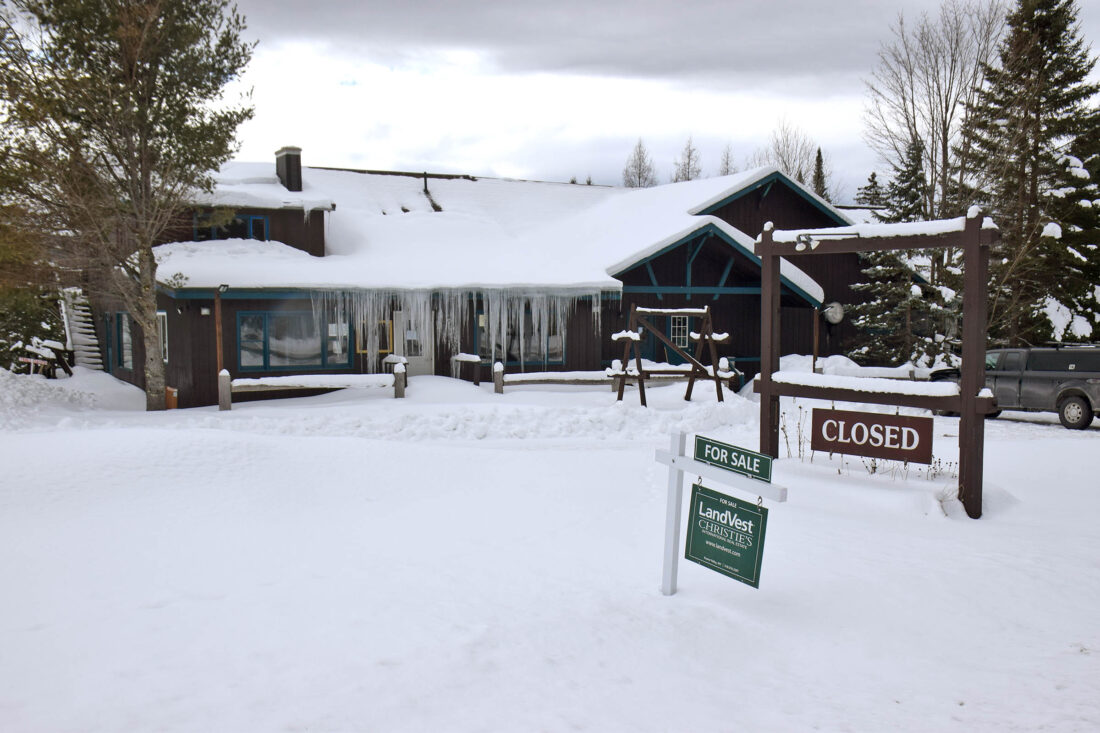
The shuttered Cascade Welcome Center is seen from state Route 78 in Lake Placid on Friday. The Adirondack Mountain Club is currently trying to sell the property. (Enterprise photo — Chris Gaige)
LAKE PLACID — For about two years, a sign outside the Cascade Welcome Center near Lake Placid highlighted a success: a state grant helped the Adirondack Mountain Club (ADK) purchase the property, to be a public-facing visitor center and winter ski destination. In reality, that grant may have been the property’s undoing.
When ADK purchased the 198-acre parcel for $2.5 million in early 2022, it expected to be reimbursed $500,000 from the Environmental Protection Fund through a grant administered by the state Office of Parks, Recreation and Historic Preservation.
Records show just $20,362.50 of that $500,000 announced in December 2021 has reached ADK’s coffers. And the state is requiring the club to pay that back now that it’s bailing on the project.
At issue: disagreements between the state and ADK over a conservation easement, a mortgage “Catch-22” and ADK leadership changes.
The property went up for sale in October for $2.85 million, and this January, ADK reduced the price by more than 30% to $1.95 million.
ADK has asked if it can wait to repay the state after the sale of the ski center, according to communications the Adirondack Explorer received from the state Office of Parks, Recreation and Historic Preservation through a Freedom of Information Law request.
Mickey Orta, chair of the ADK board, wrote that he would not comment on internal decisions and declined to discuss the grant or the communications.
“The club has long worked collaboratively with New York State agencies and continues to value those relationships,” Orta wrote. The club chose not to pursue the grant, he said, “because the associated requirements did not align with ADK’s operational needs. The decision to sell Cascade Ski Center was made independently and based on what the Board determined was in the long-term best interest of the organization and its mission.”
–
Frustration around the closure
–
Tom Andrews, the ADK board chair when the club purchased the property, said he didn’t learn of the listing until he read it in the Adirondack Explorer.
“I was really floored,” he said. “We had big plans for the property, especially because it was a ski area. Everybody feels bad for losing that ski area because it was such a popular thing, and especially with this winter, it couldn’t have been a better winter to have cross country skiing there.”
The news angered many ADK members, some who said they had joined one of the largest nonprofits in the Adirondack Park just for the skiing. Dues-paying members could ski there for free.
ADK Executive Director Cortney Worrall initially described the summer closure as temporary. In the fall, she announced its permanent closure and described it as a way “to refocus our energy on our core programs, people, and places” adding that the decision was not due to financial concerns.
But ADK members, who weren’t satisfied with that, reached out to the club. Some shared with the Explorer a note from Communications Director Sara Cook. Cook described “unseen financial headwinds” and “resources that had not yet materialized.”
Worrall declined to talk about the EPF grant or Cook’s letter.
–
Plans for a new location
–
ADK’s offices were originally in Lake George, but the organization had been looking to move up into the Lake Placid area, Andrews said. The COVID-19 pandemic also influenced the club’s decision to sell the Lake George office space.
Cascade was “right out in front” of the public on state Route 73, Andrews said. With the Lake George office sale and some other income, ADK was able to pursue it.
ADK was successful in getting a grant for nearly $304,000 from the Northern Border Regional Commission in 2022. That funding helped pay for various upgrades like new septic and internet. But the ski building needed even more work, like bringing the kitchen up to code.
“There was going to be a chunk of change there to have to be put in the property, and we were still waiting for the state to contribute that grant money back to us,” Andrews said. “ADK runs on a really tight budget. There isn’t a lot of extra money to play with.”
–
Hang ups with the state
–
The state Legislature created the Environmental Protection Fund in 1993, a pot of money for capital projects focused on things like preserving open space, mitigating climate change and updating water infrastructure. The fund has grown over the years from $31 million to $425 million. Multiple state agencies, including the Parks Department and the Department of Environmental Conservation, disperse these funds.
While the award announcements sound certain, contracts are often not finalized and the grants are reimbursements.
Records show that multiple ADK staff over the course of four years were in a tango over the grant requirements. Even without writing the check, the state made a sign and had ADK post it outside the ski center that it had been paid for with EPF funding.
The biggest sticking point was a conservation easement.
Increasingly frustrated by how long it was taking, former ADK Executive Director Michael Barrett wrote the state Parks Department’s attorney in July 2023, “to cease moving the goal posts and adhere to the original terms.”
The letter describes how the Parks Department originally wanted an easement over the nearly 200 acres, but did not want to include the building. In March 2023, the Parks Department had sent over a new conservation easement that included the building. It said that unless the parks commissioner provided written authorization, ADK would not be able to make repairs or renovations, hold any meetings or house any of its staff.
Andrews said the state wanted full control of the property, down to the paint color.
“We didn’t think that was very fair,” Andrews said. “We’re paying for it. We’re maintaining it.”
In that letter, Barrett wrote, “(t)he financial benefit of this grant has already been greatly diminished given the out-of-pocket costs, staff time, and lost opportunities for lower interest rates with alternative funding.”
Barrett, who is now the chief executive officer of Habitat for Humanity of New York State, did not return the Explorer’s requests for comment.
–
Changes at ADK
–
The club was also undergoing major organizational changes.
The board shrunk from nearly 60 members representing all 26 chapters, to its current 11 members appointed by a chapters-led advisory group. Andrews retired as ADK board chair in 2024.
Julia Goren, the club’s deputy director, was appointed interim executive director when Barrett left in late 2024. Goren had taken up the grant quest.
In communications between her and the Parks Department grant coordinator, Goren signaled the delays were impacting ADK’s ability to pay down its mortgage.
“We cannot pay more in the principle of the mortgage (thus showing more spent on this grant project) without the payment of the grant from Parks,” Goren wrote the grants coordinator last year. ADK was paying $10,819.13 per month on the loan, records show.
Goren declined to comment for this story.
–
Adding the easement to the mortgage
–
By late March, ADK had hired New York City-based Worrall. Goren left for the Adirondack Rail Trail Association. Cathy Pedler, ADK’s director of advocacy, then took up the communications with the state over the summer.
It appeared the club had resolved its concerns over the conservation easement with the state and was ready to finalize it and accept the grant.
Now the hangup, the communications show, was between ADK’s bank and the state, over a subordination of mortgage. A subordination of mortgage, in this case, involves adding the conservation easement to the mortgage so that the easement travels with the property. The bank required the easement to issue the subordination of mortgage, but the state would not confirm the easement was final without the subordination of mortgage.
By the end of August, Pedler wrote they’d like to return the grant. ADK was also slated to receive a $101,925 grant announced in 2022 for planning and renovation of the ski center, but that, too, never came to fruition.
At the beginning of October, ADK announced it was selling the ski center.
Andrews said every board and executive director has different priorities.
“I know there was a lot of disappointment,” he added.
–
Parks Department response
–
The Parks Department said the grant funding remains available if ADK wanted to move forward. A spokesperson said the conditions of the grant are standard “to ensure that property purchased with public dollars will be maintained in the public interest over the long-term.”
When asked about the apparent Catch-22 the club faced with the subordination of mortgage, the Parks Department said this was the process required by the state Attorney General’s Office.
It added that ADK could “provide the conservation easement to the bank if needed,” despite emails from its grant coordinator telling ADK that the easement language was not final.
The Parks Department did not answer the Explorer’s questions about why it continued to make changes to the easement, the amount of time the process has taken or whether there was another way to resolve the conservation easement issue with the bank. It did say projects funded by the EPF are expected to be finished within five years.
“If ADK returns the grant, any funds disbursed so far would need to be repaid to the state,” a spokesperson added.
–
Read the records
–
Below are a handful of the records the Explorer received from the state Office of Parks, Recreation and Historic Preservation and from ADK.
¯ tinyurl.com/3p6rmy6z
¯ tinyurl.com/36jtr23p
¯ tinyurl.com/4xmbwf48
¯ tinyurl.com/366s34cb
Local News

LPHS to host concussion seminar Wednesday
Weekend roller coaster as mid-March warm-up looms
SARANAC LAKE — You might want to keep a few different coat options handy this weekend. A hallmark of the ...

Saranac Lake halts controversial police cam installation
How a state grant derailed plans for Cascade Welcome Center
Snowshoer found dead in lean-to in Pharaoh Lakes Wilderness
SCHROON — A Florida man died from a self-inflicted gunshot wound to the head in a lean-to in the 44,400-acre ...