DEC plans to start Avalanche Pass repair work this summer
Work plan expected to be finalized by late spring, yet to be released for public comment
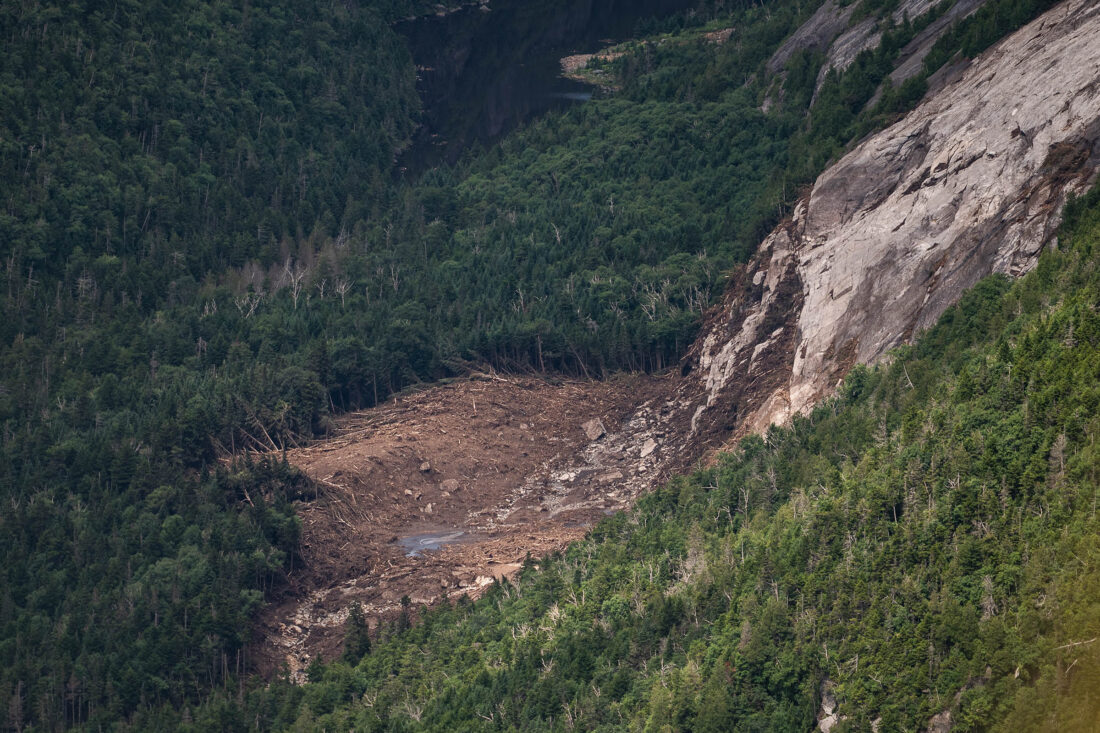
A large debris field from a mudslide is seen in Avalanche Pass on July 22, 2025. The trail has been closed since. The DEC plans to reestablish the trail this summer. (Provided photo — Jonathan Zaharek)
NORTH ELBA — The state Department of Environmental Conservation is aiming to begin repair work on the Avalanche Pass trail this summer.
The large swath of the trail — from its intersection with the Lake Arnold Trail to the southern end of Avalanche Lake — has been officially closed since July 14, 2025, when a series of mudslides occurred on Mount Colden’s northwestern face. This sent a debris wall as high as 40 feet in spots tumbling down and spreading across the trail. It runs through a narrow pass there between the shoulders of Mount Colden and Avalanche Mountain. There were no deaths or injuries associated with the mudslide, which happened overnight.
A DEC spokesperson told the Enterprise that its staff are currently reviewing a preliminary draft Forest Preserve Work Plan for reestablishing the Avalanche Pass trail. This will likely include a reroute around portions of the debris field. Work plans are used to guide specific projects on Forest Preserve Land. Given the constitutional protections afforded to these lands, the work plans are meant to show that the work is of justifiable importance, minimally invasive and well-defined in its scope.
The Avalanche Pass trail is in the High Peaks Wilderness Complex. Wilderness-zoned land is the most stringently protected state land classification. Only minimal human improvements that are “substantially unnoticeable” are generally permitted.
After the DEC completes its draft work plan for Avalanche Pass, it is expected to be posted on the department’s Environmental Notice Bulletin for public review and comment. It’s unclear when that will be, or how long the public comment period will last. The bulletin can be accessed at tinyurl.com/mr3ccub4. Once public comment closes, the work plan will undergo a final review approval process.
“DEC anticipates having a final work plan approved by late spring to allow work to commence once ground conditions allow,” the spokesperson wrote in an email. “DEC remains committed to reestablishing the Avalanche Pass trail and anticipates the required work will occur during the 2026 field season.”
When opened, Avalanche Pass is one of the most popular hiking, snowshoeing and cross-country skiing routes in the High Peaks. It links Marcy Dam and the Adirondak Loj to the north with Lake Colden to the south. The towering cliffs on either side of Avalanche Lake make for a staggering backcountry backdrop.
–
Winter conditions
–
Avalanche Lake remains accessible from Lake Colden, which is to its south, although getting there from the Avalanche Pass Trail’s traditional parking areas requires significant detours that would add several miles, and likely considerable amounts of time, to a ski or snowshoe trip.
This extra time and energy that would be required becomes especially impactful in the winter, with less daylight and potentially dangerous weather conditions. On Wednesday, the DEC reported a 50-inch snowpack at its Lake Colden interior outpost, which is at about 2,750 feet. Snow depths are likely greater at higher elevations, and many mountain trails remain unbroken, requiring substantial amounts of energy, skill and preparation to successfully navigate. For more information on winter hiking safety, visit tinyurl.com/unw4nz43.
These detours around Avalanche Pass include the Lake Arnold Trail — with options to either trek up and over 4,714-foot Mount Colden to Lake Colden, or to the Lake Arnold Trail’s terminus with the Mount Marcy trail near the Feldspar Lean-to, and from there skiing or snowshoeing west, generally downhill, away from Mount Marcy toward Lake Colden.
Another detour involves beginning the hike at Heart Lake, hiking up and over 5,114-foot Algonquin Peak, the second-tallest mountain in the state, then descending the trail to Lake Colden, which intersects at the col between Algonquin Peak and Boundary Peak.
This route — along with the one over Mount Colden — is considered an extremely challenging route in the winter, frequently subject to unforgiving weather as much of the trail is above treeline. Whiteout conditions and frigid wind chills are common, and those attempting these trails should take extra care to ensure they are prepared and advised on the latest conditions.
There are no other significant trail closures in the High Peaks Wilderness as of press time, Sunday. The latest closures and trail conditions are available at tinyurl.com/mmtyuw74.
Local News
DEC plans to start Avalanche Pass repair work this summer

1980 coach Herb Brooks’ legacy shines on in bronze
Hochul backs bills to bar state, local police from working with ICE
Gov. Kathleen C. Hochul is backing new legislation that would bar state and local police from working with federal ...
Hoyt’s High: This season’s last snowmaking frontier
ANCA launches new strategic plan for building shared prosperity
SARANAC LAKE — The Adirondack North Country Association has announced the launch of its new strategic plan, ...